


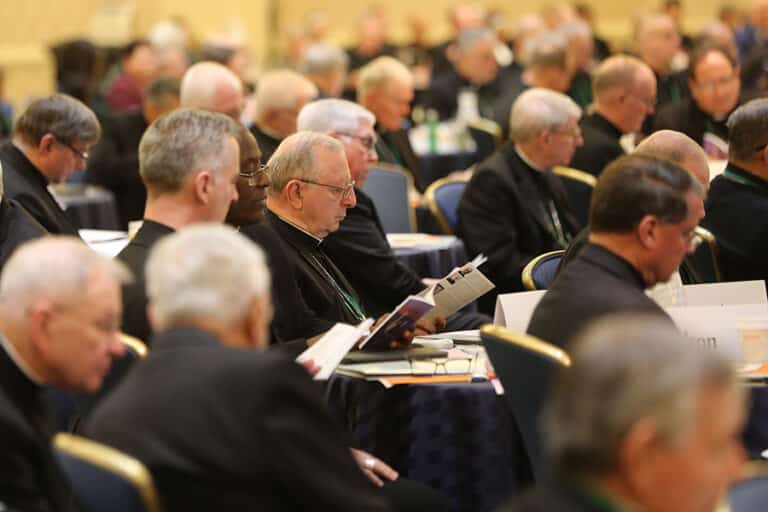
The Catholic bishops of the United States approved on November 18, during the fall plenary assembly of the Episcopal Conference (USCCB) in Baltimore, designating the last Sunday of October as an annual day of prayer for racial justice. The proposal passed with 180 votes in favor, 15 against, and seven abstentions, in an assembly held from November 16 to 19. The information was detailed by OSV News, which followed the session.
The initiative was presented by Daniel E. Garcia, bishop of Austin (Texas) and chairman of the Subcommittee for the Promotion of Racial Justice and Reconciliation. According to Garcia, the day “creates a sacred space for reflection, repentance, and conversion of hearts.” The prelate maintained that racism persists today, including within the Church, that prayer is the first step to combat it, and that racism is learned and therefore all people can change. He also cited Psalm 51 and its petition for a clean heart.
A bridge between October and November
Garcia explained that the date links October, a month dedicated to the defense of life, with November, which in the United States is dedicated to the history and heritage of African American and Native American Catholics. According to the bishop, the last Sunday of October will coincide, depending on the year, with the 30th or 31st Sunday in Ordinary Time.
To support the proposal, Garcia drew on data from the Center for Applied Research in the Apostolate (CARA). According to that data, 60% of adult Catholics in the country believe that racism exists in their local community, and 39% say they have experienced racial discrimination. The bishop also recalled that the 2018 pastoral letter “Open Wide Our Hearts,” dedicated to racism, is known by only 48% of those surveyed.
Coincidence with Christ the King on the traditional calendar
The chosen date has a liturgical consequence that has not gone unnoticed. In the 1962 calendar, in force for the Traditional Mass, the solemnity of Christ the King is celebrated precisely on the last Sunday of October. In the Novus Ordo calendar, however, that solemnity closes the liturgical year, at the end of November, so it does not coincide with the new day.
Liturgist Peter Kwasniewski reacted on X with irony: “You couldn’t make it up.” He added that next year, “while Latin Mass Catholics celebrate the feast of Christ the King, the Novus Ordo parish down the street will celebrate Diversity Day.” This is a personal assessment by the author, not a decision of the Episcopal Conference.
The Baltimore assembly
The vote took place during an assembly in which the bishops also approved new guidelines for socially responsible investment. In the opening, the president of the USCCB, Paul Coakley, stated that the prelates are willing to collaborate with the Trump Administration and with the Democratic majority in Congress.