


Dear companion:
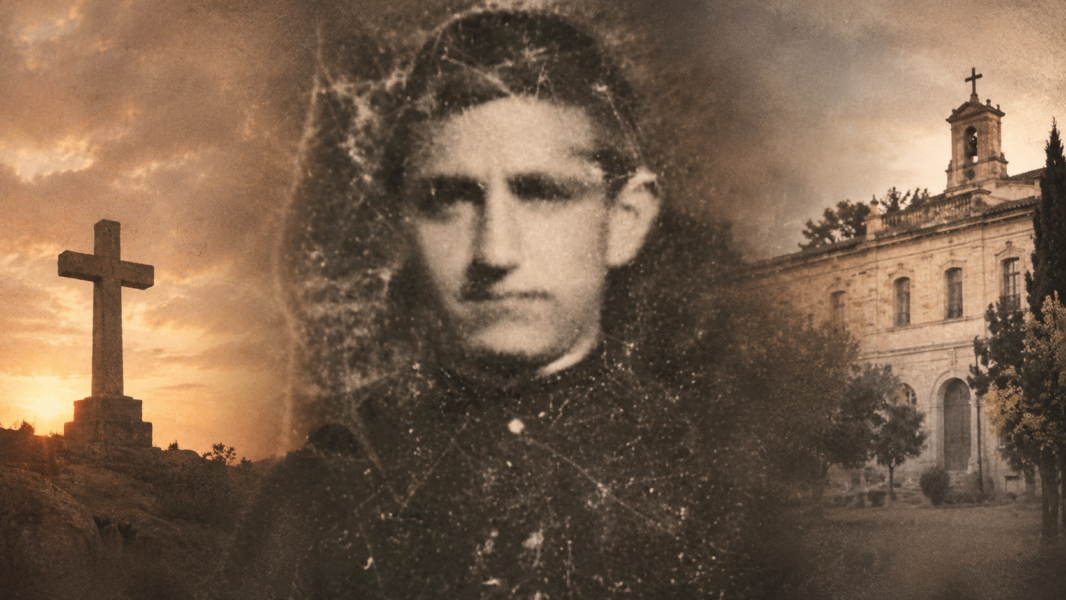
I am Ángel Trapero Sánchez-Real. I was born in Navalcarnero on 23 June 1916. My father, Juan, was a watchmaker; my mother, Sabina, came from San Martín de Valdeiglesias. Perhaps because of my father’s trade, I like to begin by speaking to you about time. A watchmaker knows that small parts matter. A wheel wrongly placed can stop the entire mechanism. Something similar happens in the soul.
I studied at the Conciliar Seminary of Madrid. I took humanities, philosophy and the first year of theology, with good grades. I had superiors of strong spiritual life, among them Don Rafael García Tuñón and Don José María García Lahiguera. Christian formation requires teachers who do not always seek to please the student; sometimes the most charitable word is a correction given in time.
I returned to Navalcarnero in July 1936. The situation became very dangerous. Those responsible for the arrests possessed information from official archives and from documents seized at the seminary. I did not belong to any political organisation; my “crime” was preparing for the priesthood.
On 11 October an armed group searched our house. They took money, jewels and me because I was a seminarian. I spent two days at García Atadell’s checa and at the premises of the Dirección General de Seguridad, of whose cells the German engineer Félix Schlayer, linked to the Norwegian embassy, wrote: “Only Dante could describe what happened there in those days of such frightful saturation and horrible cohabitation.” On the 17th of the same month I was taken to Porlier prison without any judicial order. It was the premises of the Calasancio school, in the block formed by the streets of General Díez Porlier, Lista, Padilla and Conde de Peñalver, seized by the republican government under article 26 of the 1931 Constitution, which forbade religious congregations from engaging in education or any other activity, their property being assigned to the State. On 9 November there was a saca of thirty-one inmates from that prison. It was a usual procedure of mass and systematic extraction of prisoners from the reduced spaces where detainees were normally crowded, locked in groups of up to six people in individual cells, destined for the place where they were executed. In this case, we were transferred to the East Cemetery. With me were two priests. With them and others I was murdered on 9 November 1936, beside the East Cemetery of Madrid. I was twenty years old. Buried in a common grave, I was registered as an unknown corpse, dead from haemorrhage.
When the conflict ended, I could be identified thanks to some photographs and transferred to the family pantheon in the Navalcarnero cemetery. On 7 December 2017, the eve of the Immaculate Conception, patroness of the Seminary of Madrid, my remains were placed in the seminary chapel, beneath the altarpiece of Saint Damasus, second patron of the Madrid levites and pope of the Roman martyrs. The inscription on the tomb reminds today’s seminarians that I and my martyr companions are very close to them and—with the words of Saint Clement of Rome—invites them to draw near to us, athletes of Christ victorious in the contest of faith, witnesses of love carried even to the shedding of blood.
My bishop, the Patriarch Don Leopoldo Eijo y Garay, wrote in 1937 in his pastoral letter entitled The Present Hour: “Peace be with you! That peace, beloved sons, you have merited by the moral martyrdom of your feelings and the bloody martyrdom of so many and so many beloved sons who have succumbed, pierced by murderous bullets, their hearts for the ‘crime’ of loving God and Spain.”
My father’s watch counted minutes; God taught me not to measure life only by its duration. One day of fidelity is worth more than many years spent saving appearances. May your seminary minutes not be a succession of waits: waiting for recreation, for holidays, for an ordination, for a more attractive assignment. You have a duty today. Do it well. Pray without constantly looking at the clock. Truly listen to the teacher. If a companion asks for help, do not give him the leftovers of your attention. Character is formed by small repeated decisions, not by great purposes proclaimed before an audience.
Love the real Church, not an imaginary one that always agrees with you. Her ministers may disappoint you; her institutions need correction; her children are sinners. But she gives you Jesus Christ, the sacraments and the faith of the apostles. Love with intelligence and strength, without turning obedience into flattery nor criticism into a permanent profession. Be punctual, study rigorously, keep silence. Discipline does not shrink the young man: it enables him to respond when an unexpected demand arrives. And if at any time all this formation seems useless to you, remember that you do not know on what day God will ask of you a fidelity that cannot be improvised. My earthly watch stopped early. But my vocation did not end: it was welcomed by Him for whom an instant of love contains an eternity.
With affection and my invitation to make the most of every hour,
Ángel Trapero Sánchez-Real
Seminarian and martyr