


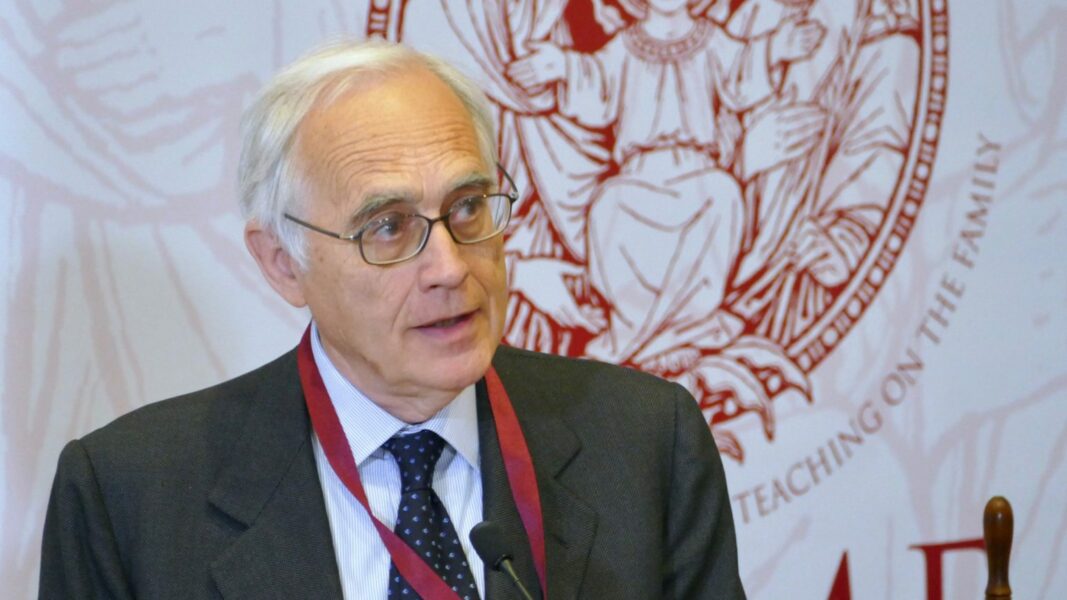
The president of the Lepanto Foundation and director of Corrispondenza Romana, Roberto de Mattei, has offered an initial assessment of Pope Leo XIV’s visit to Argentina, a stage of the apostolic journey to Latin America that the Pontiff began in Uruguay and concluded in Peru. According to the Italian historian, beyond the content of the speeches, the most striking aspect was the popular response: official figures speak of some seven million people at the various events over three days.
The family and life, from the first day
The visit began on 8 November in Buenos Aires with a meeting with President Javier Milei and, afterwards, with the authorities, civil society and the diplomatic corps. De Mattei stresses that the Pope recalled the country’s Christian heritage and dwelt on the family, which he defined as the “fundamental cell of society,” and on the defense of life, which must be welcomed “from its first moments until its natural end.”
The following day, the feast of the Dedication of the Lateran Basilica, Leo XIV spoke of the supernatural foundation of the Church and of communion with the See of Rome. He returned then to the family as the place where faith is transmitted and urged Argentines not to resign themselves before those who consider it obsolete. According to the version reported by Corrispondenza Romana, the Pope stated that the Christian family is today, more than ever, “a cornerstone amid the many uncertainties of our time.”
Holiness, confession and the interior life
For De Mattei, the Mass for the Sanctification of the Argentine People, celebrated in Córdoba on 10 November, showed with particular clarity the Pontiff’s perspective. Leo XIV recalled that every baptized person is called to holiness and proposed as models Cura Brochero (1840-1914), who found the strength of his apostolate in the Spiritual Exercises, and Saint María Antonia de Paz y Figueroa, “Mama Antula.” The historian highlights that the Pope presented the crucifix and the Rosary as weapons of evangelization, and that he recalled that charity toward the poor includes attending to their need for God.
Before the clergy and consecrated persons, gathered that same day in Córdoba’s cathedral, the Pope warned of the risk of working much for God while devoting less and less time to being in His presence. He criticized the tendency to justify faults with pastoral or personal reasons and recalled that priests and religious must also go to confession and accept correction. He acknowledged the Church’s assistance work in Argentina, but asked that every service lead to an encounter with Christ.
That night, at the prayer vigil held in Buenos Aires, Leo XIV drew on the biblical episode of the three young men who refused to worship the statue of Nebuchadnezzar to invite resistance to the idols of success, money, appearances and pleasure. He took up Francis’s “todos, todos, todos” with a new formulation, “All toward Christ, all with Christ, all like Christ,” which De Mattei links to the Instaurare omnia in Christo of St. Pius X. The historian notes that the address spoke explicitly of sin, grace, conversion and the sacraments.
Luján and the recognition of El Wanderer
On 11 November, at the Luján shrine, the visit reached its culminating Marian moment before a crowd that De Mattei estimates at some two million people. The Pope recalled that he was elected on 8 May, the feast of Our Lady of Luján, and entrusted his ministry to her protection. The reference to Mary at the foot of the Cross united the sufferings of families with the mystery of the Redemption.
The historian also mentions the review by the Argentine traditionalist blog El Wanderer, which acknowledged that its pessimistic forecasts about the visit were not fulfilled. The blog attributes that outcome to the influx of the faithful, to the organization and to the dignity of many celebrations, although it points to some debatable liturgical decisions and the almost total absence of confessors. According to the quotation reproduced by De Mattei, El Wanderer concluded that it was “a clearly apostolic visit,” in which the Pope spoke of Christ, conversion and eternal life.
De Mattei closes his analysis by contrasting the fragility of the West, which in his view is above all cultural and moral, with the message coming from Latin America: the Catholic Church retains a strength that neither secularization nor its internal difficulties have managed to erase.