


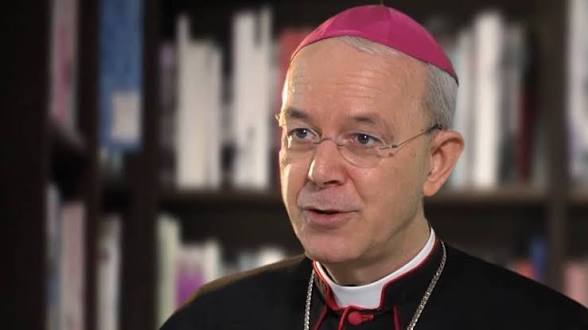
«Of course, it is an evident double standard, because at the same time the Holy See, the Pope, tolerates public heresies.» With these words, Monsignor Athanasius Schneider responded when asked about the treatment Rome has given to the Priestly Fraternity of Saint Pius X (FSSPX). The auxiliary bishop of Astana (Kazakhstan) spoke in an eighteen-minute interview with Armel Joubert des Ouches, journalist and director of the French channel RiTV.
The question referred to the excommunications of last July. On July 1, 2026, the Fraternity consecrated four new bishops in Écône (Switzerland) without a pontifical mandate. The following day, the Dicastery for the Doctrine of the Faith published a decree signed by its prefect, Cardinal Víctor Manuel Fernández. The text declared the latae sententiae excommunication of the consecrating bishop, Alfonso de Galarreta, and of the four new bishops, for a total of six prelates. It also warned clerics and lay faithful that adhering to the FSSPX schism incurs the same penalty. The interviewer summarized the situation with a formula: heresy is encouraged on one side and Tradition is condemned on the other.
From the German Synodal Way to «this wolf»
Schneider was specific. «There are bishops who are not ashamed to proclaim true heresies and remain in their ministry as bishops; also cardinals,» he stated. As a first example, he cited the German Synodal Way, which in his view «has proposed true heresies.»
The second case was that of a bishop in Belgium. According to Schneider, that bishop publicly declared that he would ordain married men to the priesthood despite the law of celibacy. «It is a public provocation by a bishop who remains at the head of a diocese, and the Pope does nothing. Not even a warning. This wolf should be punished,» he said. He also denounced «other forms of blasphemies and liturgical sacrileges» that, according to him, some bishops practice in different parts of the world.
Faced with that passivity, the prelate lamented that Leo XIV has reacted «with such rigidity, with such harshness» against the Fraternity, its priests, and its faithful. According to him, they are people who «only continue to believe, celebrate the Mass, form priests and seminarians, and teach the catechism as the Church has always done.»
Three letters before the consecrations
In the interview, Schneider also confirmed that he had personally interceded with the Pope before the rupture. «Yes, I wrote three letters to the Holy Father, three letters before the consecrations,» he explained. In them, he appealed to the Pontiff as a «man of pastoral care» and asked him for «a more paternal attitude» toward that reality of the Church and a «generous gesture.»
The bishop summarized the arguments he presented in his correspondence: the faithful and priests of the FSSPX «pray for the Pope and for the diocesan bishop» and «only want to preserve and transmit the faith that has always been that of the Church.» According to Schneider, they are not against the Pope, although the media present them as rebels. On the contrary, he maintains, they want to serve the Church and the papacy «out of love for the Church.»
«Welcoming everyone, except these faithful»
Schneider expressed his sadness that the Pope could not make «this truly pastoral, generous gesture, and I would even say synodal.» He resorted to the language of the synodal process to underline the contradiction: amid so many speeches about synodality, «inclusivity and welcoming everyone,» the welcome has not reached these faithful and priests. «I think it will remain in the history of the Church as a great lack of paternal and pastoral sensitivity,» he concluded.
It is not the first time that the bishop of Astana has publicly defended the Fraternity. Before July, he had maintained that the consecrations would not be schismatic. After the excommunications, he has asked in other interviews that Rome recognize the new bishops and integrate the FSSPX into the Church. His words are a personal assessment by a bishop, without magisterial character. They oppose a disciplinary decision of the Holy See which, for its part, has classified the consecrations as an act of a schismatic nature.