


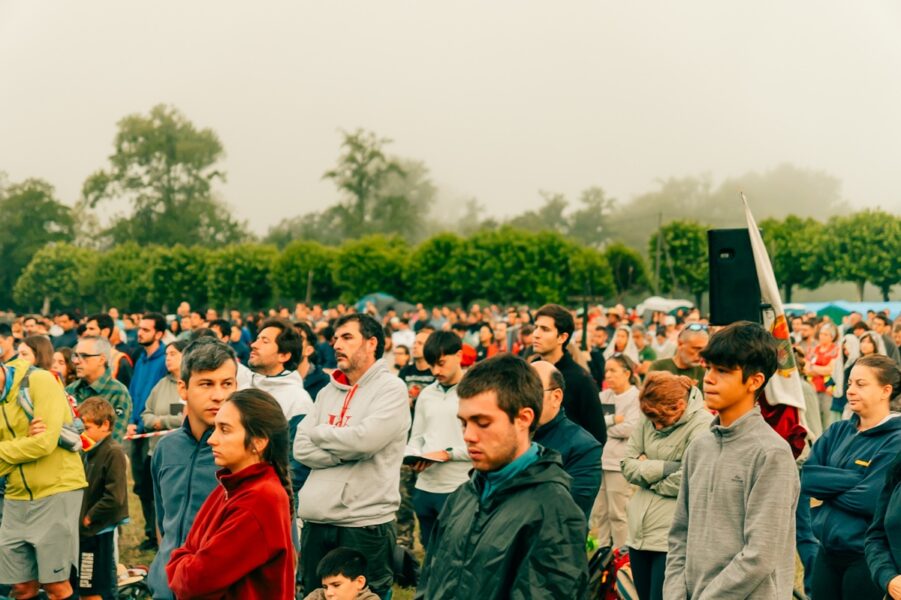
The desire of a growing number of young Catholics to attend the traditional Mass will not be extinguished by the answer that Leo XIV gave aboard the papal plane. That is the thesis of Stephen Daisley in his latest column published on November 18 in The Spectator. His starting point is the banners bearing the slogan “Young people want the traditional Mass” that accompanied the Pontiff during his visit to Argentina.
The author recalls that the Argentine newspaper La Nación documented those signs. They appeared at the major events in Buenos Aires, at the doors of the apostolic nunciature where the Pope was staying, and at the vigil with young people. InfoVaticana had already reported that on November 9 a group of university students unfurled one of those banners as the popemobile passed by. It was part of an organized campaign that accompanied a document requesting freedom to celebrate with the 1962 Missal.
“No, not for now”
The column links those banners to the question that Le Figaro journalist Jean-Marie Guénois posed to the Pope on November 16. It was during the press conference on the flight from Lima to Rome, at the end of the apostolic journey to Uruguay, Argentina, and Peru. When asked whether he intended to relax Traditionis custodes, Leo XIV replied: “No, not for now. Traditionis custodes was a decision of Pope Francis and we will continue to apply it.” He then appealed to the unity of the Church, recalled that the vast majority of Catholics celebrate the rite of Paul VI, and added that “there is a path available for those who wish to request a dispensation.”
The columnist acknowledges that the Pope’s words appear to close the door. Nevertheless, he believes that veteran Vatican observers will note two nuances: the phrase “for now” and the fact that the Pontiff attributes the decision to his predecessor. He also warns traditionalists that they cannot take refuge in semantics. The Pope has spoken, and his word stands until he or a successor says otherwise.
From Summorum Pontificum to Traditionis custodes
To place the debate in context, the text reviews the recent history of the rite. Benedict XVI promulgated the motu proprio Summorum Pontificum on July 7, 2007, which allowed priests to celebrate with the 1962 Missal without seeking permission from the bishop. In the accompanying letter to the bishops, the German Pope wrote that “what earlier generations held as sacred, remains sacred and great for us as well.” Francis overturned that framework on July 16, 2021, with Traditionis custodes. The new motu proprio returned control over the celebration of the ancient liturgy to the bishops and the Holy See.
According to the author, some had hoped that Leo XIV would ease those restrictions. Hope grew after the Priestly Fraternity of Saint Pius X consecrated four bishops without a pontifical mandate on July 1 in Écône. The following day, the Dicastery for the Doctrine of the Faith declared the six prelates involved excommunicated. The columnist believes it would have been prudent to prevent the Lefebvrians from presenting themselves as the sole custodians of the Tridentine Mass. Already in November 2025, the nuncio to Great Britain, Miguel Maury Buendía, had told the bishops of England and Wales that the Pope would not repeal the motu proprio, although the Holy See would be generous in granting exemptions.
The column does not reject the reformed rite outright. It recognizes the canonical validity of the novus ordo, recalls that it was the Mass of Saint John Paul II and Saint Carlo Acutis, and emphasizes that few young people reject the Mass of Paul VI or the Second Vatican Council. What they find in the tradition, it argues, are “the pieces that were missing” from their spiritual life. Those pieces are sacred silence in the face of technological noise, doctrine in the face of relativism, and the worship of God in the face of self-worship.
A younger, more conservative clergy
The central argument is demographic. The author cites the 2025 National Study of Catholic Priests in the United States. According to that study, more than 70% of priests ordained before 1975 identify as progressive, while more than 70% of those ordained since 2010 consider themselves conservative. Only 11% of those ordained before 1980 see access to the traditional Mass as a priority, compared to 39% of those ordained after 2000.
The text also mentions the record number of ordinations in the Priestly Fraternity of Saint Peter, which is in full communion with Rome. It further states, without citing a source, that only one-quarter of young Catholics attend Mass every Sunday, whereas among those who attend the traditional Mass the proportion rises to 98%.
In the author’s view, the aging of the post-conciliar generation, the closure and merger of parishes, and the shortage of priests will make the Church increasingly dependent on these young people. Their more orthodox sensibility will eventually shape ecclesial life. The column also attributes the diminished deference toward the hierarchy to the damage the abuse crisis has caused to the authority of bishops. Therefore, even though the Pope has spoken, the request will continue to be heard.
The text closes with the well-known phrase of Saint Augustine: “For you I am a bishop, with you I am a Christian.” The author trusts that the bishops of the future will accompany the faithful in their appreciation of tradition, without pitting the reformed form of the rite against the ancient one.