


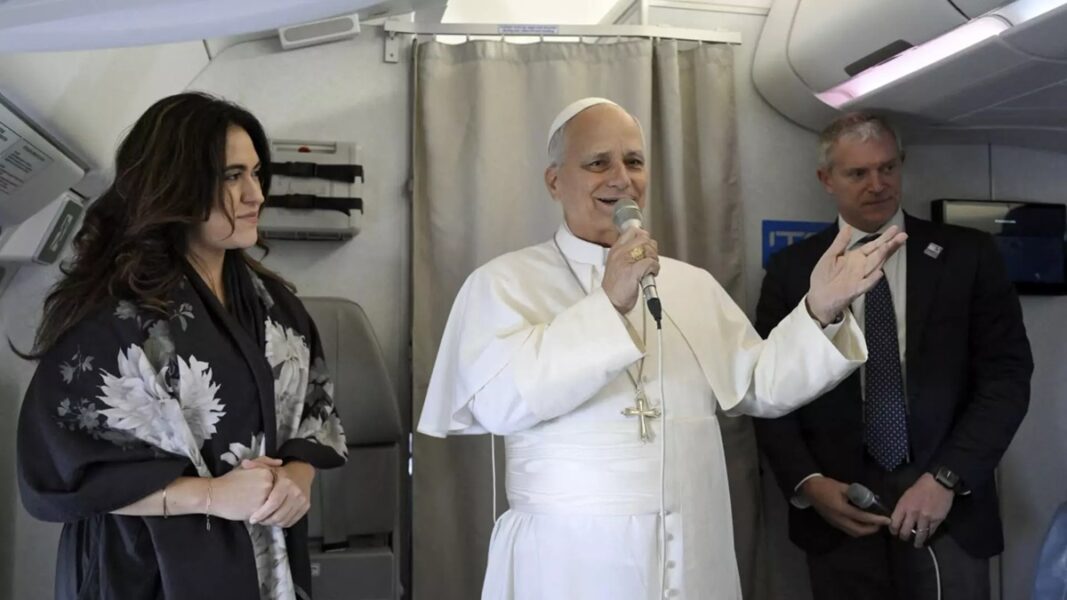
FSSPX.News, the information agency of the Priestly Fraternity of Saint Pius X, has published its analysis of the response given by Leo XIV during the return flight from Lima to Rome. On November 16, the Vatican correspondent Jean-Marie Guénois, from Le Figaro, asked the Pope whether he intended to relax the motu proprio issued by Francis. The answer was clear: «Traditionis custodes is the decision of Pope Francis and we will continue to abide by it». The Pontiff added that the document allows for dispensations to be requested for the celebration of the Tridentine Mass. He also emphasized that, for the unity of the Church, the vast majority of Catholics will continue to celebrate according to the rite of Paul VI.
For the Fraternity, these words confirm the continuity of a liturgical policy which, according to its analysis, does not address what is essential.
A system of exceptions
According to FSSPX.News, the path of dispensations mentioned by the Pope does not change the substance of the issue. The agency recalls that Summorum Pontificum (2007) recognized that the 1962 Missal had never been abrogated. Traditionis custodes (2021), on the other hand, declared that the books of the conciliar reform are «the only expression of the lex orandi of the Roman Rite». Since then, the traditional Mass has depended on the authorization of the bishops. Following the rescript of February 2023, some cases fall directly under the Holy See.
To demonstrate the «rigidity» of the system, FSSPX.News cites figures attributed to the Dicastery for Divine Worship. In 2025 there were only 34 decrees authorizing the traditional Mass in parish churches, distributed among 34 dioceses and 55 parishes, and 29 of them were renewals of already existing permissions. The agency also mentions the Summorum Pontificum pilgrimage on October 24 of last year: according to its account, the pilgrims were denied collective entry into Saint Peter’s. A year earlier, Cardinal Raymond Burke had celebrated a traditional pontifical Mass in the basilica.
«A privilege is not a right»
The Fraternity’s analysis goes beyond the question of permissions. It recalls a phrase from the Superior General, Father Davide Pagliarani, in an interview from February 2026: «a privilege is not a right». From this perspective, a Mass that exists thanks to a concession can be lost by the decision of the one who granted it.
FSSPX.News cites recent history as an example. The indults granted since 1984 and, later, the Ecclesia Dei institutes show, according to the agency, the limits of a freedom that the same authority can restrict or withdraw. Summorum Pontificum allowed a notable expansion of the ancient rite, but the decisions of Francis exposed the fragility of those guarantees.
The Fraternity is not directly subject to Traditionis custodes and continues to celebrate the traditional liturgy without depending on such permissions.
A doctrinal question, not a matter of sensibility
The central point of the text is doctrinal. The Fraternity maintains that it is not asking for more space for «a particular liturgical sensibility». What it defends is a Mass which, in its view, expresses the Catholic doctrine of the Eucharistic sacrifice and of the priesthood. That is the reason for its rejection of what it considers serious doctrinal deficiencies in the rite of Paul VI. Reducing adherence to the traditional Mass to a preference or to the charism of a community would, according to the analysis, ignore the reasons that justify its defense.
This position belongs to the Fraternity and is not shared by the Holy See. Many institutes and faithful attached to the traditional Mass, who are in full canonical communion with Rome, do not subscribe to it either: they recognize the validity and legitimacy of the Novus Ordo.
FSSPX.News concludes its analysis with a question. The Pope has said that he will continue to apply the norm of his predecessor; for the Fraternity, it remains to be seen in what direction the Church can move if it departs from its own Tradition.