


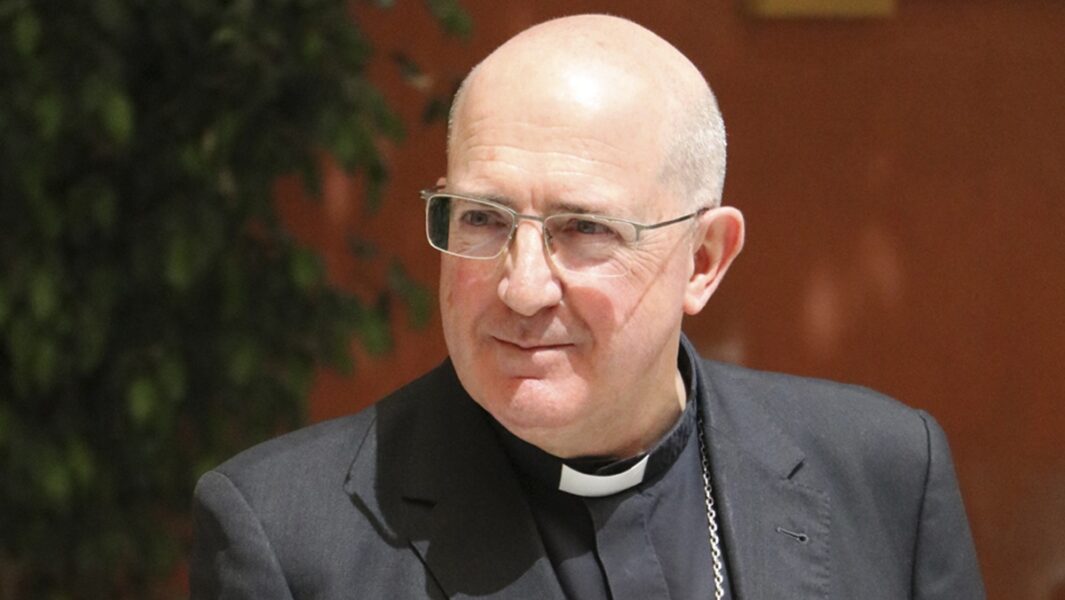
The Una Voce Huelva association has announced through its social media that the bishop of the diocese, Mons. Santiago Gómez Sierra, will attend the Traditional Latin Mass on Sunday, November 22. The celebration will take place at 11:00 a.m. at the Monastery of La Rábida, in the municipality of Palos de la Frontera.
In its message, the group addresses the “friends of the Traditional Mass” and declares itself “enormously” pleased to announce that the prelate will be present. Una Voce Sevilla has also shared the announcement, describing it as “such an important event” and inviting the faithful to join their “brothers” from Huelva.
The communiqué does not specify whether the bishop will preside over the celebration, attend in choir, or have another role in the liturgy, nor who the celebrant will be. So far, the Diocese of Huelva has not published any information about the event.
The Bishop of Huelva
Santiago Gómez Sierra was born in Madridejos (Toledo) in 1957 and was ordained a priest in 1982. His priestly ministry was linked to Córdoba, and he received episcopal ordination in 2011. On June 15, 2020, he was appointed the sixth bishop of Huelva, succeeding José Vilaplana Blasco, and took possession of the diocese on July 25 of that year in the cathedral of Huelva.
Since his arrival, he has made headlines on several occasions for the clarity of his public statements. At the Pentecost Mass in El Rocío in 2022, he reminded Catholics of the consistency required when voting, which earned him criticism in some media outlets and the support of numerous priests and faithful. He has also spoken firmly on abortion, euthanasia, and the unity of Spain.
A Franciscan Site Linked to the Discovery
The choice of venue carries its own symbolic weight. The Monastery of Santa María de La Rábida, of medieval origin and with a long-standing Franciscan presence, stands near the mouth of the Tinto River. Christopher Columbus stayed there in the years leading up to his 1492 voyage, and the intercession of the friars of the convent—particularly Friar Juan Pérez, confessor to Queen Isabella—was decisive in bringing his project before the Court. The complex was declared a National Monument in 1856.
The Traditional Liturgy after Traditionis custodes
Since the motu proprio Traditionis custodes (July 2021) came into effect, the celebration of Mass with the 1962 Roman Missal is subject to the authorization of the diocesan bishop. It is also his responsibility to determine the places and days on which it is celebrated and to appoint a priest to provide pastoral care for these groups of the faithful. This is a disciplinary norm, not a doctrinal definition, and its application has varied widely from diocese to diocese.
In this context, the diocesan bishop’s own attendance at one of these celebrations carries a significance beyond mere protocol. It represents a visible recognition of the faithful who feel connected to the traditional form of the Roman rite, in line with what Benedict XVI expressed in Summorum Pontificum: what was sacred for previous generations remains sacred and great for us as well.
Una Voce, the international federation founded in the 1960s to preserve the traditional Latin liturgy, has several local associations in Spain. The one in Huelva hopes that the bishop’s presence will draw numerous faithful from across the province to La Rábida.