


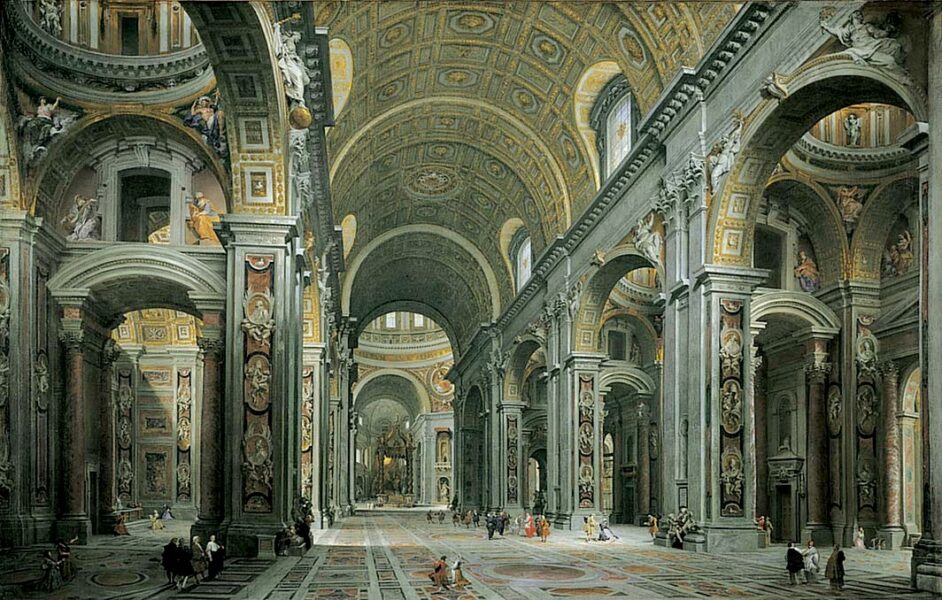
Today marks four hundred years since the consecration of the present Basilica of St. Peter. On 18 November 1626, Pope Urban VIII solemnly dedicated the new Vatican church. One hundred twenty years had passed since Julius II ordered the laying of the first stone on 18 April 1506. This anniversary concludes the commemorative year organized by the Fabbrica di San Pietro, whose central event is the solemn Mass that Pope Leo XIV was scheduled to preside over this Wednesday.
On the occasion of the date, Massimo Scapin has published an article in OnePeterFive that reconstructs the 1626 ceremony and, above all, the music that accompanied it, drawing on contemporary sources. For the author, that consecration restored to the basilica its primary purpose: liturgical worship.
A date chosen with intention
The date was not accidental. On 18 November the dedication of the basilicas of St. Peter and St. Paul was already celebrated, a tradition attributed to Pope St. Sylvester I in the time of Constantine. This is recorded by the Roman chronicler Giacinto Gigli, who adds further details of the vigil: the Pope ordered a fast and a solemn procession of all the clergy and religious from the church of San Marco to St. Peter’s.
Donato Bramante, Michelangelo, Carlo Maderno and Gian Lorenzo Bernini worked on the construction of the new basilica, together with stone-cutters, gilders and goldsmiths whose names have not survived. Scapin recalls that the Fabbrica is the body created to direct the works and that it still oversees the maintenance of the church today. Its records document every last nail, rope and plank employed.
More than four hours of Gregorian chant
The author cites the Diary of the Pontifical Musical Chapel, according to which the rite of consecration was sung in Gregorian chant and polyphonic motets were reserved for the papal Mass. Even without large-scale polyphony, the ceremony lasted more than four hours.
A tapestry by Fabio Cristofani, from the series dedicated to the life of Urban VIII, depicts one of the most striking gestures of the ancient rite. In it, the Pope traces the Greek and Latin alphabets with his crozier on a cross of ashes spread on the floor of the church. This was one of the rites proper to the dedication of churches according to the Roman Pontifical. The new rite of dedication promulgated after the Second Vatican Council no longer includes it. On the occasion of the anniversary, the Pinacoteca Vaticana has exhibited the Barberini tapestries, including the one depicting the dedication of the basilica.
The dome as a resonating chamber
The director of music was Paolo Agostini, maestro di cappella of St. Peter’s from 16 February 1626. For the occasion he placed singers and instrumentalists in the gallery that encircles the dome, some fifty metres above the floor. The voices, especially those of the castrati, seemed to descend from heaven. Scapin maintains that Urban VIII was captivated by the effect and therefore promoted this spatial arrangement of the choirs as an expression of the mystery of the liturgy and of the joy of the Tridentine Church. According to the author, the model soon spread throughout Italy.
Agostini used the same formula on other great feasts. For the solemnity of St. Peter and St. Paul on 29 June, he arranged twelve choirs, one for each apostle, directed by the finest masters from the churches of Rome. Among the organists who took part were Girolamo Frescobaldi, Orazio Benevoli and Pietro Eredia. At second Vespers of the dedication, the Cappella Giulia, the basilica’s own choir, performed music for two and three choirs.
“To the astonishment of all Rome”
The papal singer Antimo Liberati recalled him in 1685 as one of the “most lively and brilliant” minds music had known in his time. He recounted that Agostini had performed in St. Peter’s compositions for four, six and eight real choirs “to the astonishment of all Rome.” Agostini died in 1629, barely three years after the consecration. Liberati applied to him a verse from the Book of Wisdom: Consummatus in brevi explevit tempora multa (“Having reached perfection in a short time, he filled a long span”).
Scapin closes his article with the French writer Charles Dupaty, who, during his journey through Italy in 1785, confessed that he could find no words in any language adequate to describe the basilica. For the author, the anniversary invites us to remember not only the artistic enterprise but also the spiritual and musical flowering that made 18 November 1626 a decisive moment for Christianity and European culture.