


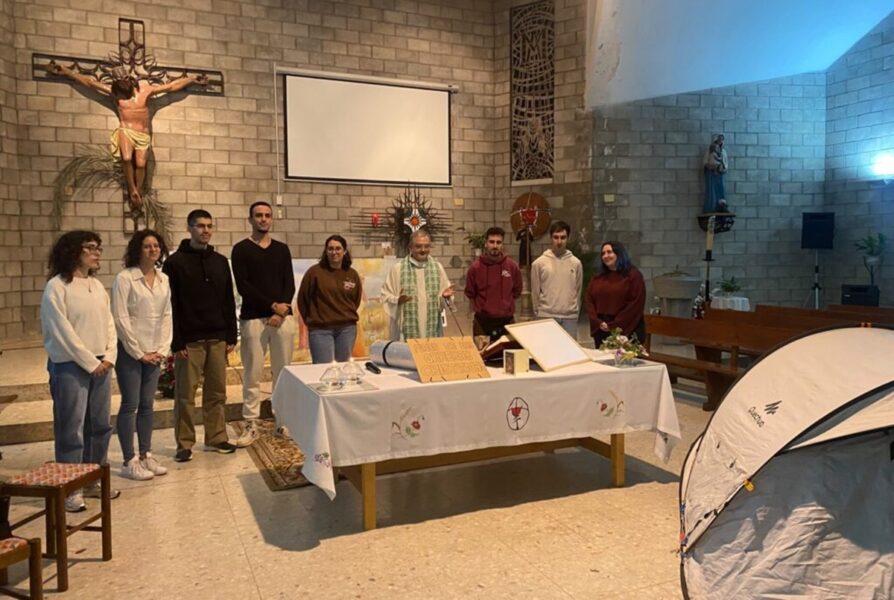
The Christian Working Youth (JOC) of Madrid closed its campaign “Defend our right: all under one roof” on Saturday, November 14, with a thanksgiving Mass. It was held at the parish of the Precious Blood, in the Orcasitas neighborhood, served by the Missionaries of the Precious Blood. The movement itself summed up the meaning of the event with the slogan: “We fight in the streets and we celebrate it at the altar.”
Noticias Obreras, the publication of the Hermandad Obrera de Acción Católica (HOAC), reports in its chronicle that a tent “presided over the celebration.” Inside it, the militants left written reflections on the Sol encampment, in which they participated during the housing protests, and on how to continue acting.
A table, a mat, and a tent before the priest
El Debate has described the images of the celebration. In them, the priest, wearing an alb and stole, appears celebrating before a simple table while the church altar remains behind him. On that table, next to the missal and the candles, there is a rolled-up mat and a protest sign. Next to it stands the tent. According to the newspaper, about thirty people attended, and seven young JOC members surrounded the celebrant.
Noticias Obreras presents the scene as a gesture that “brought the experience of the Sol encampment into the space of celebration.” According to the chronicle, the participants placed before God the struggles, joys, difficulties, and hopes of a year of mobilization. There was also an explicit recognition of those who made the encampment possible.
The current liturgical norms are clear on this point. The General Instruction of the Roman Missal establishes that, in a sacred place, the Eucharist is celebrated on the altar, and only allows a suitable table outside it (n. 297). It also stipulates that only what is required for the celebration of Mass be placed on the altar table (n. 306). Neither chronicle explains why, being inside the church, an auxiliary table was used.
“God Father-Mother” and the encampment as evangelization
The JOC chronicle states that, “among tents and assemblies,” the militants recognized the presence of “God Father-Mother.” It adds that the tent placed in the celebration made visible the link between faith and what was lived in the streets. The formula is foreign to the Church’s liturgical language, which addresses God as Father, according to the prayer taught by Christ. The Catechism of the Catholic Church admits that God’s tenderness can also be expressed with the image of motherhood. However, it specifies that God transcends the human distinction of the sexes and that no one is a father as God is (n. 239).
At a meeting held in October, the diocesan president of the JOC, María Azargui, defined the encampment as a form of “evangelizing through action.” She spoke of a Christian presence where the injustices suffered by working youth are lived. El Debate recalls that, during the protest, Azargui defended “organizing frustration, organizing anger” to undertake collective actions. On October 2, she assured that they would remain in Sol “until we see that it makes sense.” According to the same newspaper, the group left the encampment two days later to continue the mobilization from the neighborhoods.
Cardijn, Leo XIV, and a film forum
The Mass coincided with the international day of the International Coordination of Christian Working Youth (CIJOC). Attendees remembered Cardinal Joseph Cardijn, founder of the movement. In the final sending, they quoted the words with which Leo XIV encouraged young people in Madrid last June to be “a spark of a new humanity” and to hunger for justice. “For here we are: with hunger, and with the shared bread that gives us strength to continue in the struggle,” the militants responded, according to Noticias Obreras.
The JOC already has a new appointment: on November 28, it will organize a film forum on the movie En los márgenes to continue working on the housing problem with young people in their environment.