


Hostility against Christians in Europe remains at high levels. This is reflected in the annual report by OIDAC Europe, the Vienna-based observatory that monitors discrimination against Christians on the continent. The document was presented on November 16, coinciding with the International Day for Tolerance, according to the German Catholic weekly Die Tagespost.
For 2025, the report records 2,465 incidents. The most striking figure is the rise in attacks against individuals: at least 395 cases, compared to 274 in 2024, a 44% increase. This category includes physical violence, threats, and harassment.
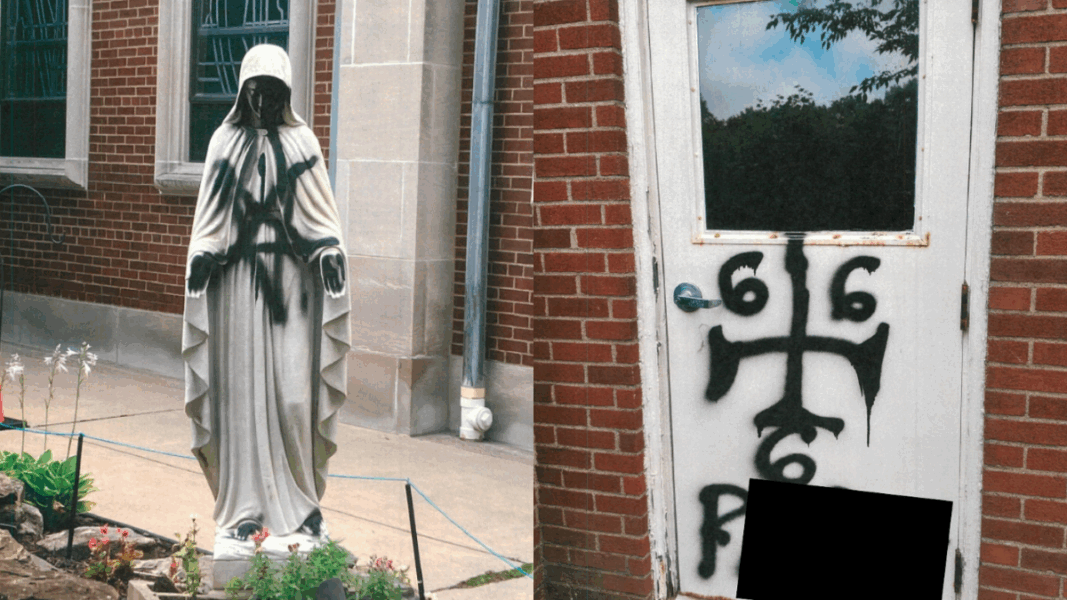
In any case, the majority of incidents continue to be attacks on churches and other Christian sites: arson, vandalism, and desecrations. The observatory also documents professional harm on grounds of faith, restrictions on freedom of conscience and parental rights, interference in the autonomy of Churches, and criminal proceedings against people who peacefully expressed their religious convictions near abortion clinics.
France, leading the official figures
The report is based on data from national governments and incidents documented by the OSCE’s Office for Democratic Institutions and Human Rights (ODIHR). Among the official figures, France records the highest number (843 cases), followed by England and Wales (624, between April 2025 and March 2026), Germany (337), and Austria (134).
The French figures come from the Ministry of the Interior, which reports a 9% increase in the total number of cases. Attacks on property account for 87% of the total, but crimes against individuals rose by 70%, reaching 109. Physical assaults on those responsible for places of worship quadrupled, reaching 14.
OIDAC warns that there are major gaps in the data, as each country collects information differently. In Germany, for example, anti-Christian crimes are only counted within politically motivated crime, so many attacks on churches do not appear in the hate crime statistics. That is why the total of 2,465 is not a simple sum of all sources. For each country, the highest available figure was taken, so cases recorded by both governments and civil society are not counted twice.
Data from civil society documented by the OSCE provides a different ranking. Germany leads (145 cases), followed by France (143), Spain (113), Italy (103), Poland (80), and the United Kingdom (60).
Spain, without its own statistics on Christianophobia
The report pays special attention to Spain, as reported by Voz. The Ministry of the Interior separates cases of antisemitism and Islamophobia in its hate crime statistics, but does not have its own category for those directed against Christians.
The only available data therefore come from civil society. OSCE/ODIHR recorded 113 anti-Christian incidents in Spain reported by these organizations. With that figure, Spain ranks third in Europe in that register, behind Germany (145) and France (143). Of those cases, 25 involved violence or threats against individuals. Among them was a knife attack that left three people injured.
The document includes Spain among the countries where it observes restrictions on religious freedom in 2025 and 2026. It points to two areas: the public expression of Catholic convictions and the right of parents to pass on the faith to their children. The first case cited is that of the emeritus bishop of Alcalá de Henares, Juan Antonio Reig Pla. In May 2025, the Ministry of Social Rights asked the Prosecutor’s Office to investigate him for a homily on disability and opened an information file. The report recalls that the prelate had clarified his words with reference to Catholic doctrine on original sin and God’s love for all people.
OIDAC also mentions the complaint filed by the municipal groups of PSOE and Hacemos Córdoba before the Prosecutor’s Office against the Catholic Association of Propagandists. They attributed to it an alleged hate crime for a campaign against the selective abortion of children with Down syndrome.
Regarding parental rights, the observatory mentions two complaints that the European Court of Human Rights has communicated to the Spanish Government. The first questions the fact that, when parents do not agree, preference is given to non-confessional schooling. The second concerns an evangelical father who was prohibited from taking his son to church and teaching him passages from the Bible.
In the section on the media, the report cites a 2025 survey by the Observatory for Religious and Conscience Freedom (OLRC). According to that poll, 90% of the Catholic priests consulted perceived a constant media bias against priests and bishops.
Murders and a hostile media climate
The report highlights several serious violent crimes, including two homicides. In Lyon, Ashur Sarnaya, an Assyrian Christian who had fled Islamist persecution in Iraq, was stabbed to death. At the time of the attack, he was live-streaming Christian messages. In Poland, a Catholic priest was tied up and murdered in his parish house.
The document also points to negative stereotypes and prejudices in public debate and the media. OIDAC criticizes that some publicly funded media outlets present a false image of Christian groups or equate extremist positions with traditional Christian ethics. It also denounces that some pressure groups label pro-life organizations as “anti-rights.”
According to the observatory, surveys of Catholic priests in Poland and Spain show that they perceive the negative image portrayed by the media as a factor fueling hostility against Christians. In Germany, a representative survey indicates that nearly half of those under 29 believe that such hostility is widespread in the country.
A European coordinator against Christianophobia
With these data, OIDAC Europe calls on the EU to appoint a coordinator to combat hostility against Christians, “in a manner analogous to the existing officials for the fight against antisemitism and anti-Muslim hatred,” in the words of its executive director, Anja Tang.
“We must carefully investigate its causes and support the victims and affected communities,” Tang stated. “An EU coordinator would be an important step toward turning this concern into lasting and coordinated action.”