


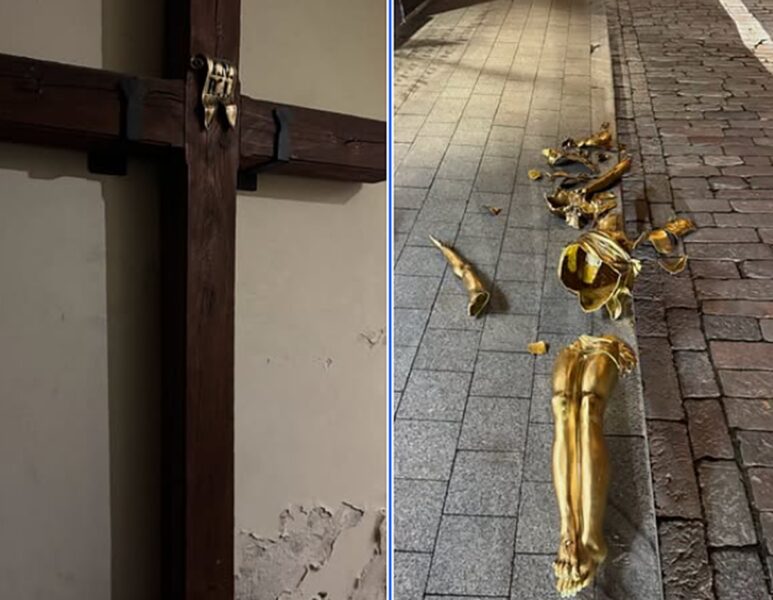
Lithuanian police have identified a British citizen as a suspect in the removal and destruction of a gilded image of the crucified Christ in the courtyard of the Shrine of Divine Mercy in Vilnius, the church that houses the original painting of Jesus the Merciful, painted under the direction of Saint Faustina Kowalska. The incident occurred on the night of Wednesday, November 11, in the old town of the Lithuanian capital, and security cameras recorded two men: one took the figure down from the wooden cross while the other filmed him with a mobile phone. The image ended up on the ground, smashed to pieces.
According to Vilnius police, the suspect, born in 1989, was identified on November 14. The following day, police spokesperson Tomas Bražėnas confirmed his British nationality and year of birth to the ELTA news agency, as reported by International Business Times. The man, who was temporarily in the country, has been formally notified of the suspicion and has given a statement, and investigators have confiscated his identity document as a procedural measure, preventing him from leaving Lithuania. His name has not been made public. The identity and nationality of the second man have not been established, and the police have not said whether he is also under investigation.
The legal classification of the case has changed within a few days. The initial police report, dated November 11, cited Article 284 of the Lithuanian Penal Code, which punishes public disorder. The update of November 14 now refers to Article 312, which defines the desecration of a grave or other place of public respect. The police have not explained why the image was destroyed. Accounts of what the man who took it down shouted do not match: Lithuanian television TV3 reported an exclamation of “God!”, while other media cite “Praise the Lord!”.
The deputy rector of the shrine, Father Elijas Anatolijus Markauskas, posted photos and videos from nearby shop cameras on social media and asked anyone who recognized the two men, including owners of tourist accommodations, to notify the police. “It hurts me, because it is not just a sacred object”, he wrote, according to the English translation by International Business Times. “It is the image of the One we love, to whom we pray and to whom we entrust the world”. In a later message, reported by El Debate, he admitted that it is difficult for him to pray for the perpetrators, although he recalled that God also loves them and that the path of repentance and forgiveness remains open. According to the same newspaper, the shrine stated in a communiqué that it was a sign that man continues to try to destroy his Creator.
The site of the attack is not just any church. The Shrine of Divine Mercy, on Dominikonų Street, houses the first painting of Jesus the Merciful, painted in Vilnius in 1934 by Eugeniusz Kazimirowski following the instructions of Saint Faustina and her confessor, Blessed Michał Sopoćko. It is one of the main pilgrimage destinations for the devotion that Saint John Paul II extended to the entire Church by instituting the feast of Divine Mercy in the year 2000, the same day he canonized the Polish nun.
The case adds to other attacks on Christian images and churches that this media has reported on in recent months, such as the desecration of the tabernacle in Guitiriz, Lugo, or the theft of the one in Parla, Madrid. This time the target was the shrine to which the faithful from all over the world make pilgrimage every year to pray before the image that Saint Faustina asked to be painted with the inscription “Jesus, I trust in you”.
Read also