


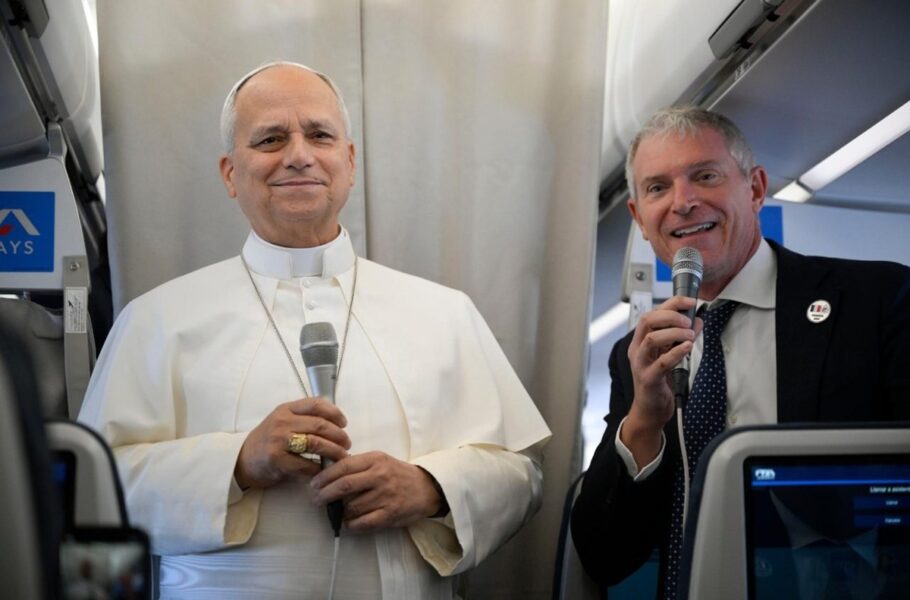
On the return flight from Lima to Rome, Leo XIV avoided closing the door to the priestly ordination of married men, although he made it clear that it is not an issue for this moment. “For now, this is enough,” he replied. He insisted that his priority is the unity of the Church and that “the Pope does not change doctrine.”
Leo XIV has not closed the door to the priestly ordination of married men, but he has made it clear that it is not among his immediate plans. He expressed this during the press conference aboard the plane that was returning him from Lima to Rome, at the end of his apostolic journey through Uruguay, Argentina, and Peru.
The question was asked by Gerry O’Connell of America Magazine. The journalist recalled that, in Pucallpa, the Pope himself had pointed out that that Amazonian vicariate, “larger than many countries,” has only 25 priests. He also recalled that the Synod of the Amazon approved a proposal to ordain viri probati, and that Francis neither said yes nor no to that question in Querida Amazonia. He asked whether the matter remains open during his pontificate.
The Pontiff began with his missionary experience. When he arrived in Peru, he explained, among the Augustinians there were between fifteen and twenty Americans and two Peruvians. Today, in the north of the country, barely any Americans remain, but there are 35 Peruvians. “The Spirit works in many ways,” he affirmed, also where vocational promotion and formation bear fruit. He admitted that in the Amazon the vocational question “has been more complex” and that, of the seven Peruvian apostolic vicariates, some have far fewer vocations than others.
“The Pope does not change the doctrine of the Church”
Regarding the ordination of married men, Leo XIV said that it is “one of the proposed solutions,” but “not the only one.” He added that “in some parts of the Church, it can cause divisions, because not everyone accepts this idea.” From there he appealed to what he has described as one of his priorities: “to promote, above all, unity and communion.”
“To move forward with an idea that the Holy Spirit may continue to suggest, and that may also suggest to others besides myself, we must all listen. The Pope does not change the doctrine of the Church. Bishops must listen. It is possible that some things may change in the future,” he noted.
The Pope did not specify whether this statement referred to celibacy. Priestly celibacy is not a dogma, but a discipline of the Latin Church, contained in the Code of Canon Law. The Eastern Catholic Churches, in full communion with Rome, ordain married men as presbyters.
Twice “for now”
The expression appears twice in the response. The first, right after admitting possible future changes: “But, for now, I believe that an important part of my ministry in the Church consists in healing and uniting people.” The second, when closing the matter: “I think that, for now, this is enough, because the question of married men in the clergy is complex.”
Leo XIV compared his approach to what he had said earlier about political polarization in the Church in some countries: first to meet, then to reflect on priorities, and only then to see how to proceed. “I know very well that many people do not agree with this approach. That’s fine,” he acknowledged. He also mentioned that “there are those who put forward other proposals,” without specifying them, and concluded that all these questions “will require time and we will move forward as the Lord guides us.”
The response is neither a formal no nor the announcement of a study. The Pope places the possible ordination of married men behind ecclesial unity and leaves it, in his own words, for later.