


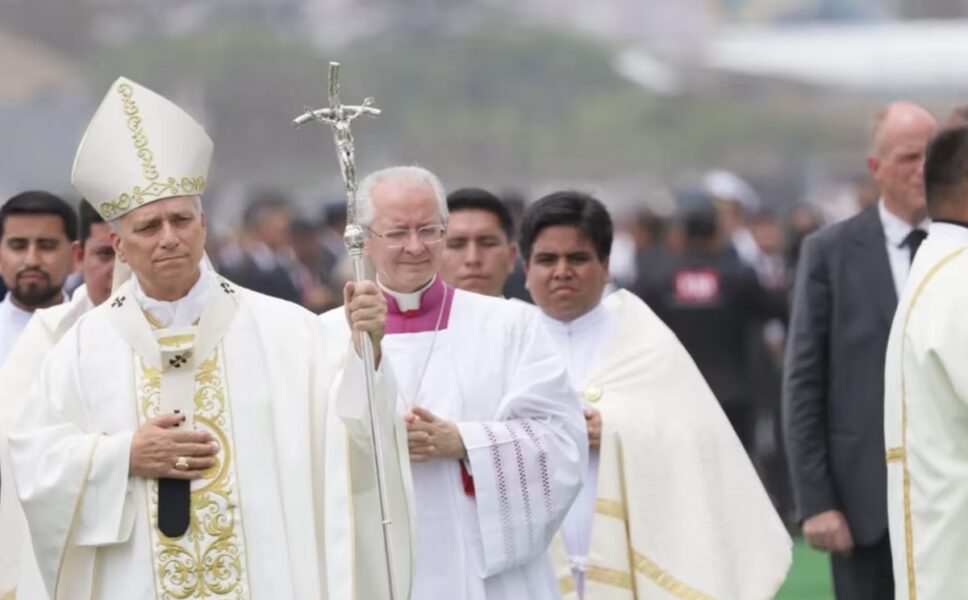
Pope Leo XIV presided this Monday at the Las Palmas Air Base in Lima over the final Mass of his apostolic journey to Peru. He opened the homily with the promise of the risen Christ to his disciples: “Know that I am with you always, until the end of the age” (Mt 28:20). The rest of the preaching centered on Saint Turibius of Mogrovejo, second archbishop of Lima, on the third centenary of his canonization. The full text of the homily was published by EWTN News.
Communion, from the Eucharist to synodality
The Pontiff presented Saint Turibius as an example of ecclesial communion and as someone who lived the Church “as a missionary communion.” This communion, he explained, values “differences, sensibilities, and distinct thoughts within the unity of faith,” and “is manifested and consolidated in the Eucharist, sacrament of unity,” which for the archbishop “was the center of life.”
He then made the statement that summarizes this part of the homily: “Communion is expressed today in synodality, thus becoming, at every level, a style of ecclesial life.” According to Leo XIV, Saint Turibius anticipated this in the councils and synods he celebrated, where he knew how “to listen, to dialogue, to welcome the suggestions of the Spirit, and to put communal discernment into practice,” and he also included the poorest “in the search for truth.” The Pope added that this explains why the orientations of those sixteenth-century assemblies remained in force until the Latin American Plenary Council at the end of the nineteenth century.
Saint Turibius, from law to the episcopate
To present the figure of the saint, the Pope quoted Benedict XVI: “The saints are the true interpretation of Sacred Scripture.” From there he read the day’s readings in the light of the archbishop’s life. He recalled that Turibius was a layman with a rising legal career when he was called to be a pastor, and that he walked “hundreds and hundreds of kilometers” to meet indigenous peoples while learning their language.
Leo XIV highlighted his dedication to the ministry of the Word, his insistence that priests learn Quechua, and his struggle to ordain indigenous people and mestizos, whom “many members of the clergy still despised.” He also stated that the archbishop was convinced that gentleness was the only way to announce the “true religion,” and attributed that teaching to Bartolomé de Las Casas.
Pastoral visits, according to the Pontiff, served “to know, to help, and, if necessary, to correct” the faithful, to instruct them in the divine Word, and to administer the sacraments. Those visits earned him “opposition and calumnies, even from the authorities.” The Pope recalled that the saint did not accept gifts, that he distributed almost everything that belonged to him among the poor, and that after each visit he sent the king reports denouncing the injustices against the indigenous population.
The power of crucified love and the final sending
Commenting on the Gospel of the missionary sending, Leo XIV contrasted the authority Christ receives from the Father with the “arrogance” that wounds the world. “It is the power of crucified love!” he exclaimed. He said that the command to baptize all nations helps us understand “the essence of the Church’s mission: to carry forward the work of Jesus Christ, with his power, so different from worldly powers.”
In his farewell, the Pope, who had been bishop of Chiclayo before his election, told the faithful: “the Peruvian people are also my people!” He named Saint Rose of Lima, Saint Martin de Porres, and Saint Francis Solano as protagonists of the “civilization of love,” which he opposed to the “builders of Babel.” He closed with a missionary call: “My journey ends, but the time of mission continues!”
With this Mass, the Pope’s visit to Peru concluded, which began on November 11 and passed through Lima, Chiclayo, Cusco, and Pucallpa. According to the organizers, the celebration also closed the jubilee year for the tricentenary of the canonization of Saint Turibius.