


By Robert Royal
NOTE: We are making good progress in our fundraising campaign. Still, we really need more of you to join in now if we are to continue offering you the many and varied “things” – from columns to news and commentary, podcasts and courses, and even a weekly commentary on the Catechism – that TCT and the Faith & Reason Institute produce. All of this – and more – is sorely needed, both in the Church and in the world. We are not going to give up any of it. In fact, we plan to do even more next year. So, please, if you recognize that need, here is the opportunity to do something about it. Be generous, be part of the work of The Catholic Thing. – Robert Royal
It has been a real pleasure to follow this past week the impressive journey of Pope Leo to Latin America. If there was any doubt about his health, the way he seemed to do nothing but gain energy as he traveled through Uruguay and Argentina and finally reached the crowds that acclaimed him in Peru – a twelve-day schedule that would have exhausted most people half his age – has proven beyond any doubt that, at least for now, we have a very vigorous pontiff.
The media tended to focus on scattered political remarks by the Pope (universal healthcare in Uruguay, justice for the murdered environmentalists in Peru), the usual phrases of circumstance. His specifically Catholic messages were more interesting: prayer and fasting for vocations in Montevideo; not setting aside doctrine for “pastoral” reasons in Buenos Aires (a correction to Pope Francis?); and remaining faithful to the Church of Jesus in Peru (Protestantism is growing throughout Latin America).
All good words, but it would be good to see them followed by firm actions, especially with appointments along the same lines in the Curia and in the designations for the College of Cardinals. And with attention to several challenges in other parts of the world.
A wise Italian friend told me last week in Rome something that becomes obvious once you think about it, though we rarely do. The Vatican is the nerve center of Christianity and, as such, seeks to promote Catholic spiritual and moral/cultural objectives. But it is also a State and, as such, also seeks to maintain good diplomatic relations with other States and even with large cultural groups.
This has its positive side: Rome can be a disinterested mediator when international tensions arise, and it has often played that role throughout history. But it also has costs if carried out poorly; just look at the disastrous, still “secret” agreement with China, or the way the two most recent popes have ignored clear historical truth and tried to make peace with Islam, and even deny the threats that come from it.
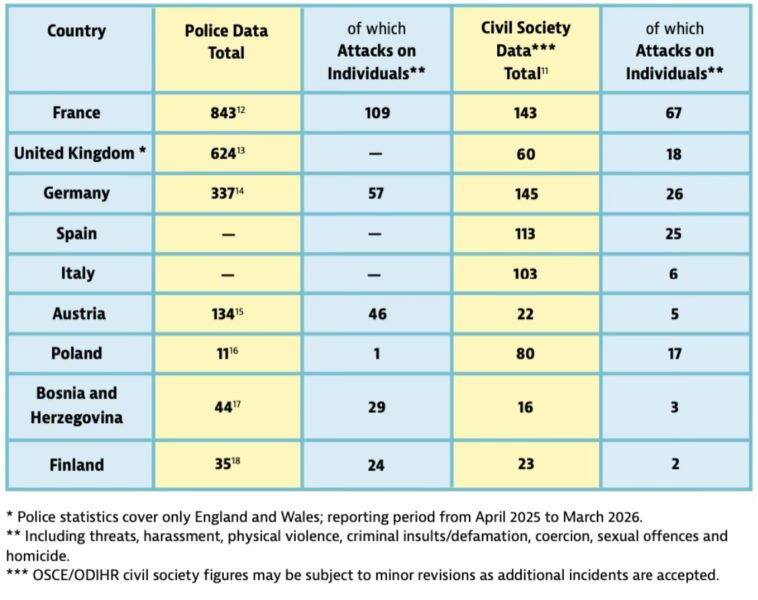
Precisely this week, the Observatory on Intolerance and Discrimination against Christians in Europe (OIDAC), in its 2026 report on anti-Christian “hate crimes” (according to the European Union’s own criteria), recorded 2465 cases in Europe. The breakdown by country is interesting:
It is no coincidence that the countries that have allowed the greatest influx of illegal immigration from Islamic states – France, the United Kingdom, Germany, and Austria – have the highest number of incidents. Islamic radicals are not responsible for all of these attacks, of course, but it would be very naïve to dismiss the correlation.
Pope Leo has spoken several times of the need to have “less fear” of Islam. The facts on the ground – rarely reported, or minimized, by the mainstream media – indicate that the simply truthful thing is to have greater concern about Islam, both for what it is doing in the secular world and for the way treating Islam as just another of the “world religions” is having tangible consequences for Christians.
Aid to the Church in Need has also just published a biennial report on the persecution of Christians in the world. (See our podcast with the lead author of the report here). Christians are threatened in 165 countries, more than 220 million worldwide. Sometimes one gets the impression that, like European governments and the media, the Vatican does not want to draw attention to this phenomenon for fear of provoking a backlash, as happened after Benedict XVI’s moderate comments on Islam in his Regensburg speech.
For anyone who has paid attention to the endless agitation in the Church around “Vatican II” – a council that ended six decades ago – all of this recalls questions (that is, concerns) that arose during the Council itself and calls into question whether what seemed good to the bishops of the world between 1962 and 1965 is still the best star to steer by in a very different world.
I was rereading some pages of my book A Deeper Vision and came across these words from Joseph Ratzinger when he was still a cardinal:
Not every council valid in the history of the Church has been fruitful; in the end, many of them have been nothing more than a waste of time. […] [D]espite all the good that is found in the texts it produced, the last word on the historical value of the Second Vatican Council has yet to be said. That it will ultimately be counted among the culminating moments in the history of the Church depends on those who transform its words into the life of the Church.
The old narrative told us that the Church was too closed in on itself before the Council; that John XXIII’s intention in calling it was, by opening the Church to what was good in the modern world, to make possible a more effective evangelization. To this end, the conciliar Fathers emphasized the positive and, in fact, were instructed not even to mention obvious evils such as communism, that is, the most militant, best organized, and most murderous movement in human history (100 million dead). And anti-religious in its essence.
Pope John Paul II’s Ostpolitik took a firmer stance, with clear benefits.
It is a simplification, but only a slight one, to say that then and still today the main question is whether the Church evangelizes the world or the world evangelizes the Church. When Pope Leo was a missionary in Peru in the mid-1980s, many of us noticed that “Christian-Marxist dialogue” meant that Christians too often became Marxists. Marxists almost never became Christians. More recently, radical feminism and LGBT activists are pushing the “dialogue” through synodality.
At the very least, this history should alert us to the problems with easy claims that continuing to “apply” Vatican II, or that “synodality,” is somehow the path to better evangelization today. Sister Nathalie Becquart, one of those responsible for the synodal process, has said: “Synodality is Vatican II in a nutshell.”
If that is true – and it is not obvious that it is – it raises many big questions that Pope Leo must at least begin to address now that he is back in Rome.
About the Author
Robert Royal is editor-in-chief of The Catholic Thing and president of the Faith & Reason Institute in Washington, D.C. His most recent books are The Martyrs of the New Millennium: The Global Persecution of Christians in the Twenty-First Century, Columbus and the Crisis of the West, and A Deeper Vision: The Catholic Intellectual Tradition in the Twentieth Century.