


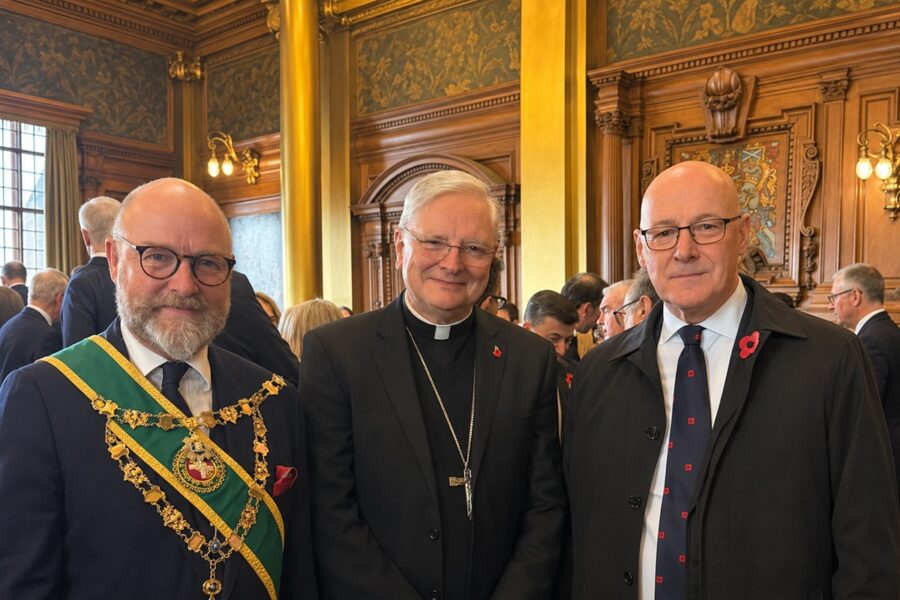
The image was taken on Sunday, November 8, at Edinburgh City Hall, during the reception that closed the annual events in memory of those fallen in combat. According to the portal AdVaticanum, it was published by the Instagram account “scotsmasons.” The accompanying message stated that the Freemasons of the entire Scottish Constitution had joined their communities to commemorate the day. The First Minister of Scotland, John Swinney, also attended the reception.
The commemoration began mid-morning with a parade from the castle along the Royal Mile, led by the RAF Central Scotland pipe and drum band. The central ceremony took place in front of the Stone of Remembrance on High Street, with a minute of silence at eleven o’clock. It was presided over by the Reverend Scott Rennie, minister of the Presbyterian cathedral of St Giles. Wreaths were laid by Swinney, Lord Provost Robert Aldridge, the Secretary of State for Scotland Douglas Alexander, the heads of the Armed Forces, and several veterans’ organizations. Participants then attended a service at St Giles and, finally, the reception where the photograph was taken.
Civic presence and institutional appearance
The same outlet reporting the news emphasizes that nothing indicates the archbishop has endorsed Masonic principles. Scottish Freemasons frequently take part in civic events of this kind, just as the country’s leading religious figures do, and sharing in a tribute to the deceased does not, in itself, constitute religious cooperation. AdVaticanum raises another question: where is the line between civic participation and the appearance of institutional association with an organization that Catholics are not permitted to join? The article contains no statement from the archbishop or the archdiocese.
British Freemasonry attaches its own significance to these dates. The portal Global Freemasonry explained a year ago that the United Grand Lodge of England had held its National Masonic Service of Remembrance on November 1, 2025, at the National Memorial Arboretum in Staffordshire. According to that outlet, for English Freemasonry Remembrance Day is an occasion to reaffirm its commitment to “peace, tolerance, and cooperation,” and that ceremony was both an act of homage and “of identity.” That is why the publication of the photograph on the Scottish Freemasons’ own social media gives it a relevance that goes beyond a merely protocolary encounter.
A repeated condemnation by the Holy See
In the 1884 encyclical Humanum genus, Leo XIII condemned Freemasonry and, in particular, religious indifferentism, which the Pontiff described as the great error of the age: considering religion a matter of indifference and all religions equal. The Pope asked the bishops to instruct the faithful about the dangers of the sect and warned that no one should join it for any reason.
In 1983, the Congregation for the Doctrine of the Faith, chaired by Cardinal Joseph Ratzinger, declared that “the faithful who belong to Masonic associations are in a state of grave sin and may not approach Holy Communion.” In November 2023, the Dicastery for the Doctrine of the Faith, in a text signed by Cardinal Víctor Manuel Fernández and approved by Pope Francis, reiterated that the active affiliation of a member of the faithful to Freemasonry is forbidden because of the incompatibility between the two doctrines.
Nothing prevents a bishop from dealing with people of other convictions or collaborating in legitimate civic initiatives. It is also his responsibility, as AdVaticanum recalls, to prevent the faithful from perceiving as compatible with the faith organizations that the Church has expressly condemned.
The Church’s teaching on excommunication and dual membership
The condemnation of Freemasonry dates back to 1738, when Clement XII prohibited it in the bull In eminenti under pain of excommunication. His successors reiterated the prohibition for two centuries. The 1917 Code of Canon Law included it in canon 2335, which imposed latae sententiae excommunication, reserved to the Holy See, on those who enrolled in the Masonic sect or in similar associations that plotted against the Church or against legitimate civil authorities.
The 1983 Code no longer mentions Freemasonry by name. Its canon 1374, which retained the same wording in the 2021 penal reform, provides that anyone who enrolls in an association that plots against the Church must be punished with a just penalty, and anyone who promotes or directs it, with an interdict. In response to those who interpreted that silence as a change of criterion, the 1983 Declaration clarified that the Church’s negative judgment on Masonic associations remained unchanged, because their principles continue to be considered incompatible with Catholic doctrine. It further warned that local ecclesiastical authorities may not issue statements that would derogate from that teaching.
Two levels must be distinguished. The canonical penalty is a disciplinary matter. The incompatibility is a doctrinal judgment that does not depend on it. For the Church, the so-called dual membership—being both Catholic and a Freemason—is not open to the particular discernment of each member of the faithful or of each diocese.