


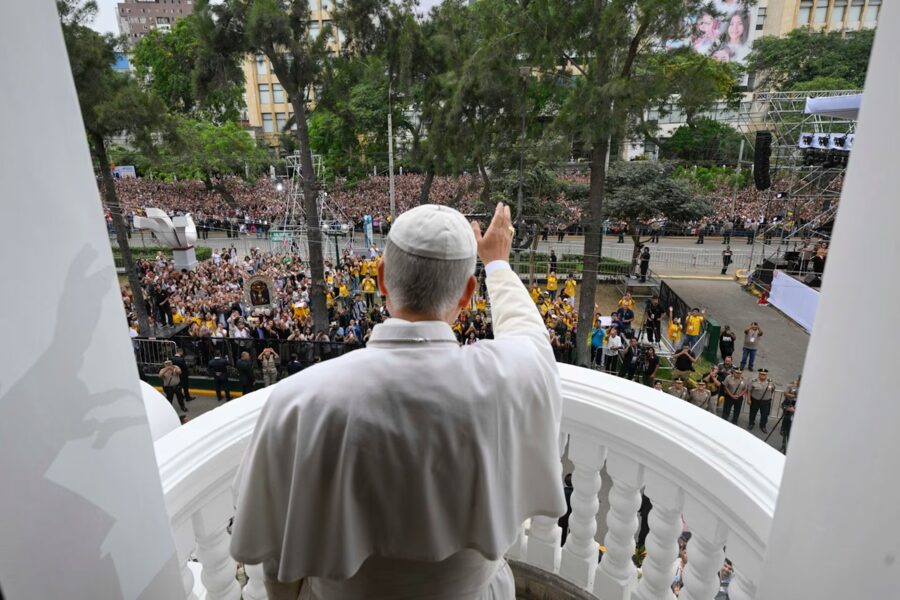
Pope Leo XIV will land at Rome-Fiumicino airport at 10:25 a.m. on Tuesday, November 17. This will mark the end of the longest apostolic journey of his pontificate, which has taken him for twelve days through Uruguay, Argentina, and Peru. As journalist Luke Coppen reports in The Pillar, the Pontiff will have little of his usual Tuesday rest day left, and no period of rest is planned upon his return.
On Wednesday the 18th, the general audience is scheduled in St. Peter’s Square, which he will likely dedicate to his trip to Latin America. In the afternoon, he will preside over the Mass for the fourth centenary of the dedication of the Vatican basilica. According to information gathered by the U.S. outlet, that same day he would also meet with the families of the so-called “Disappeared”: the 17 people abducted, murdered, and secretly buried during the conflict in Northern Ireland.
Until Christmas, the Pope’s public schedule is relatively light. No small feat for a 71-year-old Pope who, according to The Pillar, underwent surgery in October for localized cancer and then embarked on a journey of more than 30,000 kilometers. Starting November 27, he will visit five Roman parishes during Advent. The final visit, on December 20, will coincide with the beginning of the Vatican’s Christmas program, which opens with the traditional exchange of greetings with the Curia.
Amoris laetitia, study groups, and Germany
The first pending matter is the synthesis report of the meeting held at the Vatican from October 7 to 14 for the tenth anniversary of Amoris laetitia. It is Francis’s exhortation on the family, whose chapter VIII sparked intense debate over access to the sacraments for the divorced and civilly remarried. Leo XIV was unable to attend the closing because on October 13 his lower right lung lobe was removed. The organizers then announced that the text would not be published as planned, but would instead be delivered to the Pope. More than a month later, no decision has been made. The Pope may publish it as is, accompany it with his own observations, or treat it as a mere recommendation.
He also awaits the reports of the study groups created by Francis within the framework of the Synod on Synodality. Nine of the fifteen planned reports have been made public, with proposals ranging from changes in the functioning of seminaries to a complete revision of the Code of Canon Law. Leo XIV has asked Vatican officials to extract “operational proposals” from them for his evaluation, and it will be he who decides which ones to adopt and which to discard.
More delicate is the approval of the statutes of the German synodal conference. It is a “consultative and decision-making” body that, in practice, would make permanent the Synodal Way of 2019–2023, with bishops and selected laypeople making major decisions about the Church in Germany. The Holy See already warned in 2022 that the Synodal Way had no authority to compel bishops to adopt new forms of governance. The first session of the new body, scheduled for November 6 and 7, was postponed when it became clear that Rome would not speed up its response. Its promoters are growing impatient, and the Pope may approve the statutes, demand changes, or resort to what Coppen calls “strategic inaction.”
Cardinals, Curia changes, and major sees
Vatican observers place the first consistory of the pontificate on February 22, the feast of the Chair of St. Peter. They anticipate a list of about 16 new cardinals headed by Archbishop Filippo Iannone, successor to Robert Francis Prevost at the head of the Dicastery for Bishops. The list will be read as an indication of the Pope’s preferences. Observers will note whether he rescues previously overlooked figures, restores traditionally cardinalatial sees, and grants the red hat to prelates over 80, who have no right to vote in a conclave.
Several Curia replacements are pending due to age: Cardinals Kevin Farrell (79, Laity, Family and Life), Marcello Semeraro (78, Causes of Saints), Arthur Roche (76, Divine Worship), and Kurt Koch (76, Christian Unity). The succession of Roche, whose dicastery published the Responsa ad dubia in 2021 that tightened the application of Traditionis custodes, will be followed with particular attention among the faithful linked to the traditional liturgy. Appointments are also awaited for sees such as Chicago, Los Angeles, Mexico City, Guadalajara, Lima, São Paulo, Rio de Janeiro, Manila, Jakarta, Colombo, Yangon, Budapest, Milan, and Paris, whose incumbents are over or nearing 75 years of age.
Trips, Antwerp, and the 2033 horizon
Only two more trips have been confirmed: World Youth Day in Seoul, from August 3 to 8, 2027, and the International Eucharistic Congress in Sydney, from September 24 to October 1, 2028. Among the possible destinations are Brazil, Mexico, the Philippines, India, Nigeria, Poland, Ukraine, Germany, the United Kingdom, and the United States.
The case of Antwerp has a date: in 2028, Bishop Johan Bonny plans to ordain married men to the priesthood. Priestly celibacy is a disciplinary norm of the Latin Church (canon 277), not a dogmatic definition, but only the Holy See can dispense from it. According to The Pillar, Bonny is already training candidates and appears determined to proceed unless Rome prevents it.
In the longer term are the ecclesial assembly of 2028, convened by Francis shortly before his death, and the Jubilee of 2033 for the bimillennium of the Redemption. Coppen compares that year to what the Great Jubilee of 2000 was for the pontificate of St. John Paul II.