


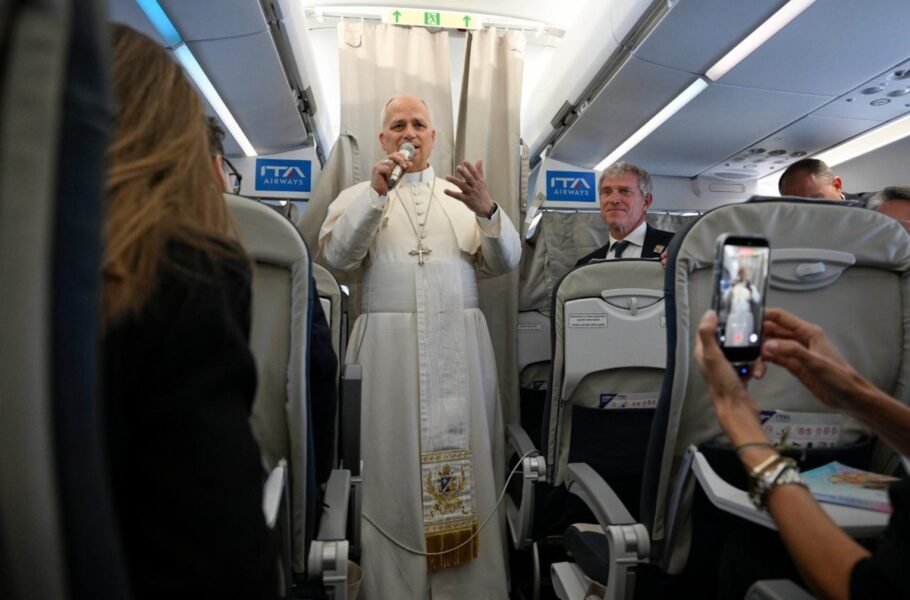
At the press conference on the return flight from Lima to Rome, Leo XIV responded to the question of whether he was considering relaxing Traditionis Custodes: “It was a decision of Pope Francis and we will continue to apply it.” The Pontiff recalled that those who wish to celebrate according to the Vetus Ordo may request a dispensation. With this, he confirms, for now, the restrictive framework in force since 2021.
The question came in the final part of the press conference aboard the plane that was returning Leo XIV from Lima to Rome. It marked the end of his sixth apostolic journey, which had taken him to Uruguay, Argentina, and Peru. Journalist Jean-Marie Guénois, of Le Figaro, asked him whether he was considering relaxing the motu proprio Traditionis Custodes. The Pontiff’s reply was brief: “Traditionis Custodes was a decision of Pope Francis and we will continue to apply it.”
Leo XIV then clarified that the document “provides for the possibility of granting dispensations or allowing the celebration of Mass according to the Vetus Ordo.” He defended maintaining the current framework by appealing to unity: “Therefore, once again, for the unity of the Church, the vast majority of Catholics throughout the world celebrate according to the rite of Vatican II, that of Paul VI, and we will continue to do so.” He concluded: “There is a path for those who wish to request a dispensation.”
The Pope’s words do not introduce any new norms. They do, at least for the moment, dispel the uncertainty over whether his pontificate would revise the liturgical discipline left by his predecessor. For priests and faithful attached to the traditional liturgy, the response means they will continue to depend on episcopal authorizations and, in certain cases, on Rome to celebrate with the 1962 Missal.
Francis promulgated Traditionis Custodes on July 16, 2021. The text repealed the regime of Summorum Pontificum, the motu proprio with which Benedict XVI had recognized in 2007 the faculty of every Latin-rite priest to celebrate with the pre-reform missal. Francis’s norm declared that the liturgical books promulgated by Paul VI and John Paul II are the “only expression of the lex orandi of the Roman Rite.” It also assigned to the diocesan bishop the competence to authorize the use of the 1962 Missal. In February 2023, a rescript reserved to the Apostolic See the dispensations to celebrate in parish churches and to grant permission to priests ordained after the publication of the motu proprio.
The vocabulary used by Leo XIV, with terms such as “dispensation” and “path for those who wish to request it,” aligns with that normative framework. In it, the traditional celebration is understood as a concession subject to permission and not as an ordinary option. The argument of unity, on which the Pope based his response, is the same one Francis set forth in the letter to the bishops that accompanied the publication of the document.
Unity was also the thread running through other responses from the Pontiff during the flight. Asked about the possible ordination of married men, he stated that “an important part of my ministry in the Church consists in healing and uniting people.” The Pope did not refer to the conditions under which permissions are currently granted nor to the communities that celebrate with the ancient rite.
Spiritual abuse: “a rather imprecise concept”
In the same question, Guénois wanted to know whether the Holy See is preparing a document on spiritual abuse that would provide for canonical sanctions. Leo XIV replied that it is “a very serious issue in the Church” and that the Vatican is studying it. He clarified, however, that “there is still no document prepared for publication.”
The Pope explained that the difficulty is juridical. To administer justice, “a codification or legal formulation that allows determining how to apply it” is needed, and for now the concept “remains rather imprecise,” although concrete cases can be described. Regarding the creation of new cardinals, he declined to comment and merely noted that the current number is around 116: “The time will come.”