


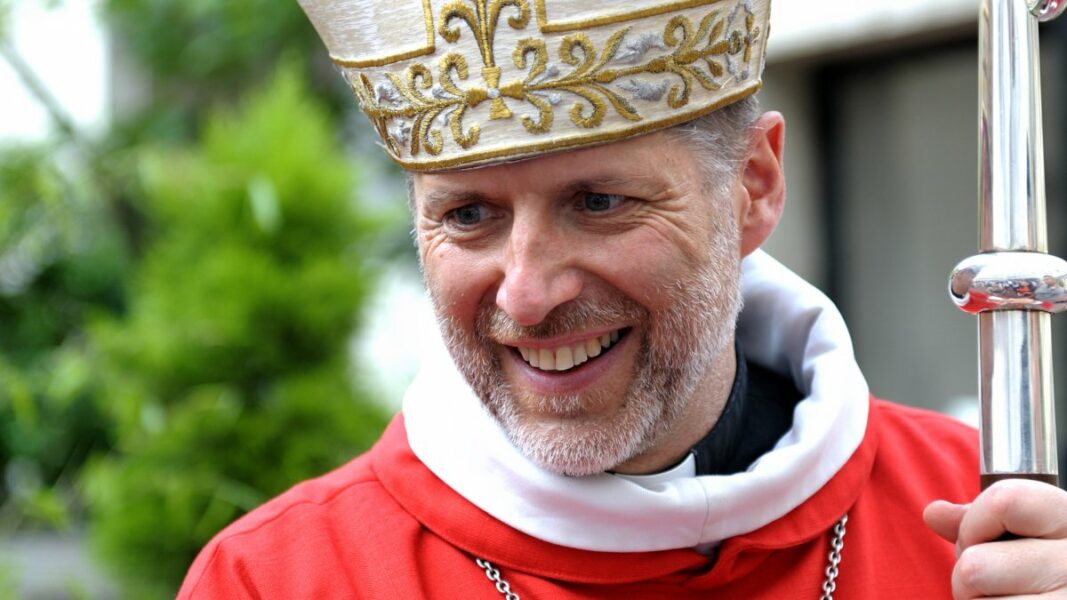
The decision is contained in a letter dated October 25, 2026, addressed to the faithful who attend the chapel, located in the municipality of La Gaubretière. The regional newspaper Le Courrier de l’Ouest had access to the text, and the portal Advaticanum has reported its content. The text leaves no room for continuity: “I cannot accept that this situation continue. I ask him to cease the religious services and related activities there,” the prelate writes in reference to Father Cuchet. The prohibition also extends to activities linked to the chapel, including the catechesis of children, which the diocese had been examining.
A French priest incardinated in Cuenca
The story of Ramberge begins in the early 1980s. Abbé Jehan de Durat, owner of the castle on whose grounds the chapel stands, wished to be ordained according to the 1962 rite and was unable to do so in France. In 1982 he was incardinated in the Spanish diocese of Cuenca by its then bishop, Msgr. José Guerra Campos. From 1983 onward he celebrated the Mass according to the traditional missal in Ramberge, and over the years the chapel became a point of reference for Catholics attached to the ancient rite in the Choletais region, the area around Nantes, and the Bressuirais.
According to the bishop’s own account, that initiative never sought nor obtained canonical recognition from the diocese. The celebrations nevertheless continued for more than forty years. Father de Durat died on December 8, 2025, at the age of 70, and his funeral Mass was celebrated on the 13th in the parish church of La Gaubretière.
After his death, the celebrations were taken over by Father Jean Cuchet, a priest of the Institute of the Good Shepherd (IBP), a society of apostolic life erected in 2006 under Benedict XVI whose members celebrate according to the traditional Roman liturgy. Cuchet had come to Ramberge sent by his superiors to assist Father de Durat.
“With the death of Father de Durat, the situation has changed”
For Msgr. de Dinechin, that continuity took place “without the bishop’s consent.” “With the death of Father de Durat, the situation has changed,” he argues, and expressly rules out regularizing the community: “I will not grant canonical recognition to the assembly gathered in Ramberge.”
The bishop bases his refusal on the provisions adopted under the pontificate of Francis following the motu proprio Traditionis custodes (2021), which entrusted the regulation of the traditional Mass to diocesan bishops. Article 3 of that document asks them to designate places of celebration “without erecting new personal parishes.” “Pope Francis explicitly asked the bishops to stop the creation of new personal parishes,” the prelate recalls. It is a disciplinary norm, not a doctrinal definition, whose concrete application falls to each ordinary.
As an alternative, Msgr. de Dinechin directs the faithful to four places where the ancient rite is celebrated in communion with the bishop and the Pope: Bellefontaine Abbey (Maine-et-Loire), near Cholet; the chapel of the religious Victims of the Sacred Heart of Jesus in Chavagnes-en-Paillers; the chapel of the Collège de l’Espérance in Sainte-Cécile; and the church of Notre-Dame de La Roche-sur-Yon. “For many people […], this step will not be easy. I offer them my prayers,” he writes, before asking them to renew their bond “in obedience to the Church,” because “obedience to the Church bears fruit.”
A bishop who ordained FSSP priests
Leo XIV appointed Msgr. de Dinechin bishop of Luçon on September 16, 2025, after a decade at the head of the diocese of Soissons, Laon and Saint-Quentin. There, on June 27, 2020, he ordained three seminarians of the Priestly Fraternity of Saint Peter to the priesthood in Laon Cathedral, an antecedent that qualifies the reading of his decision in the Vendée.
The case of Ramberge adds to other episodes in France since 2021. In Dijon, Msgr. Roland Minnerath ended the 23-year presence of the FSSP at the Basilica of Saint Bernard in Fontaine-lès-Dijon. In Quimper and Léon, Msgr. Laurent Dognin rescinded the agreement with the same Fraternity between late 2023 and early 2024. In Valence, Msgr. François Durand announced in May 2025 that the diocesan clergy would assume the traditional Mass. In Paris, Msgr. Michel Aupetit reduced the number of authorized churches to five in 2021.