


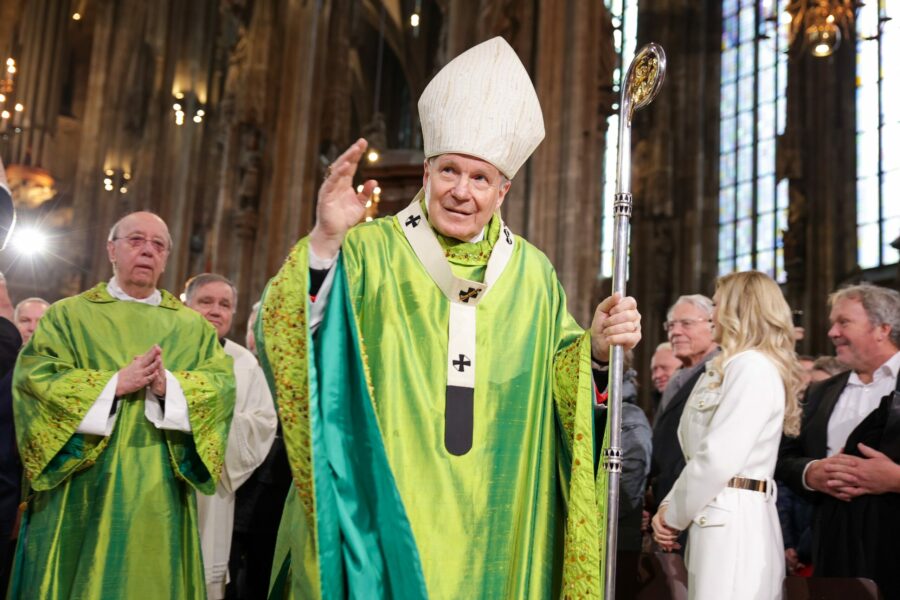
Cardinal Christoph Schönborn, Archbishop Emeritus of Vienna, has defended the validity of the Catechism of the Catholic Church as a fundamental instrument for transmitting the faith, even in a Church that is increasingly diverse and spread throughout the world. The prelate, who participated directly in its elaboration under the direction of then-Cardinal Joseph Ratzinger, recalled that the Church needs to express in a common way the truths it professes.
During an international symposium held in Vienna on the theology of Joseph Ratzinger, Schönborn pointed out that Christians believe in the same God the Creator and in Jesus Christ, who came for all people. “How can we not believe that it is possible to express together, for all of us, the faith in our time?” he asked, according to Kathpress.
The Catechism, a reference for knowing the faith
Schönborn was appointed by Ratzinger as secretary of the editorial committee of the Catechism of the Catholic Church, published in 1992 during the pontificate of Saint John Paul II. The cardinal recalled that responsibility as “undoubtedly, the most exciting task of my life.”
The Archbishop Emeritus defended that the elaboration of a common catechism responds to a permanent need of the Church. “If Luther could make a catechism that expressed the faith, if the Council of Trent made a catechism, why would it not be possible in our time?” he asked.
He also encouraged Catholics to use this text, beyond keeping it as a work of reference. Although he acknowledged that it is unlikely anyone memorizes the entire Catechism, he recalled that “it is not forbidden to use the Catechism, and not only as an object that gathers dust.”
“We can also know something about our faith,” he added.
The cardinal explained that the purpose of the Catechism is to present Catholic doctrine in a synthetic and orderly manner. Theology studies and reflects on the sources of Revelation, but its foundation remains the faith professed by the Church.
Resistance to the Catechism and its international dissemination
Schönborn recalled that the elaboration of the Catechism encountered resistance, particularly in certain academic circles in the German-speaking world, where the convenience of presenting a universal exposition of Catholic doctrine was questioned.
In the face of those reservations, he highlighted the wide international reception of the work, even outside Christianity. As an example, he mentioned that a Shiite theological institution in Qom, Iran, produced a translation into Persian.
His statements were made during the symposium “The Theology of Joseph Ratzinger in Controversy,” held in Vienna from October 22 to 24. The meeting served as preparation for the commemorations of the centenary of the birth of Benedict XVI, which will take place on April 16, 2027.
Schönborn’s words come after the cardinal himself recently warned of the limits of the structural reforms promoted by the German Synodal Way, recalling that the renewal of the Church cannot be reduced to organizational changes.