


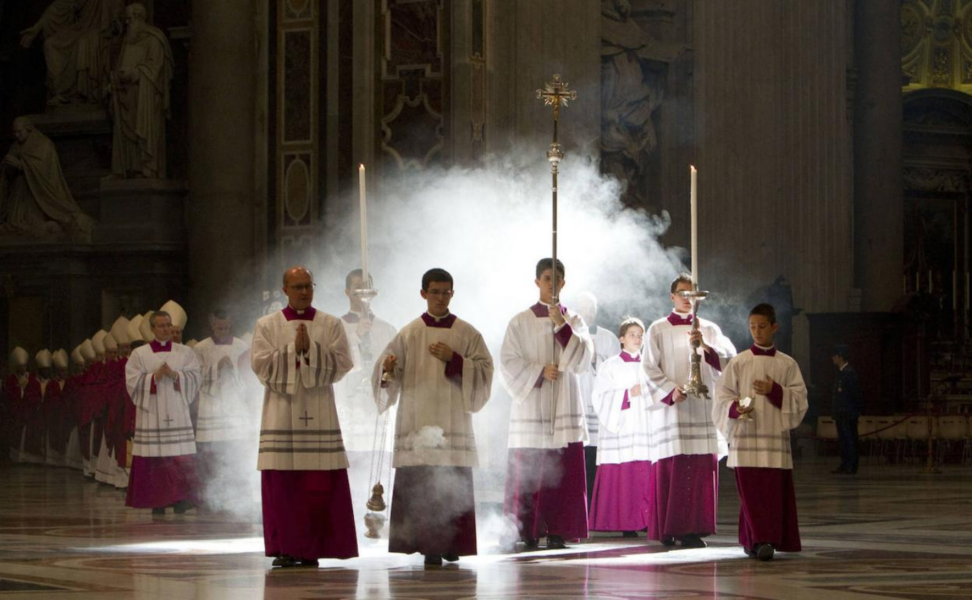
The beauty of the liturgy, the depth of Catholic doctrine, and greater participation in sacramental life are sparking growing interest among students at Stanford University in California (United States). The Dominican friars responsible for university ministry have observed in recent years a movement among young people toward more traditional forms of worship and the philosophical and theological heritage of the Church, a phenomenon that coincides with a notable increase in conversions to Catholicism.
During Easter 2026, a total of 46 students and young adults received the sacraments of Christian initiation or were admitted to full communion with the Church, compared to 14 the previous year. According to data from the Diocese of San José, 16 adults received baptism, ten were incorporated into full Catholic communion, and another twenty, already baptized, received Confirmation. Over the past three decades, the university community had recorded an average of only four adult baptisms per year.
The appeal of a more traditional liturgy
Father Bart Hutcherson, the Dominican who has led Stanford’s Catholic community for two years, attributes part of this growth to the renewed interest among students in the Church’s liturgical tradition. In statements to EWTN News, the priest explained that he has perceived a shift in the religious preferences of young people compared to previous generations.
“Students are really drawn to a more traditional form of worship,” Hutcherson noted, highlighting that the beauty of the university chapel lends itself to especially well-prepared celebrations.
“I believe our liturgy should be as majestic and beautiful as the place in which we worship. I find that young people are responding to beauty,” he stated.
The Dominican recalled that beauty holds a central place in the Catholic philosophical and theological tradition. In his view, this aspect of the Church’s life is finding a significant response among university students, which is also reflected in increased attendance at Sunday celebrations.
Stanford’s Catholic community, served by the Order of Preachers for more than 35 years, has strengthened its pastoral activity in recent academic years, with special attention to the celebration of Mass, Eucharistic adoration, and the availability of the sacrament of Penance.
Catholic doctrine sparks interest in the academic sphere
Alongside the liturgy, Hutcherson identifies another element that attracts students: the solidity of the Church’s intellectual tradition, developed over two millennia of philosophical and theological reflection.
In a university characterized by scientific research and academic rigor, the priest has observed that many young people are interested in the teachings of Catholicism precisely because they find in them questions that require study and deeper exploration.
“I think that for the intellectual minds of a place like Stanford, who are not looking for quick or easy answers, the intellectual tradition of the Church really offers them something to delve into,” he explained.
This interest is also evident in the testimonies of some of the new Catholics collected by the Diocese of San José’s magazine. Jacob Rivera, who arrived at Stanford in 2022, began studying philosophy, theology, and the writings of the Church Fathers while seeking answers to various moral and religious questions.
Elizabeth Jerstad, who comes from Lutheranism, recounted that she began to approach Catholicism after attending Mass and meeting other members of the university community. The study of doctrine and the experience of the liturgy were decisive in her decision to enter the Church.
“The beauty and reverence of the Catholic faith captivated me, and I no longer wanted to dismiss it,” she explained.
More confessions, Eucharistic adoration, and community life
The renewal of university ministry has also led to a greater offering of religious activities and opportunities to receive the sacraments.
Lisa Archuleta, a doctoral student and co-president of the Stanford Association of Catholic Graduate Students, highlighted the importance for university students of the expanded schedules for Eucharistic adoration and confession promoted by Fathers Hutcherson and Chrysostom Mijinke.
She explained that having set times during the week to come before the Blessed Sacrament has been fundamental to her own spiritual life. Archuleta has also observed over the past two years an increase in graduate student participation in the activities of the Catholic community.
The growth recorded at Stanford coincides with a trend observed on other U.S. campuses. A study by the Catholic app Hallow, with data from nearly 60 university communities, recorded an average increase of 115% in participation in adult Christian initiation programs.
Hutcherson, who has worked in university ministry for three decades, considers the interest young people show in Jesus Christ, the Church, and its teachings especially significant. Although he avoids speaking of a widespread religious revival, he acknowledges that he is witnessing a response he had not seen in a long time.
“There is a group of people willing to express their love for Jesus, for His Church, and for His teachings,” the Dominican affirmed.