


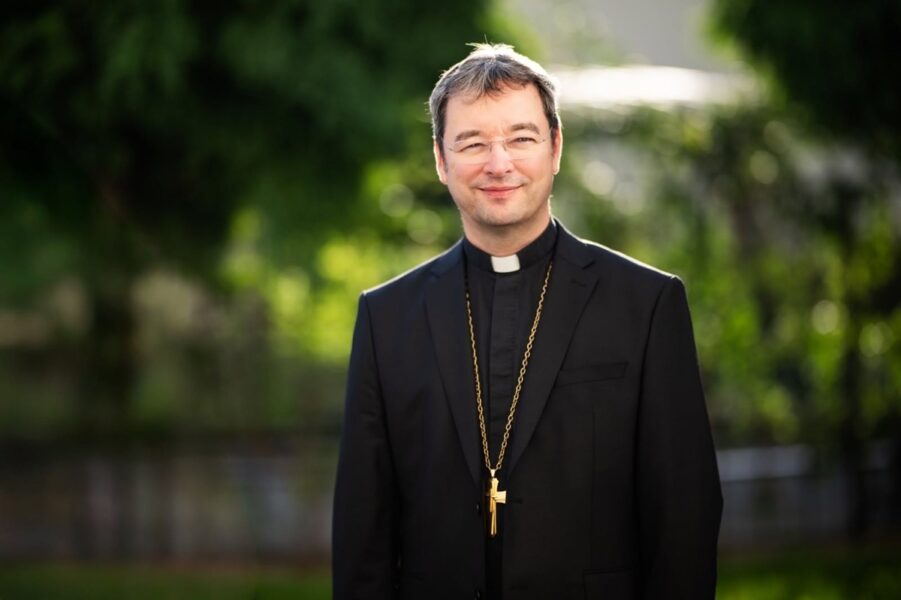
Pope Leo XIV has appointed Marek Forgáč, 52, until now auxiliary bishop of the same archdiocese, as archbishop of Košice, in eastern Slovakia. The Holy See Press Office published the appointment on Wednesday, October 14, together with the acceptance of the resignation of Archbishop Bernard Bober, who has governed the see for sixteen years. The new archbishop is known in his country for a 2024 interview in which he defended the declaration Fiducia supplicans, proposed reading it from the perspective of the universal Church, and maintained that in Slovakia “we are not well prepared” to bless couples in irregular situations.
Forgáč was born in Košice on January 21, 1974. He studied Philosophy and Theology at the seminary in Spišské Podhradie and, after military service, was ordained a priest on June 19, 1999. He holds a licentiate in Psychology from the Pontifical Gregorian University and a doctorate in Social Psychology from the University of Trnava. He served as parochial vicar in Trebišov, Snina, and Humenné, was responsible for youth ministry at the university pastoral center in Košice, and between 2007 and 2016 was professor, vice-dean, and director of studies at the Faculty of Theology in that city. Francis appointed him auxiliary bishop on June 11, 2016. In the Slovak Episcopal Conference he chairs the Commission for the Protection of Minors and the Commission for Parish Catechesis. According to the Slovak press, he will take possession in November.
The interview was published on July 23, 2024, by the magazine Nové mesto, linked to the Focolare Movement, under a title that summarizes his thesis: “Blessing couples in irregular unions? In Slovakia we are not well prepared for it.” Asked about the part of the declaration that had received the most criticism, the one referring to same-sex couples, Forgáč replied that “the Church is not only what we live here in Slovakia” and attributed much of the rejection in some Western countries to practices that the document itself prohibits. He proposed blessing the persons and not the union, without solemn form or the appearance of a sacrament, and explained it with an example: if someone asks for their house to be blessed, he said, “it is not a blessing of their union, but the blessing of the house or of the persons who are there.”
In the same conversation he recounted that, before traveling to Rome for the Synod, a young man who felt attraction to persons of the same sex wrote to him and explained that he had tried to speak with several priests without any of them receiving him. The bishop spoke with him and gave him a blessing. He framed it within a teaching of his former Psychology professor: sometimes, he said, one must “close the book and open one’s eyes, because we have a concrete person before us.” And he added: “That is also what the synod is about: the encounter with the person, not with the book.” He specified that all of this must always be done with the awareness that the Church has a clear vision of how the moral life of man should be.
Those words already provoked at the time a response from the Slovak portal Christianitas, which disseminated a video from Fatima TV featuring cardinals and bishops opposed to the declaration. After the appointment, LifeSiteNews has presented Forgáč as a bishop who supported blessings for same-sex couples, and the portal Misia Fatima maintains that his approach approaches situational ethics and contrasts it with the teaching of John Paul II in Veritatis splendor. In his first words as archbishop-elect, reported by Noviny.sk, Forgáč thanked the Pope for his trust and stated that he does not want to live “in a closed bubble,” but in truth and in contact with the faithful.
Fiducia supplicans, published in December 2023 by the Dicastery for the Doctrine of the Faith with the signature of Cardinal Víctor Manuel Fernández, admitted non-liturgical blessings for couples in irregular situations, including same-sex couples. Entire episcopates, led by those of Africa, rejected it or restricted its application. At the beginning of September, Leo XIV appointed Ferenc Palánki as archbishop of Kalocsa-Kecskemét, a member of the Hungarian episcopate, which set limits on the declaration. Košice now receives as its pastor a bishop who, in the face of that same document, asked to look at the person rather than the book.
Read also