


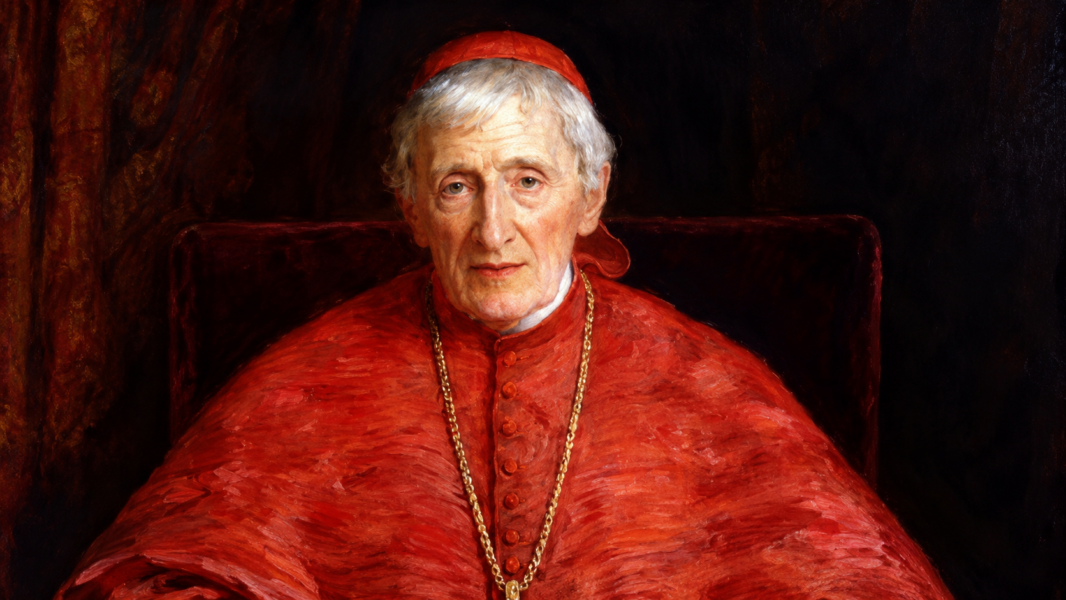
The Church celebrates this Friday, October 9, the memorial of saint John Henry Newman, inscribed for the first time in the General Roman Calendar after Leo XIV proclaimed him a Doctor of the Church on November 1, 2025. The decision, formalized by a decree of the Dicastery for Divine Worship and published in February 2026, allows his optional memorial to be celebrated throughout the Church and universally proposes as a teacher of the faith one of the most outstanding converts of the nineteenth century.
The incorporation of Newman into the universal calendar recognizes a trajectory in which the intellectual search for truth was inseparably united to personal conversion. Born in London in 1801 and educated at Oxford, Newman rose to prominence within Anglicanism before entering the Catholic Church in 1845. That decision profoundly altered his life, his relationships, and his position in English society, yet it was the result of a conviction matured through years of study, prayer, and examination of the history of Christianity.
The search for the true Church
Newman had been one of the principal figures of the Oxford Movement, which sought to recover the historical and sacramental continuity of the Church of England with ancient Christianity. His study of the Church Fathers, however, ultimately led him beyond the conclusions he had initially expected to find. The more deeply he delved into the doctrinal controversies of the early centuries, the more difficult it became for him to maintain that the Anglican Church preserved intact the continuity with the apostolic Church.
His conversion was not a sudden change of religious sensibility. Newman had to face the loss of friendships, the abandonment of a respected position, and the incomprehension of those who had shared years of intellectual work with him. The decision to enter the Catholic Church, received on October 9, 1845, by the Passionist Dominic Barberi, was for him the culmination of a search in which he had learned that truth demands obedience even when it leads along painful paths.
In his Apologia pro Vita Sua, written years later to explain publicly his religious journey, Newman described his arrival at Catholicism as a vessel entering port after a stormy crossing. The image helps us understand the meaning of his conversion: he had not simply found a religious community that better suited his preferences, but the Church in which he recognized the fullness of the faith received from the Apostles.
A teacher of the faith for the whole Church
After his conversion, Newman was ordained a Catholic priest and brought the Oratory of Saint Philip Neri to England. His work encompassed theology, preaching, education, and the defense of the faith in a society deeply marked by anti-Catholic prejudice. Among his writings, the Essay on the Development of Christian Doctrine, the Apologia pro Vita Sua, the Grammar of Assent, and his reflections on the university stand out.
In 1879, Leo XIII created him a cardinal, thereby recognizing a life dedicated to the service of the Church. Newman died in Birmingham on August 11, 1890. Benedict XVI beatified him in 2010 and Francis canonized him in 2019, before Leo XIV solemnly recognized his status as a Doctor of the Church.
The decree that provides for his inscription in the General Roman Calendar presents Newman as a man led by grace until he found peace in the Catholic Church. It recalls his dedication to intellectual research, preaching, teaching, and service to those in need, and proposes his constant search for truth as an example for the disciples of Christ.
The light of Christ and obedience to the truth
Newman’s spirituality cannot be separated from his conviction that God personally guides each soul. His well-known hymn Lead, Kindly Light, usually translated as “Lead, Kindly Light,” expresses the confidence of the Christian who does not know the entire path but allows himself to be led by Providence. That interior disposition also accompanied his thought on conscience, which he never understood as permission to invent one’s own truth, but as the obligation to recognize and obey the law of God.
The cardinal’s motto he chose, Cor ad cor loquitur, “heart speaks to heart,” summarizes another fundamental dimension of his life. Newman was an extraordinary intellectual, yet his faith was not confined to books. His thought arose from a personal relationship with Christ nourished by prayer, the sacraments, and the desire to fulfill the divine will.
The new liturgical memorial of October 9 offers Catholics throughout the world the opportunity to seek his intercession and to know better a teaching particularly necessary in an age that often presents truth as a matter of individual preferences. Newman’s life reminds us that faith demands intelligence, engages the conscience, and may require real sacrifices, but it leads man toward that for which he was created: to know, love, and serve God.