


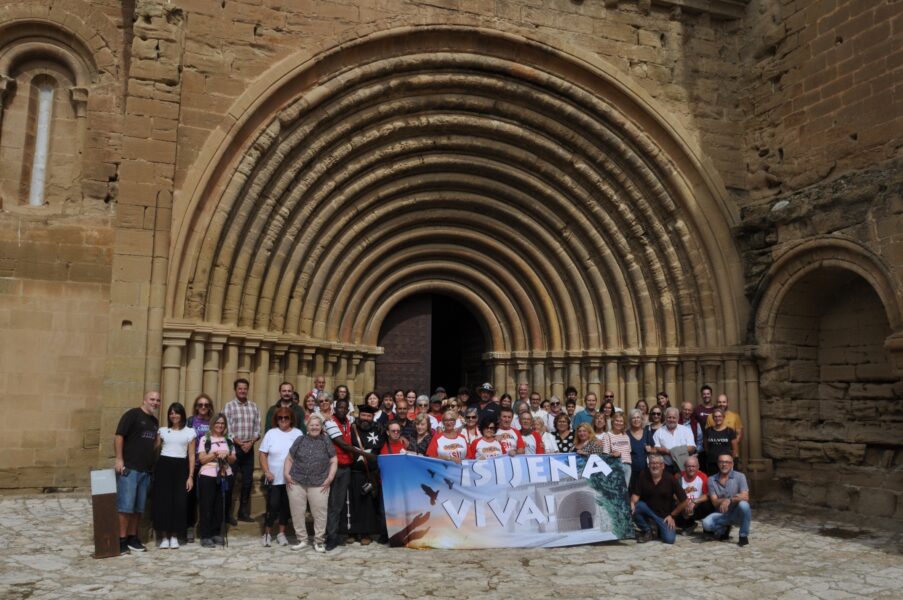
More than fifty pilgrims and a dozen riders took part this Saturday in the fifth edition of the «Sijena Viva» Pilgrimage, an initiative that seeks to recover the ancient Camino de Santiago of Sijena and, especially, to call for the return of a stable monastic community to the Royal Monastery of Santa María de Sijena, which has been without religious since July 2020.
According to various media reports, the pilgrimage was organized by the ‘Sijena Sí’ Platform together with the Order of Malta, the Sanjuanist Sisters, the town councils of Villanueva de Sijena, Sena and Sariñena, the Esperanzarte Association and the Miguel Servet Sijenense Studies Institute.
The promoting entities maintain that the recovery of monastic life is necessary not only for the conservation of Sijena’s historical and artistic heritage, but also to preserve the spiritual and religious dimension for which the monastery was founded.
The demand has accompanied the pilgrimage since its first edition. On that occasion, more than 3,000 signatures were collected and later sent to Pope Francis requesting the return of a religious community to the monastery.
Recovering the ancient Camino de Santiago of Sijena
The day began with two pilgrimages. A dozen riders completed a circular route of about 18 kilometres, while the pilgrims on foot covered nearly 17 kilometres from the hermitage of Santiago in Sariñena, following the ancient Camino de Santiago of Sijena.
Both groups converged in Sena, where additional participants joined them for the final stretch to Villanueva de Sijena.
The progressive recovery of this route constitutes the initiative’s second objective. The organizers aim to establish the pilgrimage as an annual tradition that allows the historically monastery-linked paths to be walked again and to conclude the pilgrimage with prayer in Sijena.
A Mass to request the return of monastic life
After the arrival of pilgrims and riders at the Royal Monastery, a Mass for the return of monastic life to Sijena was celebrated, presided over by the Piarist Carlos Palacios.
During the celebration, Palacios spoke about the importance of silence as a space for man’s encounter with himself and with God.
The priest also highlighted the testimony offered by monks and nuns in a society marked, he noted, by “noise, haste and materialism,” and recalled the life of those who find their vocation in silence, prayer, solitude and service to others.
The day continued with a fraternal meal and various cultural activities, including a classical guitar performance, a guided tour of the monastery’s exhibition area and other events organized for the participants.
«Sijena is not merely a monument»
The organizers want «Sijena Viva» to continue being held annually and to allow the gradual recovery of both the ancient pilgrimage route and the monastery’s religious connection.
The ‘Sijena Sí’ Platform sums up the demand with an idea that has accompanied successive editions of the initiative: «Sijena is not merely a monument to be preserved», but a place that must recover «its life, its spiritual dimension and its vocation of welcome».
The Royal Monastery of Santa María de Sijena, one of Aragon’s great historic monastic complexes, has been without a stable religious community since July 2020. The pilgrimage seeks to ensure that the heritage recovery of the complex is accompanied by the recovery of the religious purpose for which it was founded.