


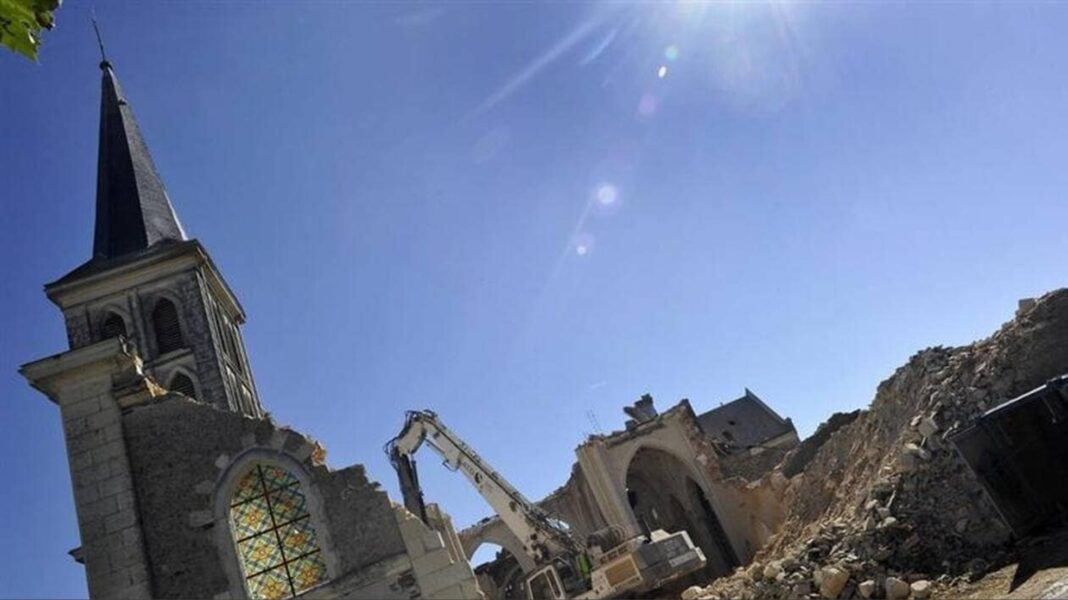
One week before León XIV lands in Paris, the Holy See Press Office has done something unusual: it has laid out the complete historical series of French Catholicism. The figures, presented on 18 September at Matteo Bruni’s press briefing on the trip, compare the country that welcomed John Paul II in 1980 with the one that now receives the Augustinian Pope. Forty-four years separate the two visits. What lies between them, in the Vatican’s cold accounting, is the disappearance of two out of every three priests and of nearly three out of every four parishes.
The Holy See’s figures
The statistical table published by the Church’s Central Office of Statistics, compiled from the Statistical Yearbook of various years, traces the full series from 1980 to 2024:
| Indicator | 1980 | 1990 | 2000 | 2010 | 2020 | 2024 | Change 1980-2024 |
|---|---|---|---|---|---|---|---|
| Population | 53,710,000 | 56,440,000 | 58,890,000 | 62,954,000 | 65,124,000 | 66,352,000 | +23.5 % |
| Baptised Catholics | 45,503,000 | 47,505,000 | 46,823,000 | 47,132,000 | 48,800,000 | 49,720,000 | +9.3 % |
| Catholics per 100 inhabitants | 84.7 | 84.2 | 79.5 | 74.9 | 74.9 | 74.9 | −9.8 points |
| Parishes | 38,391 | 34,885 | 22,156 | 15,765 | 13,577 | 10,925 | −71.5 % |
| Bishops | 197 | 206 | 170 | 188 | 181 | 186 | −5.6 % |
| Diocesan priests | 31,481 | 25,203 | 19,234 | 14,448 | 10,349 | 9,095 | −71.1 % |
| Religious priests | 7,395 | 7,064 | 6,119 | 4,901 | 3,914 | 3,495 | −52.7 % |
| Total priests | 38,876 | 32,267 | 25,353 | 19,349 | 14,263 | 12,590 | −67.6 % |
| Permanent deacons | 108 | 634 | 1,622 | 2,421 | 2,910 | 3,147 | ×29 |
| Non-ordained religious | 5,333 | 4,675 | 3,456 | 2,884 | 2,309 | 2,126 | −60.1 % |
| Religious sisters | 87,044 | 65,178 | 48,499 | 34,846 | 21,478 | 17,452 | −80.0 % |
| Major seminarians | 1,278 | 1,521 | 1,537 | 1,340 | 1,295 | 1,075 | −15.9 % |
| Baptisms | 513,501 | 472,130 | 401,054 | 306,841 | 173,300 | 186,165 | −63.7 % |
| Religious marriages | 217,479 | 147,146 | 122,580 | 75,635 | 36,916 | 40,678 | −81.3 % |
| Confirmations | n. d. | 91,281 | 62,003 | 45,911 | 36,329 | 46,539 | −49.0 % (since 1990) |
| First Communions | n. d. | 230,629 | 201,542 | 130,651 | 80,094 | 73,143 | −68.3 % (since 1990) |
| Students in Catholic schools | 1,959,480 | 2,044,874 | 2,001,810 | 2,039,144 | 2,236,079 | 2,234,563 | +14.0 % |
| Charitable institutions | 1,944 | 1,626 | 1,378 | 1,184 | 789 | 1,119 | −42.4 % |
| Net diocesan clergy emigrated/immigrated | +267 | +224 | −99 | −967 | −1,532 | −1,550 | — |
Source: Holy See Press Office, bulletin B0728, 18 September 2026.
The table allows few benevolent interpretations. In 1980 there was one priest for every 1,382 inhabitants; in 2024, one for every 5,270. The religious sisters, the backbone of Catholic welfare and education for two centuries, have fallen from 87,000 to 17,000: four out of five have disappeared without replacement. Religious marriages, which approached 220,000 in 1980, today number fewer than 41,000—the steepest drop in the entire series. And the final row depicts a historic reversal: the France that in 1980 sent missionaries to the world now receives 1,550 more priests each year than it sends.
The few figures that are rising deserve cautious reading. Permanent deacons have multiplied twenty-nine-fold, yet the diaconate is largely fed by retirees and merely supplements, without replacing, the missing clergy. Catholic-school enrolment has gained 275,000 pupils, though that demand stems largely from the search for discipline and academic standards rather than catechesis. The rebound in baptisms, confirmations and marriages between 2020 and 2024 is partly explained by recovery after the pandemic closures that made 2020 the lowest point in the series, although confirmations have risen 28 % and already exceed the 2010 level—the only sacramental indicator to achieve this. First Communions, by contrast, continue to fall even after the pandemic.
The figure of 74.9 % baptised—some 49.7 million people out of 66 million inhabitants—comes from sacramental registers and measures nominal belonging. It is, by far, the most generous figure in circulation, and should not be confused with actual practice.
What the surveys measure
The most comprehensive poll of recent years is the one Ifop conducted in 2025 for La Croix and the Bayard group. Its conclusions sketch an inverted pyramid: 5.5 % of French adults—about three million people—attend Mass every Sunday or at least twice a month; another 6.5 % describe themselves as Catholic but only enter a church at Christmas, Easter or “almost never.” And according to the same survey, barely 46 % of the French now define themselves as Catholic—twenty-nine points below the figure for baptised persons used by Rome.
France’s National Institute of Statistics (INSEE), in its major survey Trajectoires et Origines 2019-2020, corroborates the diagnosis: only 8 % of those who declare themselves Catholic regularly attend a place of worship, compared with more than 20 % among Muslims, Buddhists and other Christians, and 34 % among Jews. Catholicism is, by a notable margin, the denomination least practised by its own adherents.
Other figures complete the clinical picture. France had 65,000 priests in 1960; today only some 6,700 remain active, of whom nearly a third are foreign. In 2025, 90 presbyters were ordained for the country’s 99 dioceses—a figure close to the historic low of 88 recorded in 2023. And the gravest indicator of all, the one that foreshadows France thirty years from now: barely 13 % of children born in the country receive baptism in their early years, compared with nearly six out of ten at the end of the twentieth century. The family transmission of the faith, which sustained French Catholicism for fifteen centuries, has been broken in a single generation.
When the thread broke
The Vatican series begins in 1980, but the collapse predates it. Historian Guillaume Cuchet, in his reference work Comment notre monde a cessé d’être chrétien (Seuil, 2018), locates the rupture with almost surgical precision in 1965, the year the Second Vatican Council closed. Until then Sunday practice, though eroded since the nineteenth century, had declined with the gentleness of a slope; from that date it plummets vertically and in barely a decade loses more than half its numbers. Cuchet, a practising Catholic and rigorous scholar, does not attribute the fall to the Council itself, but to the message the faithful received from it: that attending Mass had ceased to be a grave obligation, that hell was suspended, that the boundaries between the Church and the world had become porous. Millions of “duty” Catholics understood that the duty had been abolished and acted accordingly.
Political scientist Jérôme Fourquet, in L’Archipel français (Seuil, 2019), documents the same phenomenon from another angle: given names. Until the 1960s the vast majority of French children received names from the calendar of saints; today the proportion is marginal. The Catholic matrix that once shaped the entire society has dissolved, leaving in its place an archipelago of identities without a centre.
Comparison: the paradox of the two Frances
On the very days Rome released its balance sheet, other figures pointed in the opposite direction, and the coexistence of both is what is truly revealing.
At the 2026 Easter Vigil, 13,234 adults were baptised, 28 % more than the previous year and more than triple the 4,124 of 2016. Forty-two per cent of these catechumens are between 18 and 25 years old. Adding adolescents, the total number of new baptisms at Easter exceeded 20,000.
The Chartres pilgrimage, celebrated entirely according to the traditional missal, gathered nearly 20,000 pilgrims in May; registrations reached 14,000 in a single day, compared with 6,000 the previous year, and the organisers had to close enrolment. Its president, Philippe Darantière, noted that many of these young people have entered the Church precisely through the Tridentine Mass.
The Community of Saint Martin, with its clergy in cassocks, its careful liturgy and its demanding formation, ordained twelve priests and ten deacons in June. A single community therefore supplies more than one-tenth of all priestly ordinations in France. The abbeys that survive—Solesmes, Boulaur, Le Barroux, Fontgombault—share a common trait: Latin, Gregorian chant, integral observance. Those that close—La Grande Trappe, Chantelle, the Carmel of Compiègne, the Visitation of Nevers, all announced in recent weeks—belong to the generation that bet on adaptation.
The contrast with neighbouring Germany illuminates the same phenomenon. France counts 49.7 million baptised compared with Germany’s 19.8 million, more than double; yet the German Church, with its church-tax system and its “synodal path,” suffers a haemorrhage of formal departures that France, without a civil register of membership, cannot even measure. Two different models of accommodation to the modern world have led to the same emptying.
What has failed?
The data allow a hypothesis that academic sociology usually wraps in circumlocutions: what has collapsed in France is not “the Church” in the abstract, but a concrete pastoral model dominant since the mid-1960s, and what is growing are precisely the realities that have placed themselves outside that model.
The old maxim attributed to Prosper of Aquitaine, lex orandi, lex credendi, here functions less as a theological principle than as an empirical law. A horizontalised liturgy, reduced to an assembly celebrating itself, stripped of silence, sacrality and demand, has produced exactly the kind of believer one might expect: the occasional Catholic of the 6.5 %, who feels linked to a family tradition but finds in the parish nothing that could not be found in a cultural association. Conversely, the communities that have preserved or recovered a vertical liturgy, with sacrifice at the centre, attract young people who inherited nothing and who seek precisely what the pastoral of adaptation deemed dispensable.
The second pillar of the failed model is a moral theology that renounced proposing. The French conciliar generation, nourished by personalism and an optimistic reading of modernity, dissolved sin into “situation,” commandment into “fundamental option,” and conversion into “accompaniment.” Cuchet puts it bluntly: when the Church stopped saying that missing Mass was a grave sin, the faithful stopped going. The moral need of man, his hunger for a norm that transcends and demands of him, went unanswered, and that void has been filled by Islam—whose regular practice is three times the Catholic rate, according to INSEE—by diffuse spiritualities and, in recent years, by the return of young people to the most demanding forms of Catholicism.
Joseph Ratzinger, in a celebrated radio address of 1969, foresaw a future Church that would be smaller, would lose privileges and buildings, but would be reborn from small, fervent communities. The France of 2026 seems to confirm the forecast down to the details: buildings are sold, parishes are merged, and vitality is concentrated in small, young and doctrinally firm nuclei.
What León XIV will see
The Pope will find in Paris a Stade de France with its 80,000 seats sold out and the Place de la Concorde awaiting hundreds of thousands of people. He will see a Church capable of mobilising crowds and, at the same time, incapable of filling its churches on any given Sunday. He will see 13,000 adult converts and a country where 87 % of newborns are no longer baptised. The France that receives him is, at once, proof of the failure of a model and the laboratory of what may come next. What lesson the Pontiff draws from that paradox will, to a large extent, determine the course of the European Church in the coming decade.
Sources
- Vatican News – Matteo Bruni’s press conference on the trip to France (18 September 2026)
- Holy See Press Office – Pastoral statistical table of the Church in France 1980-2024 (bulletin B0728, 18 September 2026)
- Religión en Libertad – Ifop/La Croix 2025 poll
- RCF – Profile of French Catholics (La Croix)
- INSEE – Trajectoires et Origines 2019-2020: religious practice by denomination
- Zenit – Adult baptisms at Easter 2026
- Aleteia – Paul Airiau: the figures that moderate enthusiasms
- Aleteia – Chartres Pilgrimage 2026
- Community of Saint Martin – Ordinations 2026
- FSSPX News – Clergy, ordinations and infant baptisms
- InfoCatólica – Baptised in France and Germany
- French Episcopal Conference – Official statistics
- Guillaume Cuchet, Comment notre monde a cessé d’être chrétien, Seuil, 2018.
- Jérôme Fourquet, L’Archipel français, Seuil, 2019.