


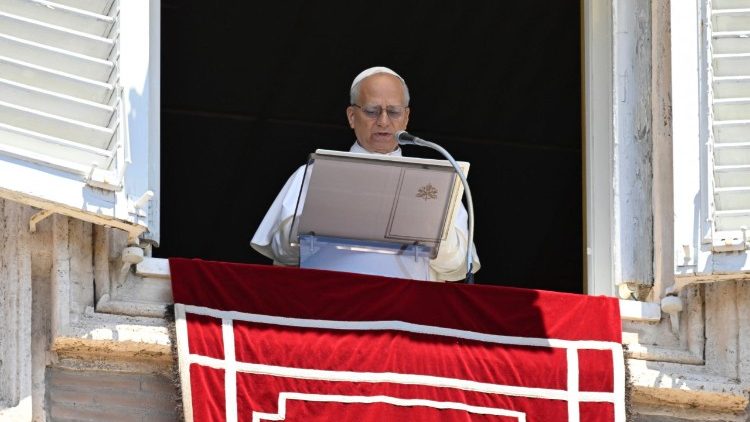
Pope Leo XIV dedicated this Sunday’s Angelus, September 6, to fraternal correction and Christian unity, recalling that love of neighbor requires speaking with sincerity when problems arise rather than resorting to complaint or slander.
From the window of the Apostolic Palace, before the faithful gathered in Saint Peter’s Square, the Pontiff noted that fraternal correction is “a delicate and often forgotten art” that demands “frankness and gradualness.” After the Marian prayer, Leo XIV again called for an end to violence in Ukraine and expressed hope that efforts to resume negotiations “will bear concrete fruit and open a space for diplomacy.”
Below we reproduce in full the words spoken by the Pope:
Dear brothers and sisters, happy Sunday!
The Word of God proclaimed in this Sunday’s liturgy offers us some fundamental criteria for thought and action. In the Letter to the Romans we read that all the commandments “are summed up in this: ‘You shall love your neighbor as yourself’” (Rom 13:9). Saint Paul insists on this point with a very strong image, also present in the “Our Father.” He writes: “Owe no one anything, except to love one another” (v. 8).
Jesus has taught us to invoke and practice the forgiveness of debts. Yet there is a debt we owe one another without being trapped by it: the debt of mutual love. All the attention, care, and good we have received make us freer and more responsible.
In this Sunday’s Gospel, Jesus suggests to every Christian community at least two ways of exercising mutual love. The first is to be capable of practicing fraternal correction. It is a delicate and often forgotten art that requires frankness and gradualness. Speaking with sincerity—first one-on-one; then, if necessary, with two or three others; finally, when required, with the whole community—means facing reality and turning problems and conflicts into steps of growth.
Complaint and slander are easier, but they produce nothing and paralyze many situations. The Gospel, however, educates us to freedom in charity.
Moreover, there is a second way of loving fraternally which, for Jesus, even transforms prayer: to be of one accord. Not only when there is conflict, but to ask God for any gift. The Lord says: “If two of you agree on earth about anything you ask, it will be done for you by my Father in heaven” (Mt 18:19). This promise suggests that we can share common desires, common sorrows, common hopes, and, through prayer, grow in unity.
Without faith, anyone could feel alone and suspect others, seeing them as strangers and enemies. Yet by grace we are brothers and sisters who can be of one accord: meeting, forgiving, and listening to one another in the Lord.
Let us ask Mary, who after the angel’s announcement hastened to her cousin Elizabeth to share the joy and weariness of pregnancy, to teach us also the joyful debt of fraternal love.
After the Angelus
Dear brothers and sisters:
With great sorrow I have followed the news of the violent attacks that recently struck several cities and civilian infrastructures in Ukraine, causing the death of innocent people.
My heart is united with the suffering of a people that has lived for years in anguish and fear.
I renew my appeal that violence cease, destruction stop, and hearts open to dialogue and peace. I hope that the efforts made in recent days to resume negotiations will bear concrete fruit and open a space for diplomacy.
Let us raise our prayer to the Lord that harmony may prevail in all the world’s conflicts.
I greet all of you, Romans and pilgrims from various countries. Thank you for being here!
In a special way I greet the community of the inter-diocesan seminary “Studienhaus Sankt Lambert” of Lantershofen (Germany).
I joyfully welcome the pilgrimage of the Parish of Saint Ulrich, Bishop of Muestre (Treviso); as well as the Diocesan Choir of the Diocese of Oppido Mamertina-Palmi, accompanied by their Bishop.
As we gradually resume our usual activities after the summer holidays, let us ask the Lord to accompany and sustain us with his light.
I wish you all a happy Sunday!