


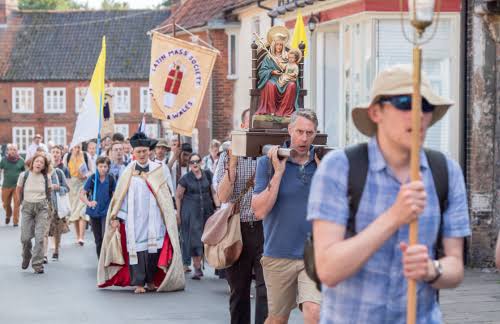
The pilgrimage of the Latin Mass Society (LMS) to Walsingham, in England, has reached a new record in attendance with 240 pilgrims, compared to the 200 registered in 2025. The organization links the strong growth of recent years to the renewed interest in the traditional Mass following the restrictions introduced by Traditionis custodes.
According to The Catholic Herald, the pilgrimage took place from August 27 to 30 and covered more than 80 kilometers to Walsingham, in the county of Norfolk, one of England’s main centers of Marian devotion. Each day featured a solemn Mass according to the traditional Roman rite, accompanied by prayers, chants, and hymns in honor of Our Lady of Walsingham.
Accelerated growth after Traditionis custodes
Joseph Shaw, president of the Latin Mass Society, stated that attendance “increased rapidly after Covid and Traditionis custodes,” the motu proprio promulgated by Francis in 2021 that restricted the celebration of the traditional Roman liturgy.
The growth has occurred precisely in the years following the implementation of those restrictions. Before this year’s pilgrimage began, Shaw acknowledged that it might seem paradoxical, but maintained that the measures had helped increase the visibility of the traditional liturgy.
“It is putting the focus on what we do and drawing people’s attention to the traditional Mass. It always encourages people to get to know it,” he explained.
The pilgrimage has grown steadily since its beginnings. The LMS itself presents it as an initiative inspired both by medieval pilgrimages and by the current traditional pilgrimage of Chartres and similar gatherings held in various countries.
Nearly 500 faithful at the Walsingham Mass
This year’s edition also featured a novelty. The reservation requested by the Latin Mass Society to celebrate Mass on Sunday at the Catholic shrine of Walsingham was denied, something that, according to The Catholic Herald, had not occurred since the walking pilgrimage began.
The Mass was ultimately celebrated on the grounds of the former abbey, where the medieval priory and the historic shrine of Walsingham once stood.
The 240 pilgrims who had completed the journey were joined by numerous faithful who came specifically for the day, bringing the congregation to around 500 people.
“More pilgrims joined us who had come for the day, and we had a congregation of about 500 people,” Shaw recounted. The turnout even exceeded the organization’s expectations: “We ran out of hosts for Communion, despite having filled two ciboria.”
Shaw thanked the Bishop of East Anglia, Peter Collins, for the permissions granted for the liturgical celebrations, as well as the managers of the abbey grounds, the volunteers, and the benefactors who made the pilgrimage possible.
A pilgrimage for the conversion of England
Over four days, the pilgrims covered a distance of more than 50 miles. The organization mobilized eight support vehicles, two vans for luggage, one vehicle for the sacristy, another for kitchen supplies, a portable altar on a trailer, and a mobile kitchen.
Weather conditions made the journey particularly difficult. Heavy rain fell during Friday afternoon, causing many pilgrims to suffer foot problems and requiring more frequent intervention by first-aid teams.
Shaw noted that, in addition to being the largest edition, it had also been one of the most demanding, and highlighted that these difficulties offered participants “much penance” to offer for the pilgrimage’s main intention: the conversion of England.
Walsingham, the “Nazareth of England”
Devotion to Our Lady of Walsingham traditionally dates back to the year 1061, when the Virgin is said to have appeared to the English noblewoman Richeldis de Faverches and asked her to build a replica of the house of Nazareth.
Walsingham later became one of the great pilgrimage centers of medieval Europe and came to be known as the “Nazareth of England”. The medieval shrine was destroyed during the English Reformation, although the Catholic pilgrimage to the site was revived centuries later.
The Latin Mass Society has been coming to Walsingham since the 1970s, initially by bus and car. The current walking pilgrimage began in 2010 and has seen a notable increase in participants in recent years.
For Shaw, the expansion of the pilgrimage after the restrictions imposed on the traditional Mass shows that these measures have ultimately sparked the interest of new faithful in a liturgy that, far from disappearing from this gathering, this year brought together the largest number of pilgrims in its history.