


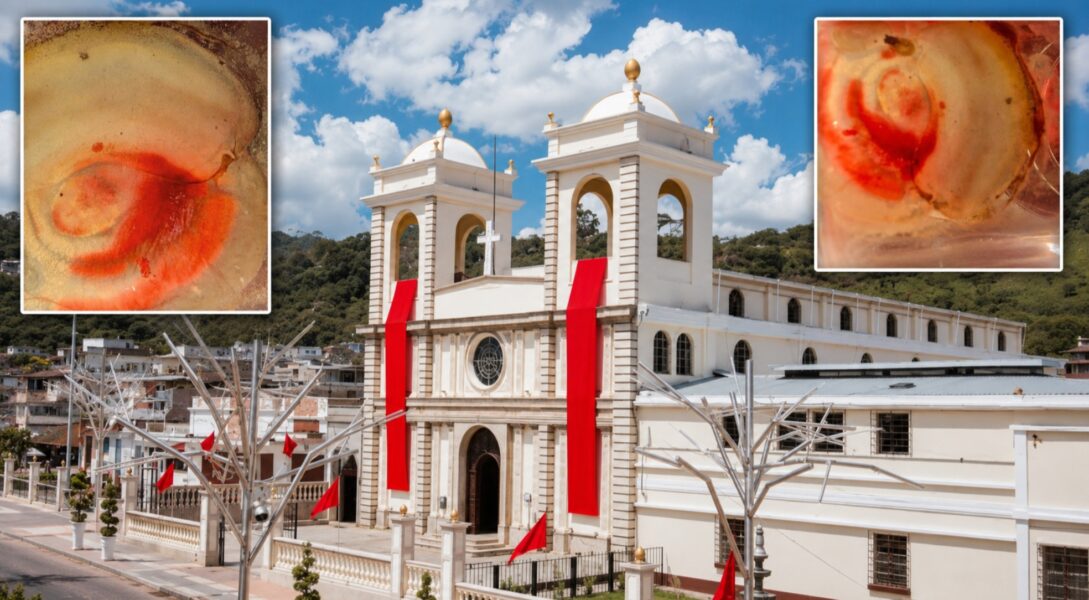
The Parish of the Child Jesus, cathedral church of the Diocese of Santa Rosa de Lima, has issued a statement informing that a consecrated Host, placed in water after an attempted desecration, has not dissolved and shows reddish stains “that could be blood.” The case has been brought to the attention of the bishop, Most Rev. José Cayetano Parra Novo, O.P., who will give instructions for its study.
(InfoVaticana) The Parish of the Child Jesus in Cuilapa, cathedral seat of the Diocese of Santa Rosa de Lima (Guatemala), released an official statement on August 22 reporting what it cautiously describes as a “possible eucharistic manifestation.”
According to the parish account, the events date back to Thursday, July 30, during the Missionary Eucharistic Week held at the parish. In the facilities of a private school in the area, and at the pastor’s direction, a priest assisting with the Week celebrated Mass. At the moment of Communion, a teenage student received the Sacred Host and returned to his place, but the celebrant noticed that the young man was removing the Host from his mouth and quickly approached him, managing to prevent it from being thrown to the floor.
Following the prescribed procedure for such cases, the priest placed the Sacred Host in a glass of water in the chapel of the parish house so that it would dissolve, in keeping with standard liturgical practice. The following Thursday, while cleaning the chapel, a parish collaborator noticed that the Host had not dissolved and showed red stains “that could be blood.” Alerted by him, a deacon and a priest immediately verified the presence of the reddish stains.
The pastor questioned the collaborator and recorded his testimony. In the following days, a deacon, a priest, and three laypeople personally observed the Host. On August 15, the pastor showed photographs of these events to the diocesan bishop.
“They cannot be called miracles until a full investigation is concluded”
The statement is notable for its prudence. “It is necessary to remember that the Church asks that the matter be judged with prudence and moderation,” the text states, recalling that throughout history the Church has received testimony of the real and substantial presence of Jesus Christ in the Eucharist “under this singular form of manifestation,” but that such cases “have been neither common nor easy to discern, and therefore cannot be called miracles until a full investigation is carried out, which must be done and will take time.”
The parish also reports that the sign “has already been reserved in a special place and will not be on public display,” and that the bishop will, in due course, give “instructions for the necessary discernment and to conduct a study of this possible eucharistic manifestation.”
The text concludes with a spiritual exhortation: that the event may prompt Catholics to renew “our faith and devotion in the greatest miracle: the real presence of Jesus Christ in every celebration of the Holy Mass,” and an invitation to make reparation for offenses against the Blessed Sacrament, to live the Mass attentively and devoutly, and to frequent the sacrament of Confession. “Let us not forget that Jesus is alive in the Eucharist; it is not something, it is Someone,” the statement concludes, dated in Cuilapa on August 22 of the “Year of the Lord 2026.”
Along with the statement, the parish has released photographs of the Host in the glass of water, showing the reddish stains, bearing the seal “Cathedral ‘Child Jesus’ Cuilapa.”
The discernment now underway
It will now fall to Most Rev. José Cayetano Parra Novo, O.P., bishop of Santa Rosa de Lima since 2021, to determine the steps of the canonical discernment and, if appropriate, to order the relevant scientific analyses, in accordance with the practice followed by the Holy See in similar cases.
One detail from the parish account that the investigation must first weigh is that a week elapsed between the placement of the Host in the glass of water and the discovery of the stains. That interval almost exactly matches the conditions described in a peer-reviewed study published in 2025 in the journal Applied Microbiology and Biotechnology, which analyzed 25 real cases of consecrated hosts that, after remaining submerged in water for several days, developed red or purple stains and gelatinous-looking masses. Analyses identified in them bacteria and fungi that produce reddish pigments—including, among others, Serratia marcescens, whose prodigiosin produces an intense red, as well as Epicoccum, Fusarium, and species of Penicillium—and in none of the 25 cases was the presence of human blood demonstrated. One week in water, in a non-sterile container, is sufficient time for microbial proliferation capable of producing blood-like colorations: that is, therefore, the first hypothesis the analyses must rule out.
It should be emphasized that this possibility does not even touch Catholic doctrine on the Eucharist. The real presence of Christ remains “as long as the eucharistic species subsist” (cf. Catechism, n. 1377): consecration does not render the matter of the bread sterile or physically incorruptible, and the fact that the Host degrades or is colonized by microorganisms does not, by itself, allow any theological conclusion to be drawn, either way.
Precisely for this reason, what is decisive is that the protocol be scrupulously followed, as the parish has done so far: the sign reserved without public display, the chain of custody preserved, and the decision left in the bishop’s hands. A serious examination will require bacterial and mycological cultures, microscopy, and specific tests for hemoglobin and human DNA, without manipulations that could contaminate the sample. Only a positive result for human blood, after ruling out every natural cause, would allow one to speak of something more than an explainable phenomenon. The Church proceeds in these cases with extreme caution: the Archdiocese of Indianapolis dismissed a similar case in 2025 after confirming the presence of common bacteria; by contrast, in 2023 the bishop of Gracias (Honduras), Most Rev. Walter Guillén Soto, recognized a eucharistic sign after the analyses were carried out, forwarding the documentation to Rome.
The Cuilapa episode thus joins the series of alleged eucharistic phenomena recorded in Latin America—Buenos Aires (1992-1996), Tixtla (2006), Gracias (2022)—whose authority of reference is always the diocesan bishop and, ultimately, the Dicastery for the Doctrine of the Faith.
Full text of the statement
PARISH OF THE CHILD JESUS
CATHEDRAL CHURCH
DIOCESE OF SANTA ROSA DE LIMA
(06001) Cuilapa, Santa Rosa, Guatemala
Telephone: (502) 7886-5429STATEMENT
POSSIBLE EUCHARISTIC MANIFESTATIONOn Thursday, July 30, 2026, in the context of the Missionary Eucharistic Week celebrated in our Parish of the Child Jesus in Cuilapa, in the facilities of a private school and at the direction of the Pastor, a priest who came to assist with the Week celebrated Holy Mass.
At the moment of Communion, a teenage student of the school joined the line to receive Communion and received the Sacred Host; he returned to his place, but the priest noticed that the teenager was removing the Sacred Host from his mouth and quickly approached him, managing to prevent him from throwing it to the floor.
Following the instructions for such cases, the priest placed the Sacred Host in a glass of water in the chapel of the parish house. The following Thursday, while cleaning the chapel, a parish collaborator noticed that the Host had not dissolved and that it had red stains, which could be blood.
At that same moment, a deacon and a priest, alerted by the parish collaborator, also verified that there were indeed reddish stains that could be blood.
The pastor has questioned the parish collaborator and has recorded his testimony. In the following days, a deacon, a priest, and three laypeople personally observed the Host. On August 15, the pastor showed photographs of these events to the Bishop.
In light of this event, it is necessary to remember that the Church asks that the matter be judged with prudence and moderation. Throughout history, the Church has received testimony of the real and substantial presence of Jesus Christ in the Eucharist, under this singular form of manifestation. Such cases have been neither common nor easy to discern, and therefore cannot be called miracles until a full investigation is carried out, which must be done and will take time.
The sign we now share with you has already been reserved in a special place and will not be on public display. In due course, the Bishop will give us instructions for the necessary discernment and to conduct a study of this possible eucharistic manifestation.
This event should prompt Catholics to renew our faith and devotion in the greatest miracle: the real presence of Jesus Christ in every celebration of the Holy Mass.
We recommend to all prudence and respect for the case, as well as for the place and the people who witnessed the sign. May today be the moment to make reparation for all the offenses Jesus receives in this Sacrament of Love, an invitation to live the Holy Mass attentively and devoutly, and an offering to frequent the sacrament of Confession. Let us not forget that Jesus is alive in the Eucharist; it is not something, it is Someone.
May He be infinitely praised!
Parish of the Child Jesus of Cuilapa, August 22, Year of the Lord 2026.