


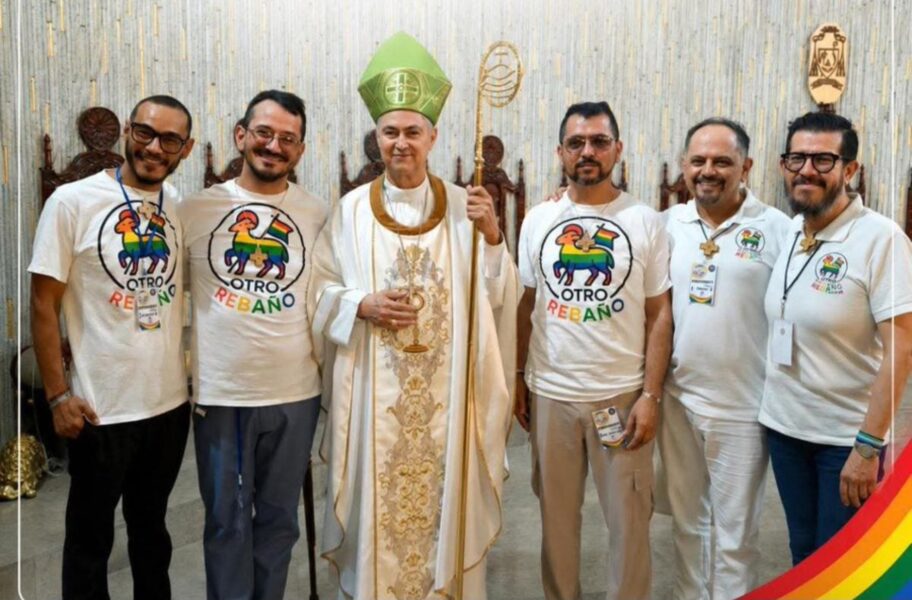
The bishops of Torreón and Gómez Palacio opened their cathedrals to the IV National Meeting of the Catholic Rainbow Network of Mexico. At the closing Mass, the emeritus of Saltillo, Raúl Vera, proclaimed from the altar that homosexuality “is not a sin,” without any reference to the call to chastity or the proposal of Catholic life.
From July 30 to August 2, the Mexican city of Torreón (Coahuila) hosted the IV National Meeting of the Catholic Rainbow Network of Mexico (RedCAM), the platform that brings together a dozen “LGBT+ Catholic” collectives from the country —Kadima (Chihuahua), Otro Rebaño (Morelia), Betania (Irapuato), La Viña (Hermosillo), Todos somos Lambda (Saltillo), among others—. Nearly a hundred participants gathered under the motto “Brotherhood and service.”
What in previous editions had taken place with a discreet profile, this time counted on the public and explicit support of two diocesan bishops in office. On Friday, July 31, the bishop of Torreón, Monsignor Luis Martín Barraza Beltrán, presided over the Eucharist of the meeting in his cathedral, concelebrated by the Dominican friar Raúl Vera López, emeritus bishop of Saltillo, famous for having invited an Anglican pastor to concelebrate Mass, a sacrilegious scandal for which he was never sanctioned. The following day, “by express invitation” of Bishop Jorge Estrada, the participants also celebrated Mass in the cathedral of Gómez Palacio (Durango).
The organizers later released an image of Monsignor Barraza posing smiling, with mitre and crozier, alongside members of the collective Otro Rebaño wearing T-shirts with the group’s logo: a lamb with the colors of the rainbow carrying the pride flag. “Thank you, Mons. Luis Martín Barraza, Bishop of Torreón, for your closeness and support,” reads the poster.
“Homosexuality is not a sin”
The most controversial moment came from Raúl Vera, an old acquaintance of these causes. During the Eucharistic celebration, the emeritus of Saltillo stated —according to El Heraldo de Saltillo, Vanguardia, and Periódico La Voz, which broadcast the video— that homosexuality “is a thing of nature and is not human perversion or disease,” and that “it is not a sin.”
He went further: “Accompanying and strengthening these people is a serious responsibility that we have with them. They have the right to participate in our meetings and also to exercise leadership of the faith among us,” he said, claiming for members of these collectives even “responsibilities of religious leadership.” And he concluded: “Without you, the Church is not complete. You are our family; do not leave us alone in this journey with the Lord Jesus.”
The method is well known: deliberate confusion is played. It starts from a truth —the condition or inclination, per se, is not a sin, as the Catechism teaches (n. 2358)— to then settle into calculated ambiguity. Never is what that same Catechism says immediately afterward mentioned: that persons with this tendency “are called to chastity” (n. 2359), and that homosexual acts “are intrinsically disordered” and “under no circumstances can they be approved” (n. 2357). Not a word about chastity was heard in Torreón. Nor is it clarified that these unions are not and cannot be equivalent to the family: one thing is the family, founded on marriage between a man and a woman, and quite another what is intended to be presented as its substitute under the rainbow flag. On that first half-truth the entire edifice is built: the rest is silenced and the silence is left to do the rest.
James Martin, via Zoom
The program of the meeting also included a “magisterial conference” delivered by videoconference by the American Jesuit James Martin, a world reference of intra-ecclesial LGBT activism, as well as workshops, a Holy Hour at the sanctuary of the Cristo de las Noas, and —according to Milenio— a “consecration to the Virgin Mary.” The meeting closed with the election of the new board of RedCAM and the announcement of the venue for the V National Meeting: Morelia (Michoacán), in 2027, the city where the collective Otro Rebaño is based, founded just a year ago and which maintains institutional relations with the state’s Human Rights Prosecutor’s Office.
The unofficial chronicle of the meeting, published in Religión Digital, does not hide the objective: it laments that “many dioceses refuse to allow spaces of accompaniment where sex-gender diversity is recognized” and presents the gestures of Barraza, Estrada, and Vera as the model to imitate. With two cathedrals granted, two diocesan bishops involved, and an emeritus openly preaching against the moral doctrine of the Church, the question is inevitable: will the Mexican Episcopal Conference say anything? And Rome?