


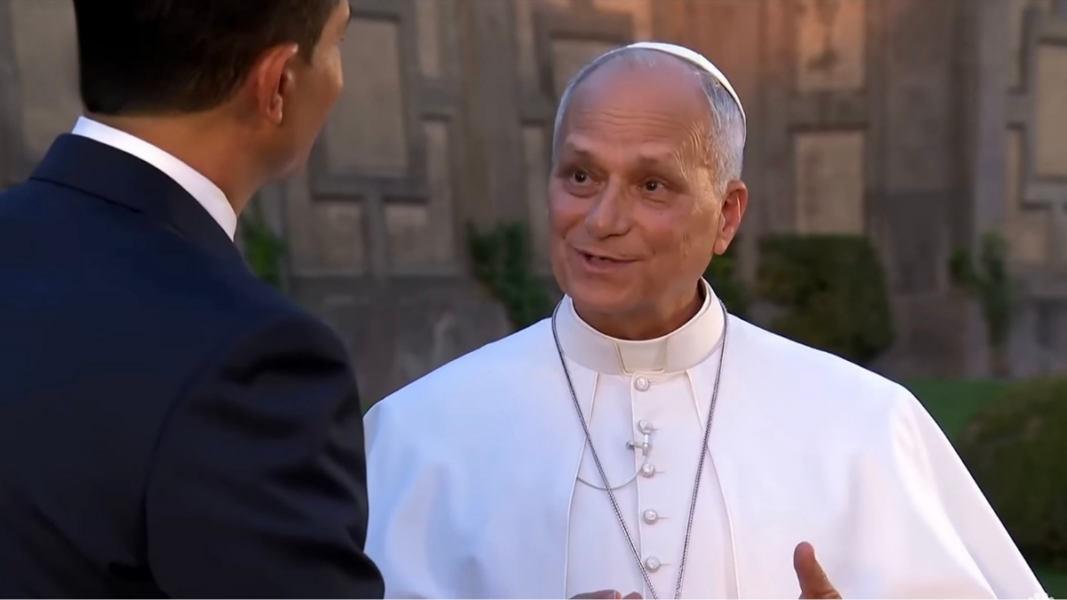
Pope Leo XIV granted a brief interview to the American networks NBC and Telemundo after participating in the prayer meeting of the «Canticle of Peace,» held at the Borgo Laudato Si’, in the Pontifical Gardens of Castel Gandolfo. In it, he spoke about his family roots, immigration, the United States, and the possibility of returning soon to his native country.
The Pontiff described the United States as a nation marked by «a sense of freedom, a sense of opportunity» and by having invited «for generations people from all over the world to become part of a single nation.» That tradition of welcome, he explained, is also part of his own family history.
A message to immigrants
Asked by Telemundo about the situation of the millions of immigrants living in fear in the United States, Leo XIV avoided responding in political terms and preferred to start from the experience lived during the Concert for Peace held shortly before in Castel Gandolfo.
The Pope recalled the image of children «from several countries, of different races, perhaps of different religions» singing together and stated that this scene invites us «to look beyond» differences to discover «the richness that is the human being,» created «in the image of God.» He also recalled the questions some of them directed at the adults: «Why is there war and not peace? Why is there hatred and not love?», assuring that «children can teach us a lot» about the need to rediscover «the treasure that lies in being all brothers and sisters.»
Addressing the immigrants directly, the Pontiff encouraged them not to lose hope. «Have hope,» he began by saying. Then he exhorted them to «seek how to live in an orderly way,» recalling that «a society cannot be built» on «crimes» or «offenses.» «We must learn to live in peace,» he added, while continuing to invite everyone to maintain «the courage and hope that always help us all.»
«I come from a family of immigrants»
During the interview with NBC, Leo XIV linked that reflection to his own family history. «I come from a family of immigrants. My grandparents were immigrants,» he stated, before recalling that on his mother’s side, he has ancestors who «were both slaves and slave owners.»
The Pope explained that this history helps him understand «one of the greatest riches of the United States» and reiterated his appreciation for the principles that, in his view, have characterized the country for generations.
After his election as Successor of Peter, various genealogical investigations carried out in the United States documented that the Prevost family has Cuban, Italian, and French roots, a legacy that the Pontiff considers part of his own history and of the history of the country where he was born.
«I consider myself the Pope who, by chance, is American»
Although he expressed the affection he still feels for his native country, Leo XIV wanted to make it clear that his ministry transcends any national identity.
«I consider myself more the Pope who, by chance, is American,» he stated. «I was born in the United States, my family still lives there, and I feel a great love for that country. But I understand that my mission has a very important dimension: to be the shepherd of a universal Church and to have the opportunity to address people all over the world.»
Even so, he acknowledged the historical significance of his election. «I also recognize that, both for me and for the people of the United States, it is of great importance to be the first American Pope.»
Finally, asked about the possibility of making a trip to the United States, he responded optimistically. «You will see me there. Nothing is decided yet, but I certainly hope to be there soon.»
The interview was recorded after the Concert for Peace held in Castel Gandolfo, in which tenor Andrea Bocelli and an international choir made up of more than 160 children and young people from Italy and countries affected by war participated. During the meeting, Leo XIV highlighted that «music has the extraordinary ability to unite diverse voices in a single harmony, where each one contributes something unique.»