


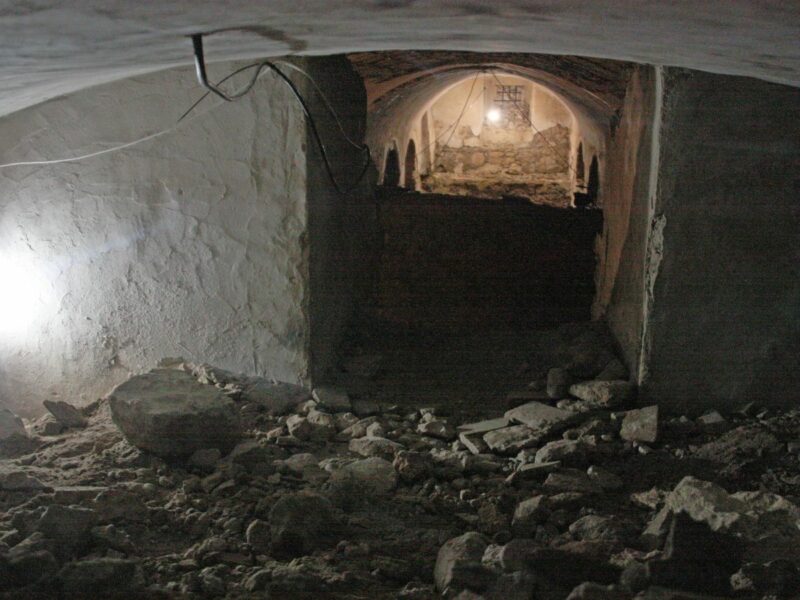
The Archdiocese of Tarragona will begin an archaeological intervention next week at the Church of San Agustín to fully recover the temple’s historic crypt, a funerary space that has remained hidden beneath the pavement for more than a hundred years. The work will allow its structure to be documented, its evolution between the 16th and 18th centuries to be studied, and the groundwork to be laid so that, in the future, it can be opened to the public.
The project, promoted by the Church of San Agustín itself—part of the Parish of San Francisco de Asís—has the collaboration of the Association of Holy Week Brotherhoods of Tarragona, whose headquarters are located in the temple and which keeps the processional floats there. The involvement of this entity has been decisive in driving a project that combines archaeological research, heritage conservation, and historical dissemination.
A crypt known since 2012, but still inaccessible
The existence of the crypt was documented in 2012 thanks to a preliminary, non-invasive archaeological and anthropological study that confirmed its state of conservation and formulated the first hypotheses about its historical evolution. That investigation already pointed to the need for new excavations to deepen scientific knowledge of the space and facilitate its recovery.
However, access to the crypt remains very limited due to the pavement renovation carried out in the 1970s. During those works, the enclosure was filled with rubble and construction materials that concealed much of its original configuration.
According to the Archdiocese, this fill also promotes the accumulation of moisture inside, a circumstance that could compromise the long-term conservation of the historic structures.
Three weeks of archaeological excavation
The intervention will begin next week and will last approximately three weeks. The work will consist of the controlled, archaeological removal of the fill material to completely uncover the crypt, document its different construction phases, and better understand its historical evolution.
At the same time, an anthropological study of the preserved human remains will be carried out to obtain new data about this funerary space and the people who were buried there.
Removing the fill will also improve the conservation conditions of the crypt by reducing the moisture problems affecting the enclosure.
A new heritage space for Tarragona
The excavation will also contribute to expanding knowledge of the historic subsoil in this sector of Tarragona and will allow evaluation of the crypt’s heritage potential within the city’s archaeological ensemble.
The results will serve to define future conservation actions and study the feasibility of a musealization project. The Archdiocese’s intention is that, once recovered and conditioned, this space can be opened to public visits and become a new place for interpreting Tarragona’s historic heritage.
A temple with more than four centuries of history
The Church of San Agustín was built starting in 1576 on the site of the former convent of the same name, whose disappearance later allowed the current Plaza Verdaguer in Tarragona to be urbanized. Construction progressed slowly due to lack of resources, although it received a decisive boost from Archbishop Antonio Agustín, with its essential parts completed around 1584.
It initially belonged to the Society of Jesus and was blessed under the patronage of the Three Kings. After the expulsion of the Jesuits decreed by Charles III in 1767, the complex passed into the hands of the Augustinians, adopting its current name. With the Mendizábal confiscation in 1835, the religious were also expelled and the convent was converted into a barracks, although the temple continued to be used for worship.
Deeply restored in 1990, the church depended until 2014 on the Claretian missionaries and now forms part of the Parish of San Francisco de Asís. Inside, the ten floats of Tarragona’s Holy Week are permanently preserved, and its façade bears the coat of arms of Onofre Morell, declared a Cultural Asset of National Interest. The temple is also one of the main examples of the so-called Camp School and preserves important artistic influences from Rome.