


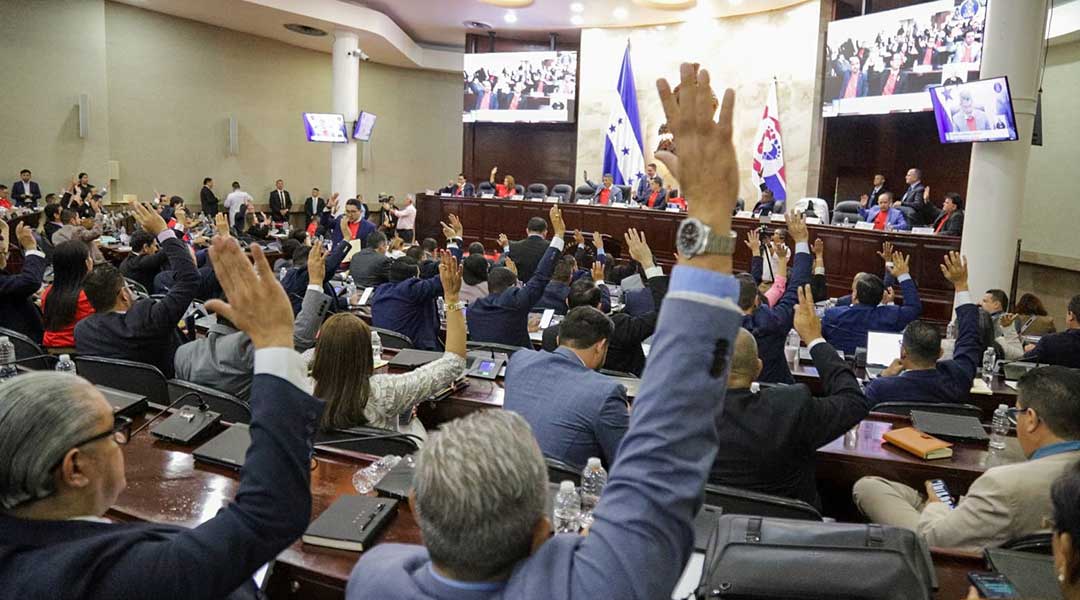
The National Congress of Honduras has just adopted a decision that should be closely watched throughout Ibero-America: it unanimously approved the creation of a commission tasked with investigating clandestine organizations that promote and facilitate illegal abortions through pills, social media, and other digital means.
This is not a symbolic statement or an abstract debate about abortion. The Honduran Congress has chosen to confront a concrete practice operating within its borders: the clandestine sale of misoprostol, the delivery of instructions via WhatsApp, and the performance of abortions in private homes, outside the law, pharmaceutical controls, and medical supervision.
The motion was introduced by the President of the National Congress, Tomás Zambrano, and received unanimous support from the plenary. The decision aims to strengthen the investigation of organizations that promote illegal abortions through social media and to coordinate the work of the Family Commission with the relevant institutions.
The unanimity is especially significant. In a region marked by political fragmentation, the Congress of Honduras understood that this was not a mere ideological difference, but a matter of legality, public health, child protection, and national sovereignty.
The internet cannot become a lawless territory. And a crime does not cease to be one simply because it is coordinated through private messages.
A complaint that began in civil society
The Congress’s response did not appear spontaneously. It was preceded by the courageous work of the Comité Provida de Honduras, which warned of the existence of networks dedicated to promoting abortions with pills and decided to bring the issue out of the shadows.
The Committee became aware of investigations conducted by the Population Research Institute into DKT International and its model for expanding pharmacological abortion. Our reports showed how international organizations use digital platforms, private distribution networks, intermediaries, and local brands to facilitate access to abortion pills, even in countries where abortion is banned or severely restricted.
The Comité Provida de Honduras understood that this information should not remain archived. It asked whether the same model might be operating in its own country and decided to act.
This is the first major lesson of this story for the Ibero-American pro-life movement: an investigation only gains real strength when someone turns it into action.
The Committee did not limit itself to voicing its concerns on social media. It promoted the complaint on television and in the press, alerted the public to the existence of these operations, and helped Honduran journalists investigate how the clandestine pharmacological abortion market works.
Thanks to that initiative, a hidden phenomenon entered the public agenda.
The ICN News investigation
ICN News took up the complaint and conducted an on-the-ground investigation. Its journalists posed as a pregnant woman seeking an abortion and contacted one of the networks offering “accompaniment” via WhatsApp.
What they found confirmed the warnings.
The network responded via chat, offered misoprostol pills, added painkillers, and arranged the sale for approximately 120 dollars. The entire procedure was carried out remotely, through digital messages and outside formal healthcare channels.
The investigation did not merely reveal the irregular sale of a medication. It exposed an organized structure that recruits women through social media, negotiates with them via WhatsApp, receives payment, and delivers products intended to induce an abortion at home.
ICN News also examined the legal implications of these operations. In Honduras, abortion is criminalized, and networks that promote it through digital platforms operate within a clandestine market that openly defies the national legal order.
The importance of the report lies in transforming a general complaint into concrete evidence. It was no longer possible to claim that digital abortion networks were an exaggeration by the pro-life movement. There were messages, sellers, medications, prices, and delivery mechanisms.
Clandestine abortion had left a trail.
Clandestine abortion has changed its face
For decades, the image of illegal abortion was associated with hidden clinics, unscrupulous doctors, and surgical procedures performed in unsanitary conditions. That reality has not disappeared, but clandestine abortion in the 21st century has taken on a different form.
Now it can be organized from a cell phone.
A Facebook or Instagram account posts content aimed at women with unexpected pregnancies. A WhatsApp number responds to inquiries. Another person receives the payment. A supplier delivers the pills, and a courier service completes the operation.
The structure may be spread across different individuals, cities, or even countries. Each participant appears to perform a limited role, but the end result is the same: facilitating an illegal abortion without assuming direct responsibility for its consequences.
The language has also changed. These networks no longer typically present themselves as clandestine sellers. They speak of “accompaniment,” “self-management,” “autonomy,” and “safe abortion.”
But behind these expressions lies a reality that is hard to disguise: a vulnerable woman receives medication to induce an abortion in her home, without a full in-person evaluation and without immediate medical assistance if complications arise.
The risk is transferred entirely to her.
Those who run the network collect payment, send the pills, and respond to messages. But they cannot stop a hemorrhage, perform an emergency ultrasound, or intervene physically when something goes wrong. If a complication arises, it will be the woman, her family, or the public health system who must bear the consequences.
A political response equal to the problem
Faced with this new reality, the National Congress of Honduras decided not to look the other way.
The creation of an investigative commission acknowledges that institutions can no longer confront clandestine abortion with tools from the last century. It is no longer enough to search for hidden clinics. It is necessary to investigate social media accounts, phone numbers, financial transfers, pharmaceutical distribution chains, and possible international connections.
The investigation must answer fundamental questions: Who manages these accounts? Where do the pills come from? Who receives the payments? How are the medications imported and distributed? How many women have been contacted? Which organizations fund or train the local networks? What happens to the personal and medical data collected?
The Honduran Congress has understood that defending the rule of law requires following both the trail of the pills and the trail of the money.
The decision also sends a clear political message: Honduras will not accept that national or foreign organizations use digital platforms to disregard its laws and, in practice, establish a policy of unrestricted abortion that the country has never approved.
That is the true meaning of the Congress’s unanimous vote: the State has decided to confront 21st-century clandestine abortion with the tools and determination that the 21st century demands.