


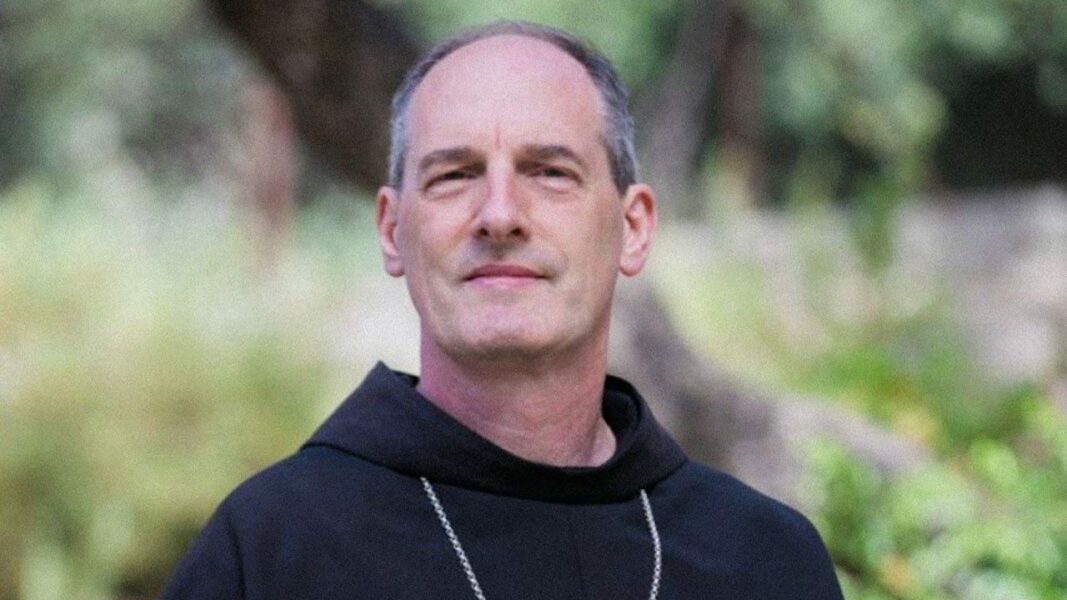
Cardinal François-Xavier Bustillo has warned of a growing “divorce between the political class and the people,” a distance he considers “dangerous for democracy.” The Bishop of Ajaccio (Corsica, France) has also defended the Church’s involvement in public debate, not to “dominate or manipulate,” but to contribute its reflection to the common good.
In an interview given to Europa Press on the occasion of the publication in Spain of his book Reparación, published by Palabra, Bustillo noted that this separation between political leaders and citizens is perceived especially in France, although it also affects other European countries.
“Today there is something like a divorce between the political class and the people. And that is dangerous for democracy,” said the cardinal, born in Pamplona in 1968.
In his view, democracy depends on the commitment of citizens and becomes “fragile” when that commitment disappears. For this reason, he called for a change among those politicians who “have distanced themselves from the people,” although he clarified that this situation cannot be attributed to everyone.
A “critical” political situation in Spain
Bustillo described the political situation in Spain as “critical” and warned of a growing contempt for politics and politicians.
In light of this climate, he urged caution, because periods of crisis can favor the emergence of “naïve messianisms” that offer simplistic solutions.
As historical examples of that risk, he cited the cases of Adolf Hitler and Benito Mussolini.
The cardinal also warned of the polarization, aggressiveness, and “deficit of reflection” he observes in Western societies.
In his opinion, in politics, the economy, society, and even the Church, there is a tendency to classify people with labels such as “right-wing or left-wing” or “conservative or progressive.”
He also criticized the “I like it, I don’t like it” logic typical of social media and called for the recovery of more reflective and peaceful criteria, as well as abandoning a “mindset of judges who pass sentences on everything and everyone.”
The Church must contribute its reflection to society
Bustillo maintained that the Church cannot limit itself to remaining on the sidelines of politics and criticizing governments or public leaders.
“The Church has to speak with politics and give its opinion on certain things,” he stated. That intervention, he added, should not seek to “dominate or manipulate,” but to contribute “to the common good of the people” through a “serene and mature” dialogue.
“The Church cannot remain only on the outside and criticize the Government or criticize politicians. The Church has to contribute its reflection to the life of society,” he defended.
The Bishop of Ajaccio believes that society is calling for less aggressive relationships and that Christian spirituality can help moderate the instinct for domination and force.
“We are becoming a bit primal, primitive,” he stated. In response, he noted that the Gospel offers the capacity to contain those impulses and build a more serene coexistence.
Fraternity, freedom, and authenticity
From his Franciscan charism, Bustillo highlighted fraternity as a necessary contribution to a “fractured society.”
The cardinal also called for greater freedom and authenticity in public, economic, social, and ecclesial life. According to him, despite the frequent discourse on freedom, “calculation, tactics, and strategy” predominate in many areas.
“There is a lot of politics and little freedom and little authenticity,” he lamented.
Leo XIV “is awakening the West”
Bustillo also referred to the recent visit of Leo XIV to Spain, which marked one month, and described it as “a very exceptional moment.”
The cardinal compared the effect of the current Pontiff with the role played by Saint John Paul II in Eastern Europe.
According to Bustillo, just as the Polish Pope “awakened the East with his mission,” Leo XIV “is awakening the West.”