


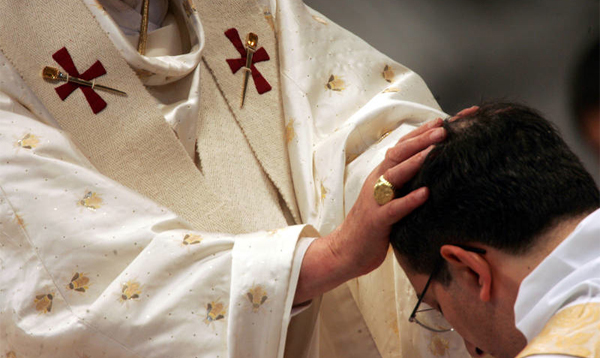
The Diocese of Charlotte, in North Carolina, has been the one that has ordained the most diocesan priests in the United States during 2026. With ten new presbyters, it tops a ranking that reflects an increasingly evident shift in the country’s vocational map: while several dioceses in the South and the Midwest maintain notable dynamism, some of the historically most influential sees of the American Church continue to register a sharp decline in the number of ordinations. This is according to an analysis published by The Pillar.
In total, the United States ordained 342 diocesan priests this year, compared to 315 in 2025, representing a slight recovery from last year. However, the figure remains lower than a decade ago, when 376 ordinations were recorded, confirming that the current upturn still does not offset the downward trend of recent years.
Charlotte leads a new vocational map
Charlotte was the only U.S. diocese to reach ten priestly ordinations this year. It was followed by the archdioceses of Cincinnati and Miami, with nine new priests each, while Philadelphia and Newark ordained eight.
The figure is significant because it confirms the shift of vocational dynamism toward the southeastern part of the country. More than half of the 2026 ordinations were concentrated in dioceses of the Midwest and the Southeast, regions that together account for just over a quarter of the U.S. Catholic population.
In contrast to this growth, the report highlights the decline of some of the major dioceses in the Northeast and the West Coast. The Archdiocese of New York, which ordained fourteen priests in 2016, celebrated only two ordinations this year. The Diocese of Brooklyn went from ten new presbyters a decade ago to just one in 2026. Los Angeles, Dallas, Paterson, Trenton, and Hartford also show significant declines compared to ten years ago.
The contrast is even more striking when considering that 50 U.S. dioceses did not ordain any diocesan priest this year, including San Diego, Fort Worth, and Sacramento, all with more than one million Catholics.
A diocese at the center of the liturgical debate
Charlotte’s leadership comes at a time when this diocese also occupies a prominent place in the U.S. ecclesial debate.
In recent months, Bishop Michael Martin has promoted a profound reorganization of the celebration of the traditional liturgy in the diocese, strictly applying the provisions of Traditionis custodes. The measures, which restrict the celebration of the Mass according to the 1962 Missal, sparked numerous reactions among the faithful and priests, making Charlotte one of the main focal points of discussion on the application of liturgical reform in the United States.
Nevertheless, the high number of ordinations this year cannot be attributed to those recent decisions. Most of the new priests began their formation several years ago, during the episcopate of Peter Jugis, under whose leadership the diocese experienced sustained growth in vocations and a significant expansion of its Catholic population.
An increasingly unequal vocational geography
The analysis by The Pillar confirms a trend that has been consolidating for years: priestly vocations are growing more intensely in the South and the interior of the country, while numerous dioceses in the Northeast and the West Coast continue to lose their capacity to generate new priests.
The pastoral region that includes Georgia, Florida, North Carolina, and South Carolina recorded the most ordinations this year, while New York saw the largest drop compared to 2016.
The data also show strong differences in the ratio of ordinations to Catholic population. While dioceses such as Steubenville, Fargo, or Dodge City present some of the best ratios in the country, other large jurisdictions barely incorporate new priests despite having hundreds of thousands—or even millions—of faithful.
Although the increase recorded in 2026 constitutes a positive sign compared to the previous year, the study reflects that the recovery of vocations in the United States remains uneven. Rather than a generalized increase, the country is witnessing a shift in the center of gravity of vocations in the American Church, with emerging dioceses taking over from some historic sees that for decades led the ordination statistics.