


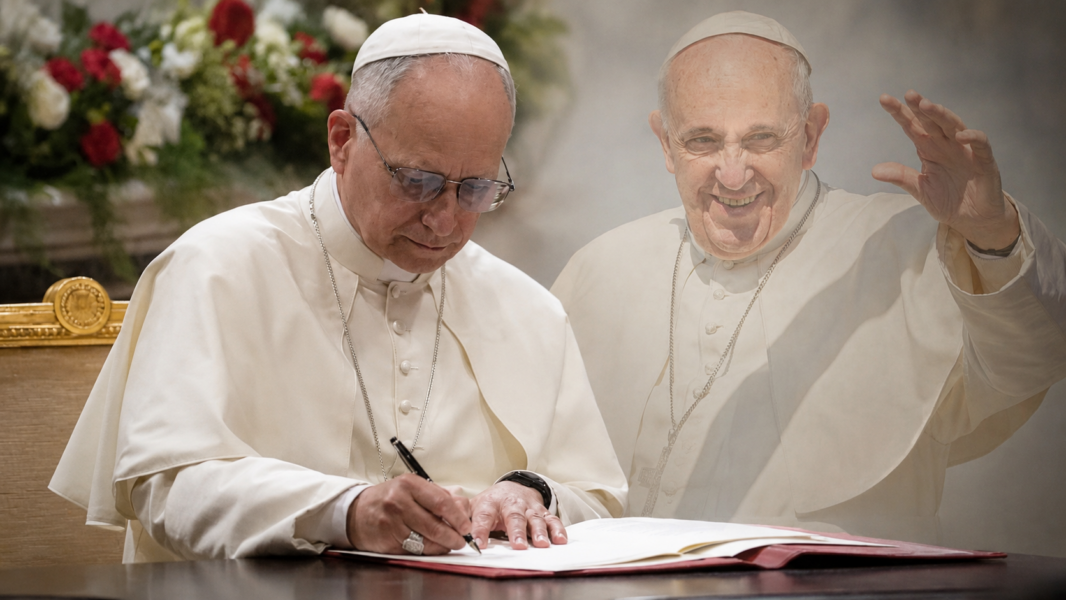
Synodality ceases to be presented solely as a pastoral process and becomes a principle regulated by law in the governance of the Pope’s diocese. That is one of the most significant aspects of the Motu Proprio Confirma Fratres Tuos, with which Leo XIV replaces the apostolic constitution In Ecclesiarum communione, promulgated by Francis in 2023, and establishes a new organizational framework for the Vicariate of Rome.
Although the document maintains the broad pastoral orientations promoted by his predecessor, it introduces a much more precise regulation of the governance structure, delimits competencies, and turns synodality into an institutional principle integrated into the ordinary functioning of the Vicariate.
A reform that entirely replaces that of Francis
The decision is of particular importance because it is not a partial modification, but the complete repeal of an apostolic constitution promulgated only three years ago.
Leo XIV himself explains that the experience accumulated since the 2023 reform came into force advised reviewing various aspects of its application. To that end, on February 25 he established a working group tasked with studying possible improvements, whose conclusions have led to the promulgation of the new text.
It is not, therefore, a break with the previous pontificate, but a review of the legal architecture designed by Francis in light of its practical application.
Pastoral continuity with a more precise organization
Confirma Fratres Tuos preserves much of the main lines introduced by Francis. The missionary orientation of the Vicariate, the co-responsibility of all the baptized, and the drive toward a Church that carries out its mission in a participatory way remain in place.
However, Leo XIV chooses to strengthen the legal security of the institution. Where the previous regulations left room for interpretations or possible overlaps of competencies, the new text more clearly delimits the functions of each governing body and establishes more defined procedures.
Rather than altering the pastoral orientation of the Vicariate, the Pope appears interested in providing a more stable, coordinated, and effective administrative structure at the service of evangelization.
A style of governance based on experience
Leo XIV does not present the reform as an ideological correction of the previous one, but as the result of the experience accumulated since 2023. Before legislating, he decided to analyze the actual functioning of the Vicariate through a study commission created a few months after the beginning of his pontificate.
This procedure reveals a way of governing based on the practical evaluation of structures before undertaking reforms, seeking to consolidate what works and correct aspects that have shown the need for greater normative definition.
A Vicariate with better-defined responsibilities
The new constitution develops in greater detail the competencies of the cardinal vicar, the vicegerent, the auxiliary bishops, and the Moderator Curiae, while consolidating the role of the Episcopal Council as the main consultative body for the governance of the diocese.
The objective seems clear: to reduce duplications, clarify responsibilities, and improve coordination among the various pastoral and administrative offices.
The organization of the Vicariate by areas—formation, catechesis, liturgy, youth, charity, culture, human mobility, or ecumenical and interreligious dialogue—is likewise maintained, although now integrated into a more coherent and better-defined governance structure.
From a pastoral process to a principle of governance
Without abandoning the language introduced by Francis, the new Motu Proprio ceases to present synodality primarily as a pastoral path and integrates it into concrete norms of organization, consultation, and distribution of responsibilities.
In other words, synodality ceases to be merely an ecclesial horizon and becomes a stable criterion of governance, with bodies, competencies, and procedures defined by the particular law of the Diocese of Rome.
This evolution allows the document to be interpreted as a step toward the institutionalization of a concept that in recent years had been associated mainly with processes of consultation and discernment. Leo XIV does not dispense with synodality, but incorporates it more organically into the ordinary functioning of the Vicariate.
Simplification of the judicial organization
The reform also introduces changes in the judicial structure.
The existence of the Ordinary Tribunal of the Diocese of Rome and the Interdiocesan Tribunal of First Instance for matrimonial cases of the Lazio region is maintained, but the Court of Appeal of the Vicariate disappears.
Henceforth, appeals will be directed directly to the Tribunal of the Roman Rota, simplifying the procedure and eliminating an intermediate instance.
The first major governance text of Leo XIV
Beyond the administrative modifications, Confirma Fratres Tuos does not abandon the broad pastoral lines promoted by Francis, but introduces a more refined legal architecture, a more precise distribution of responsibilities, and a more clearly defined institutional functioning.
In that sense, this Motu Proprio reveals a characteristic that is marking the governance of Leo XIV: the pursuit of continuity in pastoral principles, accompanied by greater normative clarity and a more solid organization of ecclesial structures. Rather than a change of course, the reform expresses the will to integrate synodality into a stable legal framework, making it not only a pastoral path but also a permanent principle of governance for the Church.