


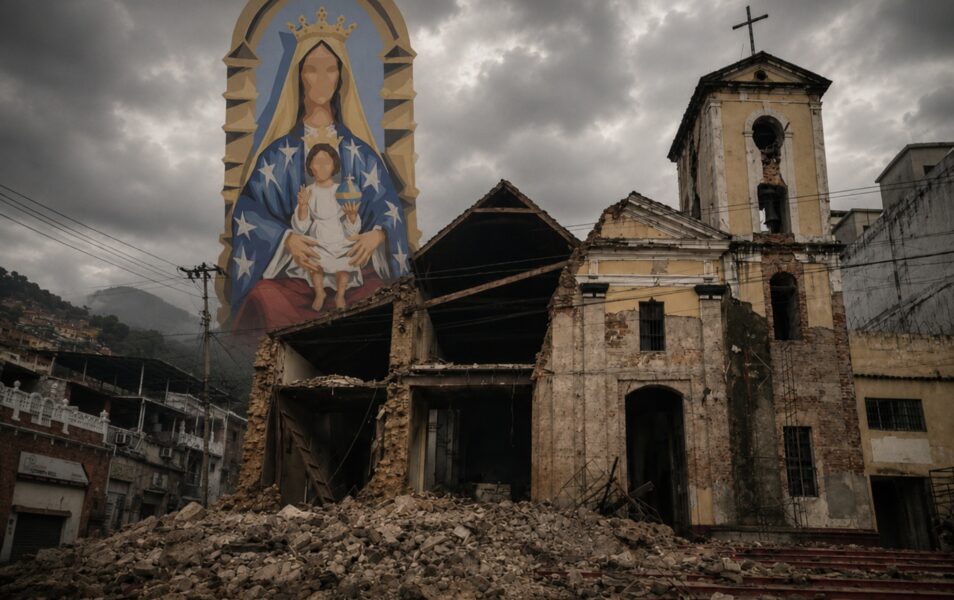
Two earthquakes of magnitude 7.2 and 7.5, separated by less than a minute, shake the north of the country and have already left dozens dead. The Venezuelan people, already battered by political uncertainty, turn their eyes to the sky under the protection of Our Lady of Coromoto.
The afternoon-evening of Wednesday, June 24, 2026, around six o’clock in the evening (local time), the northwest of the country suffered a double earthquake that has left a trail of destruction, mourning and fear. According to the United States Geological Survey (USGS), a first quake of magnitude 7.2, with its epicenter in San Felipe (Yaracuy state) and about 22 kilometers deep, was followed just 39 seconds later by the main shock, of magnitude 7.5, with its epicenter in Yumare and only ten kilometers deep. It is one of the most violent earthquakes recorded in the country in decades.
The tremor was strongly felt in Yaracuy, Lara, Carabobo, Aragua, Miranda, La Guaira, Trujillo, Falcón, Mérida and the Capital District, and was even perceived in Colombia. The succession of two major quakes within seconds heightens the danger, as the second strike unleashes its force on buildings already weakened by the first.
Dozens of victims and a wounded capital
The provisional toll released by the authorities spoke of at least 32 dead and more than 700 injured, a figure feared to rise as rescue efforts continue. The hardest-hit areas are in eastern Caracas—in neighborhoods such as Los Palos Grandes and Altamira, in Chacao municipality—where buildings and homes have collapsed. Simón Bolívar International Airport in Maiquetía, the main gateway to the capital, was closed due to damage, with flights suspended. Power outages were also reported, and tsunami alerts were issued for Aruba, Curaçao and Bonaire, some of which were later lifted. The USGS warned of a likely high number of casualties, widespread damage and potentially strong aftershocks in the coming hours.
The country, declared in a state of emergency, faces this catastrophe at an already exceptional moment, with an interim government and a political horizon full of uncertainty. To institutional fragility is now added the open wound of nature.
The Church, close to the suffering people
The Venezuelan Church has a capillary network to respond to emergencies like this one. Cáritas Venezuela, the social-action arm of the Episcopal Conference, is present in the country’s 42 dioceses and has acted in recent disasters—from the floods in Las Tejerías to the Andean rains of 2025—not only in the immediate emergency, but also in subsequent reconstruction and the spiritual accompaniment of families. Through the parishes, that same structure often becomes a collection center, an aid point and a shelter for those affected.
The Venezuelan Episcopal Conference (CEV), presided over by Bishop Jesús González de Zárate, Archbishop of Valencia, brings together the country’s 45 bishops. In recent months, the Venezuelan hierarchy has repeatedly stressed closeness to the poorest and the “noble imperative” of prayer for the homeland, a cry that now, in the face of a wounded people’s pain, takes on renewed urgency.
It is no coincidence that Rome’s gaze has long been fixed on Venezuela. On January 4, 2026, Pope Leo XIV already expressed from St. Peter’s Square that he was following the country’s situation “with great concern” and entrusted the Venezuelan people to the intercession of Our Lady of Coromoto and of Saints José Gregorio Hernández and Sister Carmen Rendiles. On May 4 he received the presidency of the Venezuelan episcopate in private audience, reiterating his “spiritual closeness” and his “constant prayer”; as Bishop González de Zárate then reported, the Pontiff remains “fully informed” of the Venezuelan reality through Cardinal Pietro Parolin, Secretary of State, and the reports of the Apostolic Nunciature in Caracas.
The echo of 1812
Venezuela’s historical memory holds the recollection of the great Caracas earthquake of March 26, 1812, Holy Thursday, when a quake of nearly magnitude 7.7 reduced much of the capital, La Guaira and Mérida to rubble and claimed tens of thousands of lives. That Holy Thursday, in the midst of Passion Week, was seared into the consciousness of the believing people. More than two centuries later, the earth once again reminds Venezuelans of the fragility of all human works and the need to place trust in God.
Let us continue praying for Venezuela
In the face of mourning and destruction, the cry that unites Venezuelan faithful resounds once more with force: let us persevere in prayer. May Our Lady of Coromoto, patroness of Venezuela, and the Venezuelan saints intercede for the deceased, console their families, strengthen the injured and sustain all who work these hours amid the rubble.
Our Lady of Coromoto, pray for Venezuela.