


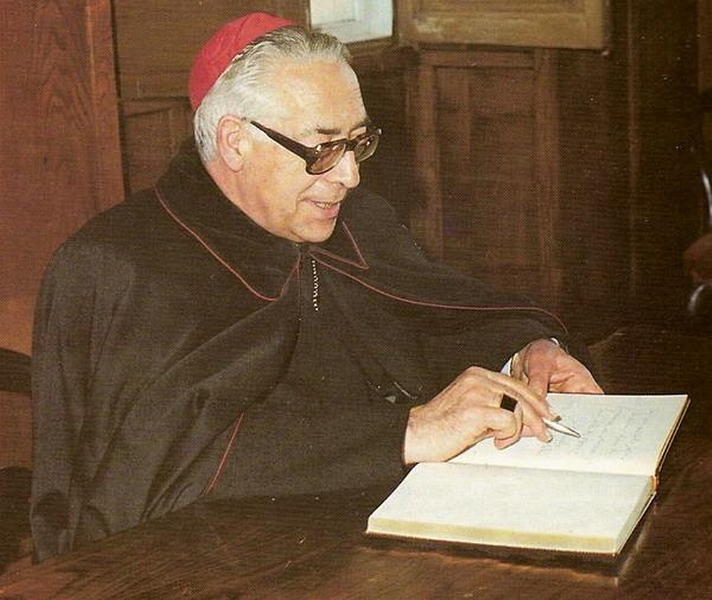
In the months leading up to the 1978 constitutional referendum, when much of the political class and a large part of Spanish society supported the new constitutional text as a symbol of consensus and national reconciliation, one of the Church’s most influential voices decided to voice its reservations publicly. It was Cardinal Marcelo González Martín, Archbishop of Toledo and Primate of Spain, who warned that certain provisions of the future Constitution could distance the nation from the Christian roots that had shaped its historical identity.
This figure and his role during the Transition have been recalled in an interview aired by the program Tiempos Modernos, hosted by Mario Pérez, in which priest and historian Alberto José González Chaves took part—one of the foremost experts on the life and thought of the cardinal primate.
The Primate Who Chose to Raise His Voice
According to González Chaves, Don Marcelo was not a bishop systematically opposed to the political changes of the Transition, nor was he a defender of state confessionality as it had existed under Francoism. Nevertheless, he believed his pastoral duty obliged him to warn about certain issues he considered especially troubling in the constitutional text.
In November 1978 he published a brief but forceful pastoral instruction in which he pointed out several aspects that, in his view, could have profound consequences for Spain’s future. Among them were the absence of any explicit reference to God, the lack of recognition of natural law as the foundation of social coexistence, insufficient guarantees for freedom of education, and ambiguities concerning the protection of life and the family institution.
That document received the support of several Spanish bishops and became one of the most significant ecclesial interventions during the constitutional debate.
A Warning on Spain’s Christian Identity
For the then Archbishop of Toledo, the underlying issue was not strictly political. As González Chaves recalled, the cardinal understood that Spain could adopt a non-confessional model of the State without thereby renouncing recognition of the Christian heritage that had marked its history for centuries.
Don Marcelo distinguished between a State that did not officially profess a religion and one that acted as though God, natural moral law, or Christian tradition were irrelevant to public life. In his opinion, omitting those principles could open the door to far-reaching cultural and legislative transformations.
His concerns focused especially on areas such as education, the family, and the defense of life—issues that years later would occupy a large part of Spanish political and social debate.
The Biography That Recovers His Legacy
The conversation also touched on the recent publication of the monumental biography Don Marcelo. Navegante y sembrador, published by Homo Legens and written by Santiago Calvo Valencia, José Luis Galán Muñoz, and Alberto José González Chaves himself. The work, presented in two extensive volumes, reconstructs in detail the human, pastoral, and intellectual trajectory of the cardinal primate and devotes ample space to his intervention during the Spanish Transition.
The authors analyze especially the years of the constituent process and the reflections that led Don Marcelo to express publicly his reservations about certain aspects of the 1978 Constitution. The study allows a better understanding of the context in which those warnings arose and of the cardinal’s concern for Spain’s spiritual future.
Many of those concerns were precisely addressed during the Tiempos Modernos interview, where González Chaves explained how the primate viewed with concern the progressive weakening of Christian consciousness in Spanish society and the risk that faith would be relegated to the strictly private sphere.
An Uncomfortable Figure in Times of Consensus
During the interview, González Chaves maintained that Don Marcelo was frequently portrayed as a dissenting voice within the climate of consensus of the Transition. However, he defended that the cardinal was simply exercising the right and duty to participate in public debate from the responsibility proper to a pastor of the Church.
The historian also stressed that the prelate possessed a long-range vision that led him to detect risks others did not perceive at the time. For this reason, he believes many of his warnings have once again become the subject of discussion decades later, especially regarding issues related to the secularization of Spanish society, the crisis of the family, the decline in birth rates, or the progressive disappearance of Christian references in public life.
A Legacy That Returns to Public Debate
Almost half a century after the approval of the Constitution, the figure of Don Marcelo González Martín continues to arouse interest among historians, priests, and observers of Spanish ecclesial life.
His intervention during the constituent process remains one of the most significant reflections offered by the Church on the cultural and moral meaning of the Transition. Beyond the political debates of the time, his question remains open: whether a nation can redefine its legal and political structures without losing the spiritual and cultural convictions that shaped it for centuries.