


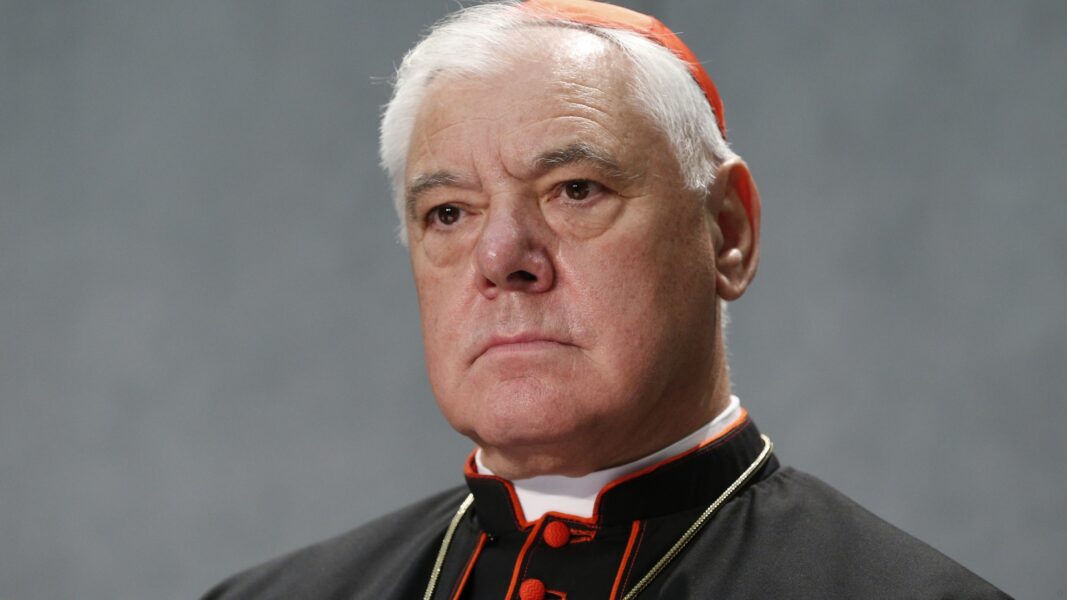
Europe runs the risk of losing its identity and even its future if it continues to drift away from the Christian roots that gave birth to its civilization. This was the warning issued by Cardinal Gerhard Müller during a conference held on June 17 at the Italian Chamber of Deputies, where the prefect emeritus of the Congregation for the Doctrine of the Faith delivered one of the most forceful critiques in recent years against the ideological drift of European institutions.
The intervention took place during the event titled «Eurogender Diktat: Christian Roots, Religious & Educational Freedom at Risk in the EU» («The Eurogender Dictatorship: Christian Roots and Religious and Educational Freedom at Risk in the EU»), organized by the Catholic association I RadicaTi dal diritto naturale alla legge and promoted by Deputy Massimo Milani, a member of Fratelli d’Italia, the party of Prime Minister Giorgia Meloni.
A conference against gender ideology and Europe’s cultural drift
The meeting was conceived to analyze the consequences of certain policies promoted from Brussels in areas such as family, education, religious freedom, and freedom of expression.
The organizers denounced that some European initiatives presented under the banner of combating discrimination are fostering a growing ideological imposition in matters related to gender, sexuality, and human anthropology.
According to the event’s promoters, Europe is going through a phase in which the defense of Christian roots and the traditional vision of the family is frequently portrayed as an obstacle to progress, while certain ideological currents receive privileged institutional protection.
It was in this context that Müller spoke, offering a broad reflection on the spiritual, cultural, and political crisis facing the continent.
«Europe was born of Christianity»
The German cardinal recalled that the founding fathers of the European project—figures such as Robert Schuman, Alcide De Gasperi, and Konrad Adenauer—never conceived of Europe as a mere economic or administrative structure.
In his view, European unity arose from a shared vision of the human person deeply shaped by Christianity, which enabled the development of concepts now considered fundamental, such as human dignity, freedom of conscience, equality before the law, and fundamental rights.
«It is on this foundation that the European Union stands today», he stated.
For this reason, he warned that a Europe detached from the Gospel risks «suicidally surrendering to its own downfall».
The crisis of the family and human identity
Müller identified the disintegration of the family and confusion over human identity as some of the main symptoms of Europe’s cultural crisis.
He explained that the continent is undergoing a process of questioning the most basic anthropological realities, driven largely by gender ideology and transhumanist currents that seek to redefine human nature itself.
The prefect emeritus denounced what he described as a cultural transformation inspired by a «Jacobin» logic, contrary to the natural family and personal identity.
He also accused certain European institutions of promoting a form of «gender totalitarianism» that increasingly threatens freedom of thought and education.
The risk of «soft despotism»
One of the central concepts of the intervention was that of «soft despotism», drawn from the French thinker Alexis de Tocqueville.
Müller argued that Western democracies no longer tend to restrict freedoms through open persecution or state violence, but rather through much more subtle mechanisms: administrative regulations, ever-expanding bureaucracies, and cultural pressures aimed at standardizing thought.
In this context, he directed explicit criticism at certain European regulations related to digital content control and the fight against disinformation.
In his view, governments and political institutions should not claim the authority to determine what is true and what is false, but should limit themselves to pursuing the common good while respecting the freedom of citizens.
«A testing ground for woke ideology»
Müller denounced the influence of certain international organizations and global elites that, he claimed, promote a technocratic and secularized vision of society.
Among other examples, he mentioned the World Economic Forum and the Club of Rome, organizations he accused of advancing cultural programs incompatible with Europe’s Christian tradition.
According to the cardinal, Europe risks becoming «a testing ground for atheistic woke ideology», where religion is progressively expelled from the public sphere and reduced to a strictly private matter.
He also expressed concern over the demographic crisis and the cultural consequences of migration policies pursued in recent decades, stating that many governments have ignored the challenges of integration and social cohesion associated with these processes.
Artificial intelligence, faith, and reason
Artificial intelligence also featured prominently in the conference.
Müller linked this debate to the reflections developed by both Benedict XVI and Leo XIV on the relationship between faith, reason, and technological progress.
Drawing on the Regensburg lecture and the recent encyclical Magnifica humanitas, he argued that technological innovation must remain subject to objective ethical criteria and respect for human dignity.
«We must not become dogs of the masters of artificial intelligence», he stated graphically.
For the cardinal, the great challenge of the 21st century is to prevent humanity from becoming subordinate to the tools it has itself created.
Recovering the roots to save Europe
The intervention concluded with a call to recover confidence in the Christian heritage that shaped Europe.
Müller maintained that the demographic, cultural, technological, and political problems currently affecting the continent cannot be solved through more bureaucracy or new ideological experiments, but only by rediscovering the moral principles that made European civilization possible.
In his view, the real dilemma facing Europe is neither political nor economic, but cultural and spiritual: whether it wishes to continue building its future on the Christian conception of the human person or to keep moving toward a society increasingly detached from the roots that for centuries gave it cohesion, identity, and meaning.