


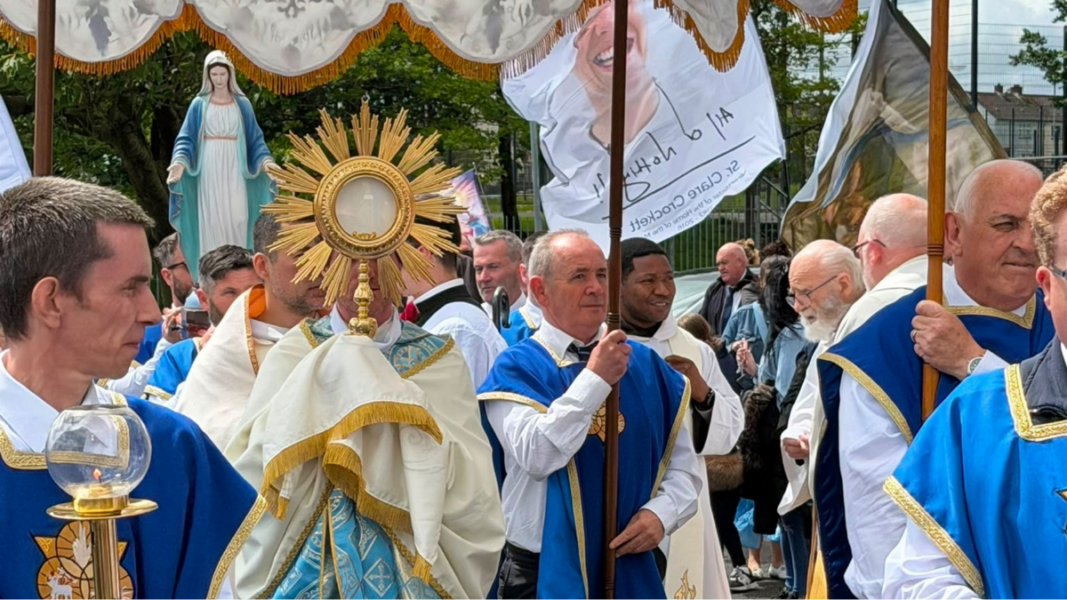
Thousands of Catholics took part on June 13 in the first coordinated worldwide Marian Eucharistic procession, an initiative that united more than 550 parishes and 16 Marian shrines across six continents to pray for peace, the conversion of souls, reparation for sins, and the triumph of the Immaculate Heart of Mary.
The event, promoted from the city of Derry in Northern Ireland, coincided with the feast of the Immaculate Heart of Mary, the memorial of Our Lady of Fatima, and the feast of Saint Anthony of Padua. It marked the first time that parishes and shrines around the world participated simultaneously in a Marian Eucharistic procession organized in a coordinated manner.
Derry, the heart of an international mobilization
The epicenter of the day was in Derry, where around 6,000 people joined a large procession that passed through some of the most emblematic sites in the recent history of Northern Ireland.
The day began with the celebration of Holy Mass in an area closely linked to the local Catholic community and to the best-known episodes of the so-called Troubles. After the Eucharist, the faithful advanced praying the Rosary, singing hymns, and carrying images of Christ the King and the Blessed Virgin while accompanying the Blessed Sacrament through the city streets.
The procession concluded beside the historic walls of Derry, near Long Tower Church, a temple tied to the city’s Catholic history and also known as the parish of origin of the Servant of God Sister Clare Crockett.
Fatima, Lourdes, Garabandal and other major shrines joined the initiative
The call transcended Irish borders. Among the participating shrines were some of the world’s main centers of Marian pilgrimage: Fatima, Lourdes, Knock, La Salette, Pontmain, Garabandal, Beauraing, and the convent of Coimbra, where Sister Lucia, one of the Fatima visionaries, lived.
In addition to these shrines, hundreds of parishes in Spain, France, Germany, Poland, the United States, Canada, India, Nigeria, Uganda, the United Arab Emirates, and other countries organized simultaneous processions with the Blessed Sacrament.
The fruit of two previous worldwide processions
The initiative did not arise spontaneously. The organizers had already promoted two major international Eucharistic processions during 2025.
The first took place in February, coinciding with the feast of Saint Brigid of Ireland, while the second was held in November, around the solemnity of Christ the King. What began by gathering a few dozen parishes has grown to more than 550 participating communities in this year’s event.
Barry Mallett, a member of Guardians of the Faith and one of the initiative’s promoters, stated that the spiritual fruits are already visible.
“We have seen an increase in Mass attendance and vocations, along with a genuine desire for these processions to continue helping to bring young people back to God,” he explained in statements to EWTN News.
According to Mallett, there has also been a rise in conversions and a renewed interest in the faith among young people of the so-called Generation Z.
Young people, families, and a renewed confidence in the faith
One of the aspects most highlighted by participants was the notable presence of young people and families.
Dominican Father Patrick Desmond, who took part in the Derry procession, said the atmosphere experienced was a source of hope for many Catholics.
“So many young people. So many young families. All of this encourages us to remember that the Lord continues to guide His Church,” he noted.
For the organizers, the mobilization shows that the Eucharist continues to hold a central place in the lives of many faithful and that public expressions of faith continue to awaken interest even in deeply secularized societies.
Ireland and the Immaculate Heart of Mary
The promoters of the event also link this initiative to recent religious events in Ireland.
Just days before the procession, the Primate of All Ireland, Archbishop Eamon Martin, renewed the consecration of the country to the Immaculate Heart of Mary during a national prayer gathering held in Knock. The previous year, he had also renewed Ireland’s consecration to the Sacred Heart of Jesus.
For many participants, these national consecrations and the growth of Eucharistic processions form part of the same movement of spiritual renewal aimed at strengthening the Catholic faith in a cultural context increasingly distant from Christianity.
A light being rekindled
Some organizers have symbolically linked this mobilization to ancient traditions associated with Saint Patrick. According to those accounts, after a period of weakening faith, a new spiritual light would arise from the north of Ireland destined to spread throughout the island and beyond its borders.
Beyond these interpretations, the first worldwide Marian Eucharistic procession has demonstrated the drawing power that the Eucharist and devotion to the Virgin Mary continue to have when presented without hesitation in the public square.