


Thousands of faithful accompanied the Blessed Sacrament through the streets of numerous Spanish cities this Thursday during the celebration of Corpus Christi, one of the most important solemnities in the Catholic liturgical calendar. From Toledo to Seville and Granada, Eucharistic processions bring together the faithful, priests, religious, and civil authorities around one shared reality: the presence of Christ in the Eucharist.
This year’s celebrations have been marked by constant references to the upcoming visit of Pope Leo XIV to Spain, as well as calls to strengthen faith, ecclesial communion, charity, and the commitment of Catholics in an increasingly secularized and fragmented society.
Toledo, where Corpus Christi is part of the city’s identity
The Primate Cathedral of Toledo hosted the solemn Eucharist in the Hispano-Mozarabic rite, presided over by the Archbishop of Toledo and Primate of Spain, Monsignor Francisco Cerro Chaves. The celebration also took place during the year in which the cathedral commemorates the eighth centenary of the beginning of its construction.
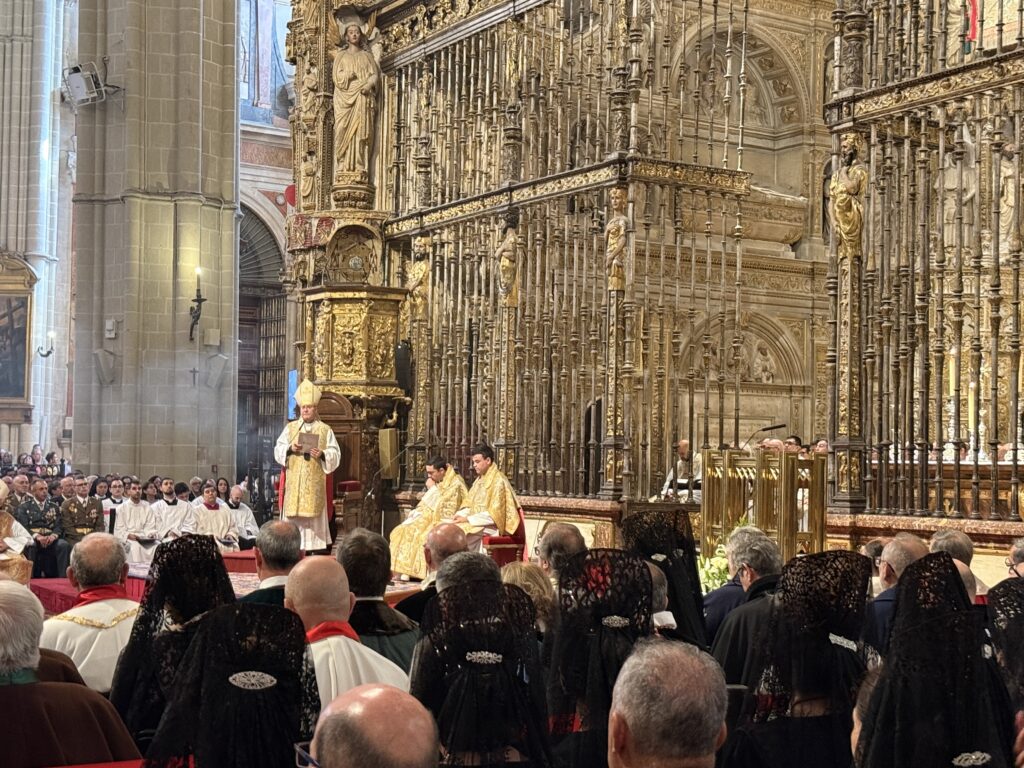
During the homily, the archbishop recalled the upcoming visit of Leo XIV to Spain and emphasized the importance of the Eucharist as the sacrament of communion. “We cannot live without the Eucharist celebrated, received, and adored,” he stated, insisting that the living and risen Christ remains truly present in the sacrament.
Cerro also highlighted the inseparable bond between Toledo and Corpus Christi, a celebration that each year turns the city into one of the main references of Eucharistic devotion in Spain. “Toledo cannot be understood without the Eucharist, without Corpus Christi, nor can Corpus Christi be understood without Toledo,” he noted.
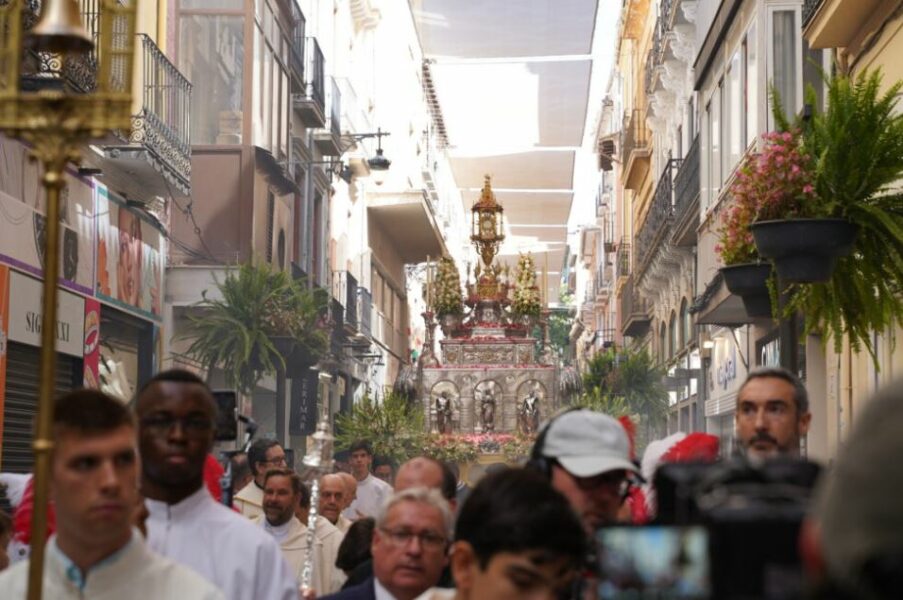
The traditional procession of the Custodia of Arfe once again wound through the streets of the historic center amid decorated balconies and thousands of faithful who accompanied the Blessed Sacrament on its route.
Seville: “The Eucharist is the heart of the Church”
In Seville, the solemnity began with the Eucharistic celebration in the Cathedral presided over by Archbishop José Ángel Saiz Meneses.
During his homily, the prelate recalled that the Church does not celebrate “an empty symbol” or a mere inherited tradition, but the true presence of Christ in the Eucharist. “Speaking today of Corpus Christi is not speaking of one more devotion among others. It is speaking of the heart of the Church, of the heart of the priesthood, of the heart of every parish,” he affirmed.

The archbishop also wished to emphasize the profound meaning of the Eucharistic procession. In his view, the passage of the Blessed Sacrament through the city streets cannot be reduced to a cultural or folkloric manifestation, but constitutes an authentic public profession of faith.
Saiz Meneses encouraged the renewal of the centrality of Sunday Mass, the promotion of Eucharistic adoration, and the strengthening of the spiritual life of parishes. He also asked that Seville continue to be a city deeply marked by the presence of Christ in the sacrament.
After the celebration, the Custodia of Arfe joined the traditional procession through the streets of Seville’s historic center, accompanied by thousands of people.
Granada unites Eucharist, charity, and concord
The city of Granada once again experienced one of its most emblematic days with the celebration of Corpus Christi, marked by the massive participation of the faithful in the Cathedral and in the subsequent Eucharistic procession.
The Custodia made its way through the city’s main streets accompanied by the Sacramental Squad, popularly known as “God’s white legion,” while thousands of people followed the Blessed Sacrament amid showers of petals and floral carpets.
In the Eucharist celebrated in the Cathedral, Archbishop José María Gil Tamayo focused much of his reflection on the need to promote unity and concord in a society marked by polarization.
The prelate recalled that the Eucharist necessarily leads to charity and highlighted the celebration of the Day of Charity, which the Church commemorates alongside the solemnity of Corpus Christi. “The Eucharist leads us to strengthen charity among all as an expression of our love for God,” he affirmed.
Gil Tamayo also invited collaboration with Caritas and not to forget those who suffer material difficulties, loneliness, or exclusion, recalling that love of neighbor is an inseparable part of Eucharistic life.
The celebration in Granada also included the participation of the Seises of the Cathedral, a tradition revived in recent years, as well as the presence of numerous children who received their First Communion this year.
God walks the streets once again
Although each city preserves its own traditions, the celebrations in Toledo, Seville, and Granada shared the same conviction: the Eucharist occupies the center of Christian life and the Corpus Christi procession constitutes a public manifestation of that faith.
The monstrances traversed squares and streets adorned for the occasion, accompanied by faithful of all ages. In a social context marked by secularization, the processions once again demonstrated the vitality of one of the most deeply rooted celebrations in Spanish Catholic tradition.
The solemnity of Corpus Christi recalls the real presence of Jesus Christ in the Eucharist and publicly prolongs the adoration the Church offers to the Blessed Sacrament. Therefore, when the monstrances leave the churches and traverse the cities, Catholics visibly express a faith rooted in centuries of tradition and which continues to find in the Eucharist its source and its summit.