


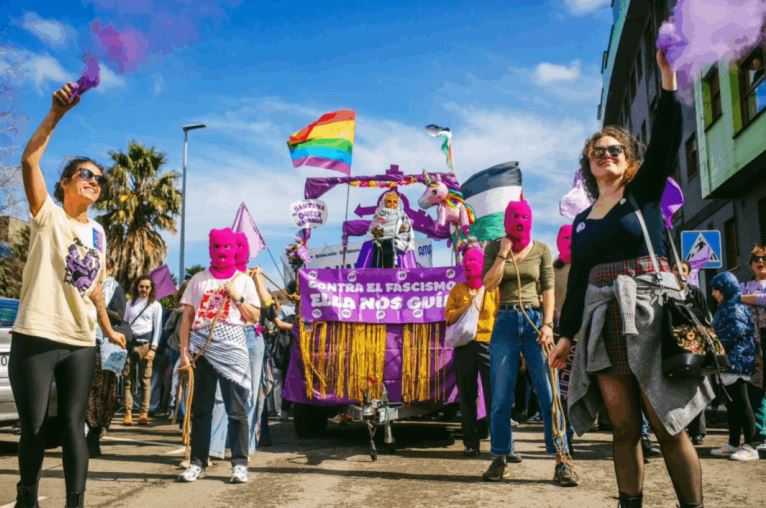
The exhibition of the so-called «Santina Queer» during the March 8 demonstration held this year in Villaviciosa has once again placed the Virgin of Covadonga at the center of a judicial controversy. The Investigating Court of the Asturian town has opened preliminary proceedings to investigate a possible crime against religious feelings for the use of an altered representation of the patron saint of Asturias during the feminist march.
The investigation adds to a complaint filed before the Hate Prosecutor’s Office of the Superior Court of Justice of Asturias by the Brotherhood of the Students of Oviedo, which considers that the use of the image amounted to a mockery of one of the most important religious symbols of the Principality.
A representation of the Santina in the middle of the feminist demonstration
The controversy revolves around a figure inspired by the Virgin of Covadonga that paraded during the demonstration accompanied by trans symbolism, rainbow flags and other elements linked to the claims of the LGTBI movement. The image, carried by members of Asamblea Moza d’Asturies (AMA), also evoked the aesthetics of a religious procession.
The complainants maintain that the representation recognizably reproduced the image of the Santina and that its use in that context constituted a lack of respect for the beliefs of Catholics. The Virgin of Covadonga occupies a singular place in the religious and cultural history of Asturias, where she is venerated as the patron saint of the Principality.
The court finds grounds to investigate the facts
The judge has ordered various proceedings to clarify what happened, including the identification of those responsible for the organization, the taking of statements from witnesses and the summons of representatives of the group involved.
The judicial ruling points to the existence of indications that justify the opening of an investigation for a possible crime of religious mockery. However, the proceedings are still in the investigation phase and must determine whether the facts have criminal relevance.
The organizers defend the initiative
From Asamblea Moza d’Asturies they reject that the action was offensive and maintain that the so-called «Santina Queer» was intended to express values related to feminism, antifascism and the defense of the rights of LGTBI people.
Their spokespersons have publicly defended that the initiative sought to claim a certain vision of society and Asturian identity, denying that there was any intention to attack the religious beliefs of Catholics.
A controversy that had already occurred
This is not the first time that this representation has generated controversy. The so-called «Santina Queer» had already been exhibited during the March 8 demonstration held last year in Gijón, giving rise then to complaints and judicial actions that also sparked an intense debate on the limits of freedom of expression and the respect due to religious symbols.
The new investigation thus reopens a discussion on the blasphemous use of Christian images and references in acts of a political and ideological nature, especially when they affect symbols deeply rooted in popular devotion and in the identity of a Catholic community.