


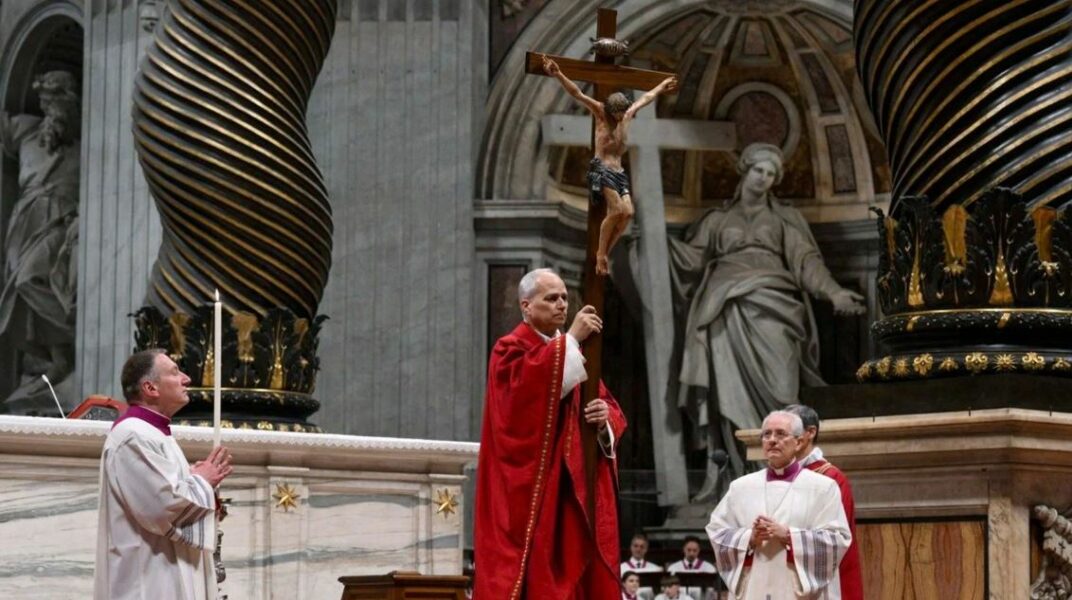
Pope Leo XIV warned this Thursday about the growing crisis of faith affecting numerous Western countries and called on the Church to recover an evangelization explicitly centered on Christ, capable of responding both to contemporary religious indifference and to the spiritual search that, he stated, remains present especially among young people.
The Pontiff made these reflections during the audience granted to participants in the plenary session of the Dicastery for Evangelization, held at the Vatican Apostolic Palace, where he insisted that the evangelizing mission cannot be relegated to a secondary aspect of ecclesial life, but must continue to be “the fundamental motivation” of every action of the universal Church and of local communities.
“The world thirsts for hope more than ever”
Leo XIV began his address by recalling the Jubilee celebrated last year, which brought together more than 33 million pilgrims in Rome. In his view, that event made it clear that, even in deeply secularized societies, a real spiritual need and a desire to find solid reasons for hope still exist.
“The world thirsts for hope more than ever,” the Pope affirmed, convinced that contemporary man continues to seek certainties capable of giving meaning to existence amid a context marked by cultural uncertainty, social tensions, and the fragmentation of traditional moral references.
Precisely from this concern, Leo XIV placed hope as one of the fundamental axes of contemporary evangelization. As he explained, the Christian proclamation cannot be reduced to an abstract or merely theoretical proposal, but must concretely show that it is possible to build a more human life and society based on the Gospel. “Evangelization,” he stated, “is not a utopian proposal: it is a testimony that attracts because it manifests the call to love and to truth.”
Secularization and the loss of meaning
Following this initial reflection, the Pontiff devoted a large part of his speech to the process of secularization affecting especially Western countries. Leo XIV lamented that, for broad sectors of society, the Christian faith today appears as something progressively irrelevant to daily life, often reduced to a cultural tradition without real capacity to guide existence.
“The underlying danger, not always perceived in all its gravity, is that the breath may be lacking for what is most human: the search for meaning,” the Pope noted, linking this situation to the expansion of a technological culture that claims to respond to all human needs, but which frequently leaves unanswered the deepest questions about the meaning of life, suffering, or humanity’s ultimate destiny.
In this context, Leo XIV defended that the encounter with Christ continues to be capable of restoring “fullness of meaning and value” to human existence and recalled that no one can replace the Church in the mission of proclaiming the Gospel. According to him, the possibility of building a future based on peace, justice, freedom, and fraternity also depends on this task.
A “Christocentric and kerygmatic” evangelization
The Pope also revisited some of the main proposals of Pope Francis’s apostolic exhortation Evangelii gaudium, which he defined as a “decisive point of reference” for the Church’s evangelizing mission today. Leo XIV expressly invited the Dicastery for Evangelization to recover this document in order to promote a “Christocentric and kerygmatic” mission, born of a personal encounter with Christ and not simply from organizational or sociological strategies.
The reference was not accidental. Throughout his entire speech, the Pontiff insisted that evangelization does not depend primarily on the effectiveness of ecclesial structures or on the social recognition the Church may receive at certain historical moments, but on the authenticity of faith and on the capacity of Christians to give a coherent and credible witness.
“Evangelization does not rely on the effectiveness of structures or on social relevance,” he affirmed. “What is essential is to trust in the guidance of the Holy Spirit.”
Young people and the spiritual search
One of the central moments of the address was dedicated to young people. Leo XIV stated that the new generations do not show an automatic rejection of Christianity and that, on the contrary, there exists among many of them a strong spiritual search that often does not find convincing answers in the dominant culture.
The Pope noted that numerous young people, when they rediscover the Gospel, wish to deepen in it because they perceive that it contains “the secret to being truly happy.” From this perspective, he rejected the idea that Christianity could become more attractive by lowering the demands of faith or diluting its doctrinal content.
“It is not by diluting the contents or softening the demands that Christianity becomes attractive,” the Pontiff affirmed, but through the humble and coherent witness of those who live the faith authentically. In this context, he extensively quoted Benedict XVI to emphasize that the Church needs men and women capable of making God credible in today’s world through an enlightened and lived faith.
For Leo XIV, “the holiness of life remains always the most convincing form of the beauty of the Christian faith,” an affirmation with which he wished to insist that the transmission of faith depends above all on personal and communal witness.
Concern for the transmission of faith
The Pontiff finally expressed his concern about the growing difficulties in transmitting the faith between generations. As he explained, in some regions of the world this process “has practically been interrupted,” leaving many young people in a situation of “spiritual poverty” marked by the lack of solid references and tools to face the great questions of life.
Leo XIV also warned that hypermediated and consumerist societies reduce the capacity for a patient search for truth and favor any message being perceived simply as “one opinion among many.” In response, he insisted on the need for Christian communities capable of personally accompanying young people, catechumens, and new baptized through authentic relationships, communal life, and coherent witness.
For this reason, he also devoted a significant part of his speech to catechesis, calling for special attention to those who today approach Baptism or receive Confirmation. In the Pontiff’s view, the Church’s task does not end with the administration of the sacraments, but requires offering human and spiritual environments where faith can grow and be sustained over time.