


The publication of Magnifica Humanitas, the first major encyclical of Leo XIV, has been received as an intellectual event of enormous relevance both inside and outside the Church. The document addresses in depth decisive issues for the future of the West: artificial intelligence, human dignity, technocratic power, and the identity of peoples.
However, while much of the debate has focused on the content of the encyclical, another seemingly minor detail has gone almost unnoticed: for the first time in modern history, a papal encyclical has been published without an official Latin edition.
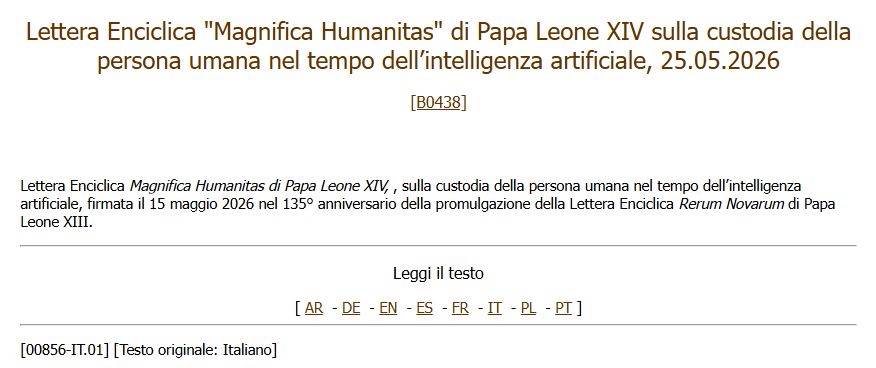
The document was released directly in Arabic, German, English, Spanish, French, Italian, Portuguese, and Polish, but not in Latin. The last encyclical published by the Holy See had been Dilexit nos, by Francis, in 2024, and it did include its corresponding official Latin version.
And that fact, far from being anecdotal, reveals a much deeper transformation within the Church.
For centuries, Latin was the official voice of the Church
Latin was not a mere academic formality or an aesthetic concession to tradition. For centuries it was the juridical, doctrinal, and liturgical language of the Catholic Church.
Encyclicals, apostolic constitutions, canons, and major documents of the magisterium were officially promulgated in Latin. Translations into other languages derived from that original text, considered the authentic and definitive reference.
Read also. Latin in the Church: history, decline, and the new Vatican regulation on its use
For centuries, Latin functioned as the definitive reference text of the pontifical magisterium: if a doubt arose about a specific expression, an ambiguous translation, or the true scope of a formulation, one could always turn to the original Latin as a reliable interpretive criterion.
With Magnifica Humanitas, however, the situation changes radically. Having been published simultaneously in different modern languages without a normative Latin edition, it is no longer entirely clear which text should be considered definitive in case of divergences, differing nuances, or translation issues between versions.
The reform of Leo XIV formalizes a trend begun years ago
The absence of an official Latin version of Magnifica Humanitas does not appear in isolation. It is part of a broader transformation that Leo XIV decided to consolidate legally at the end of 2025 with the promulgation of the new General Regulations of the Roman Curia.
The regulation, which came into force on January 1, 2026, introduced a historic change in the Vatican’s language policy by establishing that curial documents may be drafted “in Latin or in another language.” The formula, seemingly technical, in practice marks the end of the effective primacy of Latin as the normal working and reference language within the Roman Curia.
Read also. Deep reform in the Vatican: this is how the Curia will be under Leo XIV
For centuries, Latin had occupied a singular and clearly superior place in ecclesiastical administration. Now, by contrast, it appears legally equated with any other modern language, reflecting a reality that had been imposing itself de facto for years in numerous Vatican bodies.
In reality, the new regulation did not initiate the transformation but rather officially regularized a dynamic that had accelerated especially during the pontificate of Francis: documents drafted directly in Italian or English, synods conducted in modern languages, and a progressive reduction of Latin to symbolic, ceremonial, or purely archival functions.
A paradox of the new pontificate
All of this is especially striking because Magnifica Humanitas is, precisely, an encyclical deeply concerned with the anthropological crisis of the West.
In it, Leo XIV denounces a civilization increasingly uprooted, dominated by technological power, technocratic logic, and the loss of common cultural and moral references.
Yet at the same time, the Church itself seems to be slowly moving toward a loss of linguistic and historical continuity that for centuries was one of the most visible signs of its universality.
Because Latin was not merely a tool of communication. It was also a link with the memory of the Church, a concrete expression of continuity between generations, and a defense against the cultural fragmentation of the present.
The problem is not translating. The problem is ceasing to have a common language
No one disputes that the Church must speak the languages of the peoples. It has always done so. Evangelization requires entering into concrete cultures.
The real change occurs when the awareness disappears that there also exists a common language that expresses the unity of the Church beyond borders, eras, and political contexts.
Latin precisely recalled this: that Catholicism was not a federation of national Churches adapted to the spirit of the times, but a spiritual civilization with its own memory.
That is why the question of Magnifica Humanitas is not a simple debate for specialists or lovers of liturgical tradition.
The underlying question is another: Can the Church continue to defend the cultural and anthropological continuity of the West while progressively abandoning the most visible expressions of its own historical continuity?