


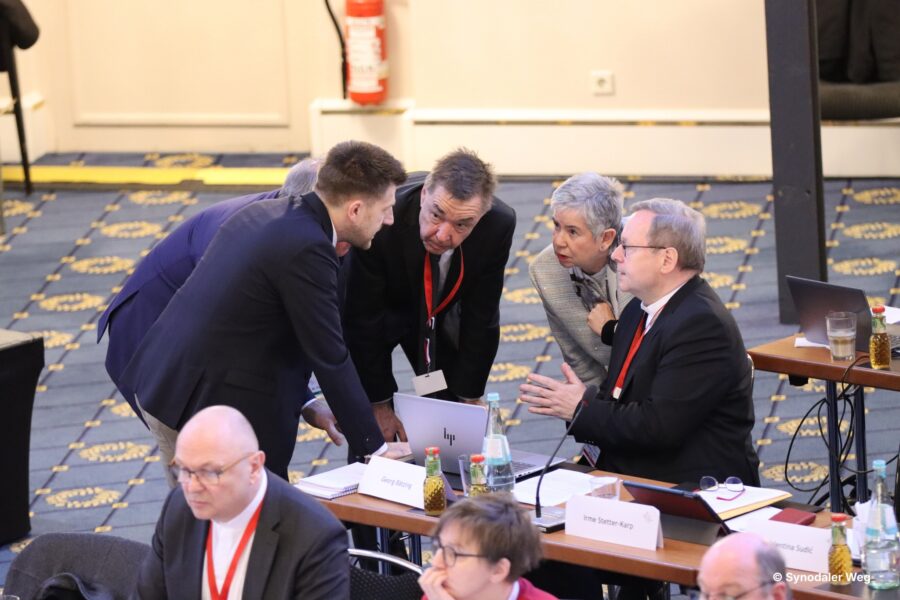
The ambitious German project to permanently institutionalize the Synodal Way is beginning to encounter serious obstacles in Rome. The president of the German Episcopal Conference, Bishop Heiner Wilmer, publicly acknowledged—during the 104th German Catholic Congress held in Würzburg—that the so-called Synodal Conference will hardly be able to meet this November as planned, because its statutes are still being examined by various dicasteries of the Roman Curia, although he expressed confidence that an agreement with the Vatican can ultimately be reached.
The admission is not minor. This new body was meant to become the stable structure that would give continuity to the controversial German Synodal Way, launched in 2019 and marked for years by proposals on sexual morality, ecclesial governance, the role of the laity, celibacy, and the ordination of women, many of which have been repeatedly questioned by Rome.
The German project loses momentum
The so-called Synodal Conference was conceived as a permanent body composed of bishops and laity with the capacity to jointly intervene in pastoral, strategic, and ecclesial governance issues in Germany.
The first session had already been scheduled for November in Stuttgart. However, Wilmer admitted in Würzburg that the schedule will probably have to be delayed because the statutory text continues to move “from one dicastery to another” within the Curia.
Although the German bishop tried to convey calm and assured that he still trusts the process, his words reflect a reality that is becoming increasingly evident: Rome does not seem willing to allow the hasty creation of a structure that many consider incompatible with Catholic ecclesiology.
Rome fears a German “national Church”
The Vatican’s reservations about the Synodal Way are not new. Over the years, various Roman bodies have warned about the risk of creating structures that limit the authority of diocesan bishops or consolidate autonomous dynamics in relation to the universal Church.
The underlying concern remains the same: that Germany might end up institutionalizing a kind of parallel ecclesial structure, capable of acting de facto as a semi-autonomous “national Church.”
Leo XIV changes the climate
Although during the pontificate of Francis, Rome made several interventions against certain drifts of the Synodal Way, in Germany there was always the sense that the Vatican avoided a head-on confrontation.
Now the climate appears different. The recent appointment of Wilmer as bishop of Münster by decision of Leo XIV has been interpreted in some ecclesial circles as a clear signal: the new Pontiff wants to keep Germany within the margins of Roman communion.
This does not mean an immediate dismantling of the German synodal process. In fact, in recent weeks Cardinal Mario Grech avoided completely closing the door to possible convergences between the German Synodal Way and the universal synodal process promoted from Rome.
However, the current delay of the Synodal Conference shows that Leo XIV also does not appear willing to tolerate structural ambiguities or ecclesial experiments that could erode the doctrinal and hierarchical authority of the Church.
Germany no longer appears so united
On the other hand, the German episcopal bloc is beginning to show cracks. The statutory project was approved by very narrow margins within the Episcopal Conference itself, while several bishops continue to express reservations about the possibility of creating bodies that supervise or condition the governance of diocesan bishops.
Even figures traditionally associated with the reformist wing, such as Cardinal Reinhard Marx, expressed discomfort over the idea of a permanent body that could act as a superior instance of episcopal control. The fact that these reservations are beginning to emerge within the very sector that drove the Synodal Way shows how much the project has lost internal security.
A decisive moment for the German experiment
For the first time since the start of the Synodal Way, the German project appears slowed down by Rome and, at the same time, less solid within the own episcopate. We hope that it is a real brake and not a slow and timid pace that avoids facing the issue, while Germany continues to push its reforms without the clear backing of an episcopal majority.