


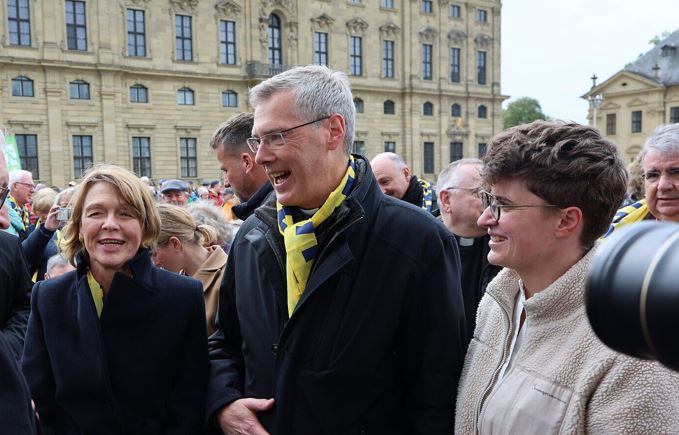
A video circulated on social media shows Monsignor Heiner Wilmer, Bishop of Münster and current president of the German Bishops’ Conference (DBK), receiving Holy Communion from the hands of a laywoman during a Holy Mass celebrated at the German Katholikentag. The images have reignited the debate on sacramental discipline and the growing normalization of controversial practices within certain sectors of the Church in Germany.
The images were captured at the Residenzplatz in Würzburg on Thursday, 14 May, the second day of the 104th German Katholikentag, held between 13 and 17 May 2026. Although the organizers refer to the event as the Eröffnungsgottesdienst (“opening service”), it was in fact a Holy Mass, as shown by the official photographs of the event, where the moment of Eucharistic consecration is clearly visible.
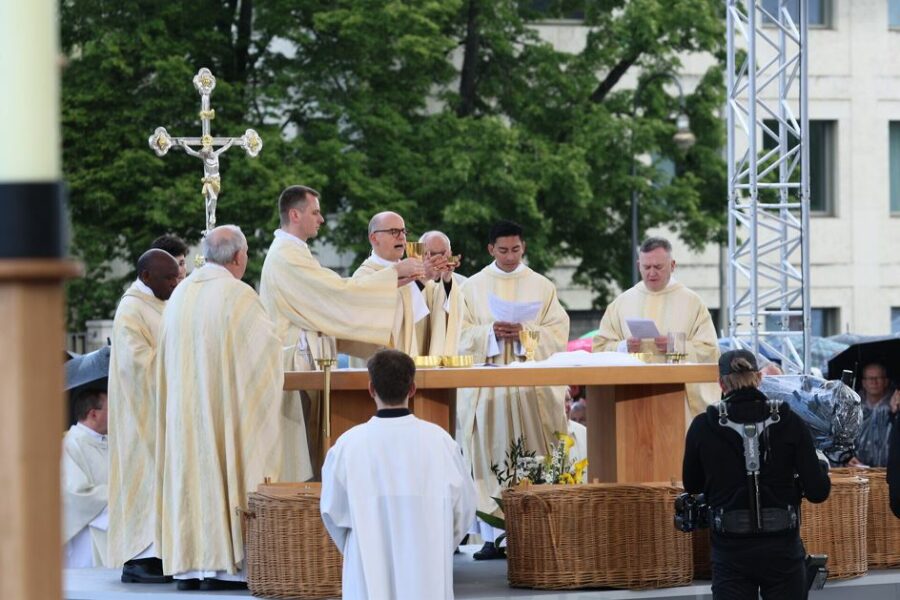
In this context, Monsignor Heiner Wilmer, identifiable by his black coat, is seen receiving Holy Communion from a woman dressed in civilian attire who was acting as an extraordinary minister of Holy Communion.
The scene is striking not so much because of the figure of the extraordinary minister—provided for in canon law for situations of genuine pastoral need—but because it is precisely a bishop who resorts to this assistance during a large-scale celebration with abundant clerical presence. Canon 910 of the Code of Canon Law clearly states that the ordinary minister of Holy Communion is the bishop, priest, or deacon, while the extraordinary minister should only intervene when ordinary ministers are absent or impeded.
«Shouldn’t it be the other way around?»
The question, posed by the user who circulated the video, summarizes the perplexity of many faithful: in a celebration where at least one bishop is present, sacramental logic would indicate that he should be the one distributing Communion, not receiving it from lay hands. The role reversal does not respond to any apparent liturgical need.
A Protestant leader also received Communion
The images also show that, immediately after Monsignor Wilmer, Anna-Nicole Heinrich, president of the XIII Synod of the Evangelical Church in Germany (EKD), the main Protestant organization in the country, also receives Communion.
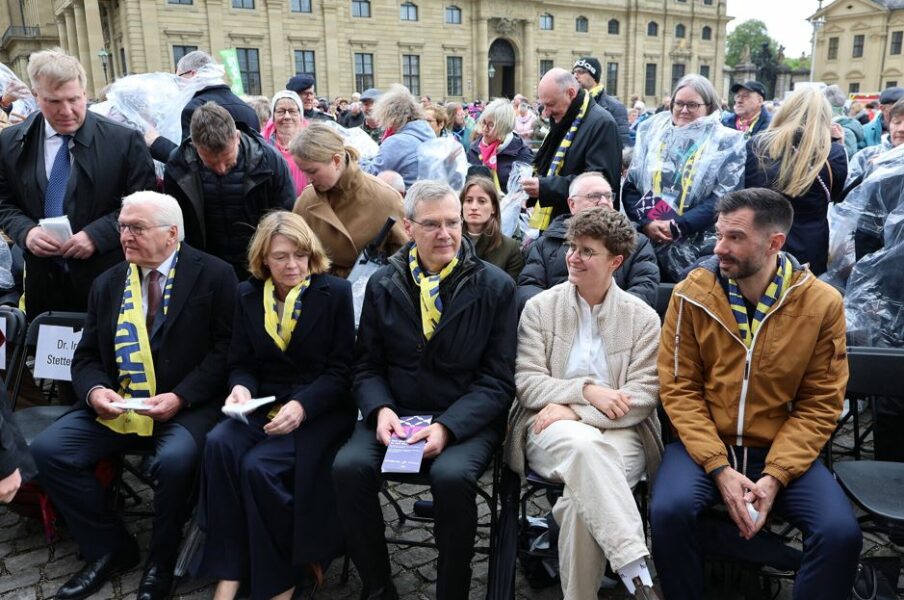
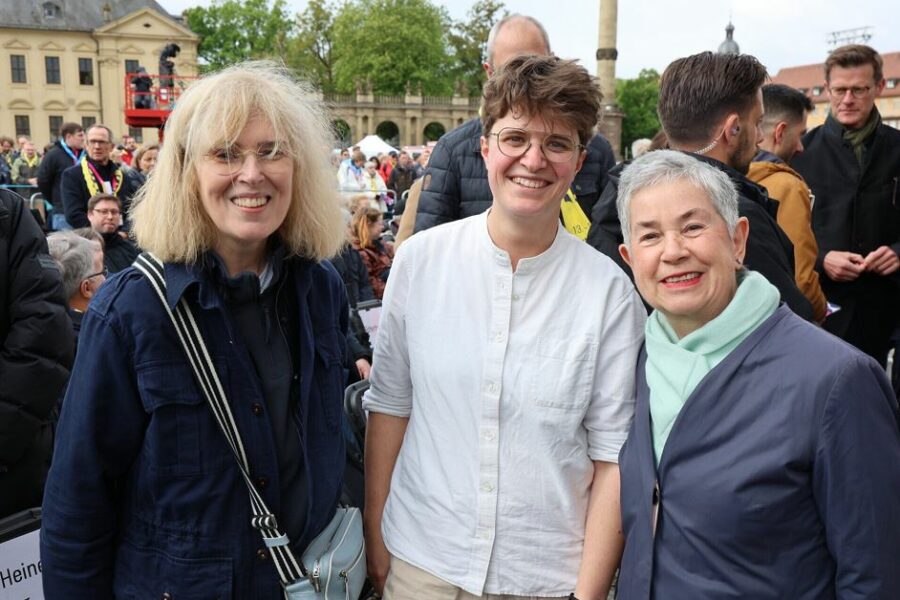
The presence of Heinrich was not incidental. The Protestant leader was also seated next to Monsignor Wilmer during the Mass.
Heinrich participated actively in several events of the congress. According to the official program of the Katholikentag, she took part in the “Central Ecumenical Service” held on Friday, 15 May, alongside Catholic, Orthodox, Anglican, and Old Catholic representatives. She also participated as a speaker in a panel titled “Faith, Homeland, Identity”, dedicated to debating the use of Christian motifs by right-wing political movements.
Her prominent presence within the official program confirms the strong ecumenical and socio-political profile that has characterized the German Katholikentag in recent years, in line with many of the priorities promoted through the Synodal Way.
The Context of the German Synodal Way
The image of a bishop receiving Communion from a laywoman gains special significance within the framework of the Synodal Way promoted by the Church in Germany, a process that has systematically promoted the expansion of the role of laypeople—especially women—in functions previously reserved to the clergy.
Among the most controversial proposals of the German Synod include precisely women’s access to the diaconate, the normalization of lay ministries in the liturgy, and greater openness toward intercommunion with Protestants.
Monsignor Wilmer, a Dehonian of 63 years, has been one of the voices most favorable to the reforms of the Synodal Way since his arrival at the Hildesheim see in 2018 and, subsequently, at Münster in 2023. His election as president of the DBK was interpreted as a sign of continuity with the reformist line of his predecessor, Cardinal Georg Bätzing.
The instruction Redemptionis Sacramentum (2004) of the Congregation for Divine Worship expressly warned against the abuse of using extraordinary ministers when priests are available, describing it as a “reprobable” practice that obscures the nature of ministerial priesthood.
The fact that a bishop is the protagonist of this scene—and not the one correcting it—illustrates the extent to which liturgical discipline has been relaxed in certain sectors of the Central European episcopate.
What Canon Law Says About Protestant Communion
On the other hand, the participation of Anna-Nicole Heinrich in Communion during a Catholic Mass highlights the liturgical drift of certain sectors of the German Church. This is all the more significant during an official celebration of a Catholic Congress and in the presence of the German episcopate, who are also aware of who Heinrich is.
Canon 844 §1 of the Code of Canon Law establishes that Catholic ministers may licitly administer sacraments “only to Catholic faithful,” except for very specific exceptions provided for by the law itself.
In the case of Christians belonging to Protestant or Evangelical communities, Canon 844 §4 only contemplates this possibility in extraordinary situations: danger of death or other grave necessity, inability to approach a minister of their own community, spontaneous request by the interested party, explicit profession of the Catholic faith regarding the Eucharist, and adequate spiritual disposition.
The Church also distinguishes between the validity of the Eucharist and the licitness of receiving it. If the hosts had been validly consecrated, they remained truly the Body of Christ. The problem does not affect the validity of the sacrament, but rather the illicit reception of Communion outside the conditions established by the Catholic Church.