


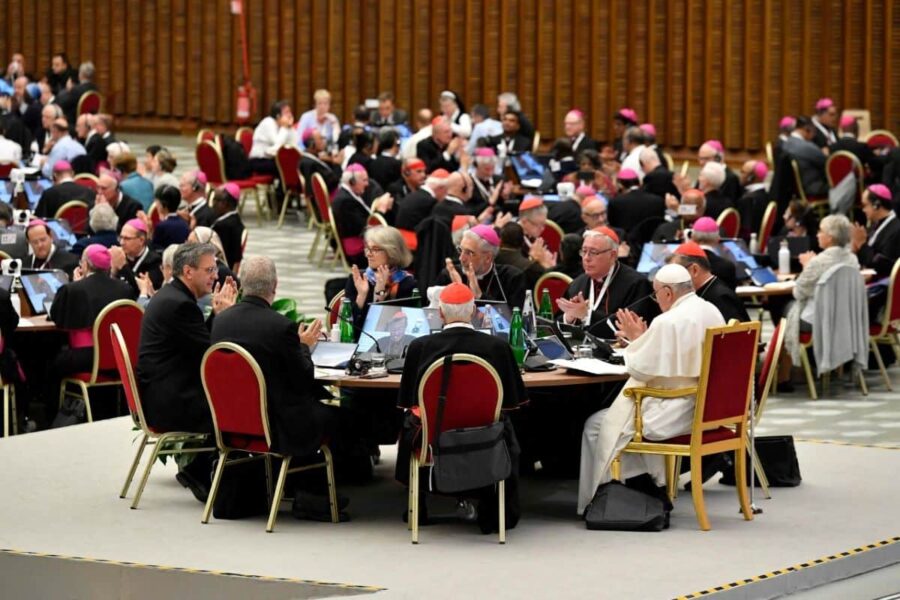
The General Secretariat of the Synod has published this Wednesday the new guidelines for the implementation phase of the so-called “Synod on Synodality”, a process that will culminate in a major Ecclesial Assembly at the Vatican in October 2028 and that consolidates the continuity of the ecclesial model promoted during the pontificate of Francis.
The document, titled Towards the Assemblies 2027-2028: stages, criteria and instruments for preparation, establishes a broad global itinerary through which dioceses, episcopal conferences and continental bodies will evaluate and deepen the reception of the Synod held between 2021 and 2024. The process was initiated by Francis and has been confirmed by Leo XIV, according to the text itself.
Synodality as a permanent structure
The new guidelines make it clear that Rome does not consider the synodal process closed, but rather intends to progressively turn it into a stable principle of functioning within the ordinary life of the Church.
The text repeatedly insists on what it calls “synodal conversion” and presents the future assemblies not as one-off meetings, but as permanent instruments of discernment, evaluation and ecclesial reorganization.
Cardinal Mario Grech, Secretary General of the Synod and principal promoter of the process, stated that the objective is for “synodality to increasingly take shape as the ordinary style of ecclesial life”.
In this way, the synod initiated under Francis ceases to appear as an exceptional event and is projected as a structural dynamic destined to have a lasting impact on the organization and governance of the Church.
Successive assemblies in dioceses, countries and continents
The document foresees a long chain of assemblies that will develop until 2028. During 2027, diocesan meetings will first be held, followed by national and regional encounters. Then continental assemblies will take place, finally culminating in a major Ecclesial Assembly in Rome with the Pope.
Each stage must produce reports, letters and evaluation documents intended to feed the next phase of the process. The Vatican insists that it is not simply about repeating previous consultations, but about consolidating a new ecclesial culture based on listening, co-responsibility and the continuous review of structures and pastoral practices.
“Synodal-style liturgy” and new spaces for lay faithful
The document proposes expanding the access of lay faithful —men and women— to ecclesial responsibilities and leadership functions that do not require the sacrament of Holy Orders. Also proposes reviewing decision-making processes, strengthening participatory bodies and deepening mechanisms of transparency and accountability.
The language used confirms that the Vatican considers synodality not only as a method of consultation, but as a broader transformation of the internal dynamics of authority and participation within the Church.
Participation of other religions and attention to specific groups
The guidelines also insist that the future assemblies must reflect cultural, generational and social diversity, with special attention to women, young people and people in situations of vulnerability or marginalization.
The text also contemplates the possible participation of representatives from other Christian Churches and even from other religions when deemed appropriate.
At the same time, it promotes a “synodal style” applied to ecumenism, interreligious dialogue and the Church’s public presence in educational, cultural, social and political spheres.
A process that will continue beyond 2028
Although the Ecclesial Assembly scheduled for October 2028 appears formally as the culmination of the process, the document itself makes clear that the real objective is to ensure the continuity of this dynamic beyond that date.
In fact, it explicitly asks that those who participate in the various assemblies be willing to sustain the process in the future and to guarantee its continuity in the ordinary life of the Church.
The text also underlines that the liturgical celebrations must serve to visibly express the model of a “synodal missionary Church” promoted by the Vatican.
With these new guidelines, Rome definitively consolidates the extension of the synodal process initiated by Francis and confirms that synodality will continue to mark a large part of the ecclesial reorganization during the pontificate of Leo XIV.