


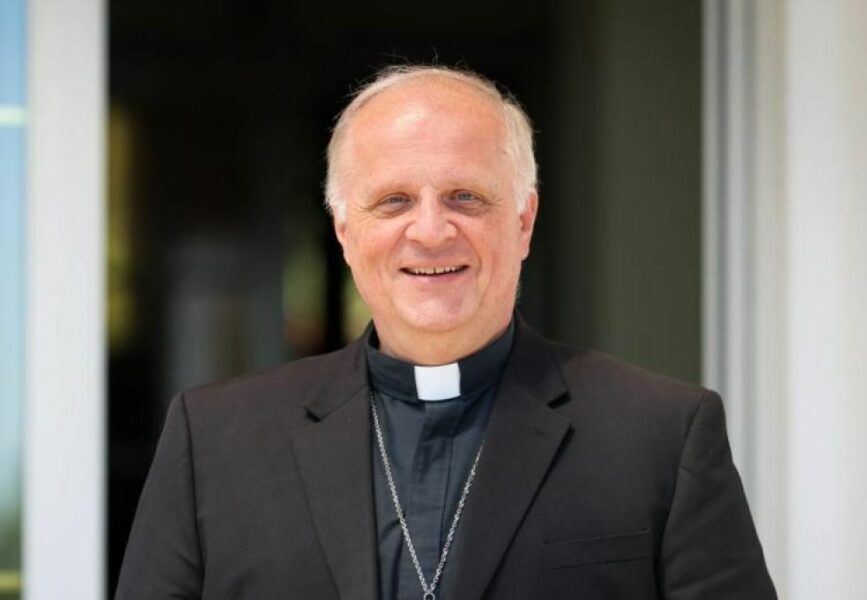
Pope Leo XIV has entrusted the apostolic nunciature in Argentina to a career diplomat trained in the classical school of the Secretariat of State and with experience in some of the most complex scenarios of the contemporary world. The appointment of Monsignor Michael Wallace Banach does not seem accidental. Rome is sending to Buenos Aires a discreet man, seasoned in international diplomacy, doctrinally solid and little inclined to media protagonism.
At 63, Banach lands in an Argentina marked by political tensions, cultural debates on abortion and education, an episcopate still heavily influenced by the long pontificate of Francis, and a new ecclesial stage under Leo XIV. His profile offers important clues about the kind of relationship the Vatican wants to establish with the Argentine Church and with the government of Javier Milei.
An American formed in the old Roman diplomatic school
Michael Wallace Banach was born in Worcester, Massachusetts, on November 19, 1962. He studied Philosophy at the College of the Holy Cross and later moved to Rome to train at the Pontifical North American College. He subsequently earned a doctorate in Canon Law at the Pontifical Gregorian University and completed his diplomatic preparation at the Pontifical Ecclesiastical Academy, the historic training ground for nuncios of the Holy See.
He was ordained a priest for the Diocese of Worcester in 1988 and, just a few years later, entered the Vatican diplomatic service. Since then, virtually his entire priestly life has been spent in pontifical diplomacy.
His résumé reveals a typically Roman trajectory: quiet work, institutional fidelity, and experience accumulated in very different contexts. He served in Bolivia and Nigeria, worked at the Secretariat of State, and later served as the Holy See’s representative to international organizations in Vienna, including the International Atomic Energy Agency, the OSCE, and the Preparatory Commission for the Comprehensive Nuclear-Test-Ban Treaty.
He was subsequently nuncio to Papua New Guinea, the Solomon Islands, Senegal, Mauritania, Cape Verde, and Guinea-Bissau, before being sent by Francis to Hungary in 2022.
A man of Rome, not of ideological laboratory
Those looking for a strident ideological profile in Banach will likely be mistaken. He does not publicly belong to any identifiable ecclesial current, nor is he known for controversial interventions of a political or doctrinal nature. He is not a “media prelate” in the style of certain American bishops, nor a man of explosive statements.
That does not mean doctrinal ambiguity, however.
In his public interventions, Banach has repeatedly defended religious freedom, conscientious objection in bioethical and educational matters, human dignity, and the social role of the Church. In international forums he insisted that religious freedom cannot be subordinated to other ideological rights imposed by states.
This point is especially relevant for Argentina, where issues such as legal abortion, mandatory sex education, and cultural pressures on Catholic institutions remain open.
Banach also does not fit the profile of a progressive diplomat obsessed with climate or sociological agendas. Although he uses the Holy See’s usual diplomatic language on peace, dialogue, and human development, his tone is clearly classical: ecclesial communion, defense of human dignity, centrality of faith, and the irreplaceable role of the Church.
Marian devotion and sober pastoral style
One of the most visible traits of the new nuncio is his Marian spirituality. During his time in Hungary he frequently participated in celebrations linked to the Virgin Mary and delivered homilies centered on forgiveness, mercy, and Christian hope.
His episcopal motto, Humanitate et Caritate, well summarizes his profile: institutional firmness combined with a close and serene pastoral approach.
Those who dealt with him in Hungary describe him as a cordial man with a sense of humor and little given to unnecessary confrontations. Yet behind that affable style also appears an experienced diplomat, accustomed to negotiating in difficult scenarios and representing the interests of the Holy See without stridency.
What his arrival in Argentina may mean
Banach’s arrival coincides with a particularly delicate moment for the Argentine Church. After the death of Francis and the start of Leo XIV’s pontificate, many are waiting for signals about the future direction of the Vatican regarding the Argentine episcopate.
And here the nuncio will play a decisive role.
The main task of a nunciature is not diplomatic in the political sense, but ecclesial: to inform Rome about the situation of the dioceses and to participate in the selection of future bishops. This makes Banach a key figure for the future of the Argentine Church over the next decade.
Everything suggests that he will favor institutional, prudent episcopal profiles capable of maintaining communion with Rome, avoiding both progressive ideological adventures and excessively confrontational styles.
He does not appear to be a man willing to push revolutions, but rather to order and stabilize.
A silent nuncio who may leave a mark
Michael Wallace Banach does not arrive in Argentina as a media figure or as a man called to dominate daily headlines. He is a classic, Roman, institutional, and disciplined diplomat.
But precisely for that reason he may end up having more influence than he appears to.
Rome has not sent an agitator to Buenos Aires. It has sent a professional. And in Vatican diplomacy, that is rarely a minor detail.