


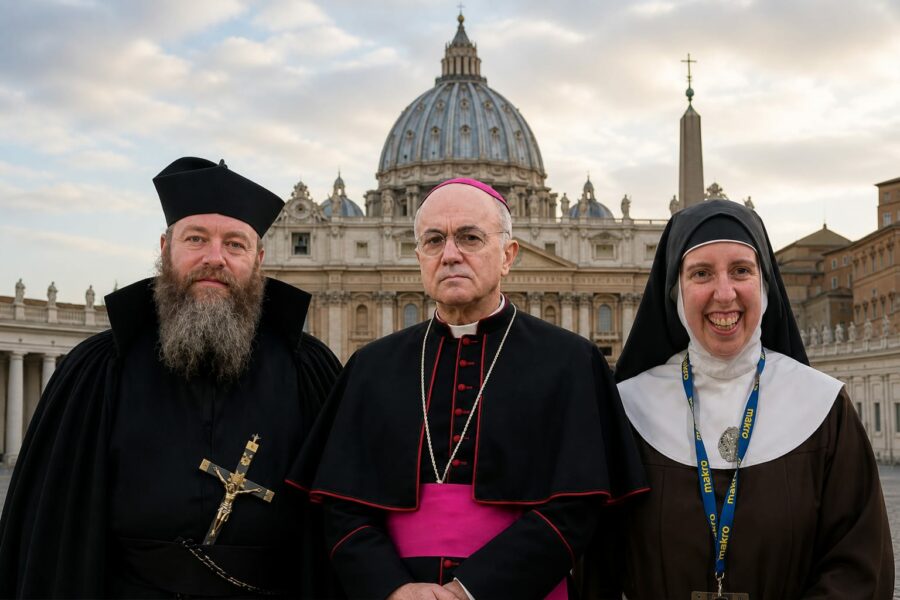
The so-called Transalpine Redemptorists—known as Transalpine Redemptorists—are a traditional-profile community that, after an initial period in the orbit of the Priestly Fraternity of Saint Pius X, was regularized during the pontificate of Benedict XVI and incardinated in a diocese in New Zealand. At that time, they accepted an interpretation of the Second Vatican Council in the light of Tradition and compatible with their charism.
Their austere life and strict liturgical sensitivity had not prevented them from remaining within the ecclesial structure. Until now. A disciplinary intervention motivated by internal denunciations, which point to extreme practices in community life, has precipitated an abrupt shift also on the doctrinal level.
First the conflict, then the doctrine
From that moment on, a pattern reproduces that appears all too frequently: personal or institutional conflict precedes doctrinal rupture. Suddenly, what for years was tolerated or accepted becomes denounced as illegitimate. At the moment the grievance arrives, the Second Vatican Council suddenly becomes indefensible, the liturgical reform becomes heretical, and the very legitimacy of the Pope is questioned.
The case of the Poor Clares of Belorado fits into this dynamic: internal tensions, economic and governance problems, and, as a consequence, a sudden doctrinal drift that leads to rupture. It is also the case of Archbishop Carlo Maria Viganò.
Viganò: the discovery came when he was no longer inside
For years, as nuncio in the United States, Viganò had no problem celebrating the reformed liturgy, with Bugnini’s Eucharistic Prayers, nor in operating with total normality within the system he now denounces. He was at the pinnacle of the ecclesial diplomatic structure, fully integrated and without public objections of substance to the post-conciliar framework.
The turning point was not doctrinal, but personal. When, as a result of his denunciations (legitimate ones), he felt marginalized, when his position within the system deteriorated, then the “enlightenment” appeared: only then is the new Mass problematic, the Council unassumable, and the See could be vacant.
The sequence is too evident to ignore. He did not discover something new after a long theological process; he redefined the entire framework at the moment when that framework ceased to support him.
That shift turns his discourse into something different. It is no longer structured criticism, but a reaction. And there it loses strength. Because if for decades there was no substantial objection while exercising power, and it only appeared when that power disappeared, the suspicion of instrumentalization is inevitable.
The contrast with the FSSPX
In contrast to this type of trajectory, it is worth emphasizing the great difference with the attitude of the Priestly Fraternity of Saint Pius X. With all its controversies, it has developed a deliberately prudent policy toward those who arrive after personal conflicts with the hierarchy.
It does not automatically integrate these profiles precisely because it identifies that pattern better than anyone: when adherence does not arise from a consolidated doctrinal conviction, but from a circumstantial rebound.
This marks an essential difference. One thing is to sustain a coherent position for years, regardless of personal circumstances, assuming real costs. Quite another is to adopt that position as a direct consequence of a direct grievance. In the first case, there is an arguable but consistent line of argument; in the second, there is an alibi.
The problem is not only what they say, but when they say it
The case of the Transalpine Redemptorists fits, at least apparently, into this second group. Not so much because of the specific content of their criticisms, but because of the moment they appear. While there was institutional fit, there was no doctrinal rupture. When that fit breaks due to a particular situation, the condemnation of the system as a whole emerges.
The conclusion is uncomfortable but clear: when major theological objections systematically appear after a personal problem, the problem is not so much the doctrine as the motivation. And without an intellectually clean motivation, the debate ceases to be theological and becomes a post hoc justification.