


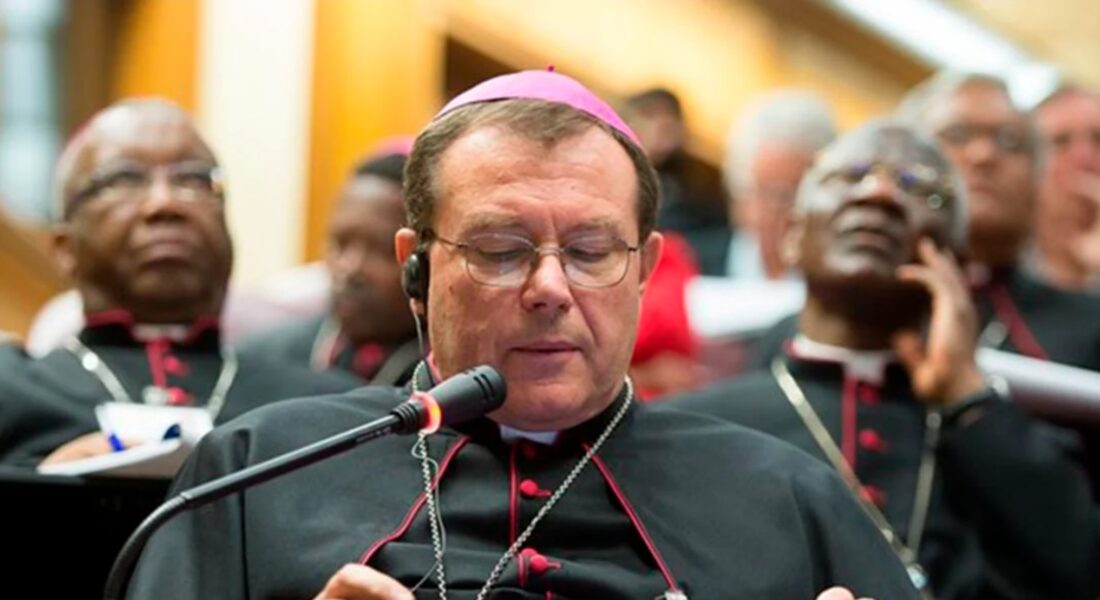
The departure of the Archbishop of Moscow, Paolo Pezzi, introduces a significant shift in one of the most sensitive sees for the Catholic Church. This is not an ordinary replacement. At 65 years old, the Italian prelate was still far from the canonical age of resignation—set at 75—which makes his decision an early resignation and, in strict terms, anomalous within the usual patterns of episcopal governance.
A long tenure in an exceptional posting
Pezzi had been appointed Archbishop of the Archdiocese of the Mother of God in Moscow in 2007, accumulating nearly two decades at the helm of a minority Church in a particularly demanding environment. A member of the Missionaries of San Carlos Borromeo, his profile combined pastoral experience and the ability to engage in dialogue in a context where the Catholic Church lacks structural weight.
Catholicism in Russia represents a minimal fraction of the population and relies on communities of foreign origin—especially Poles, Ukrainians, and other European groups—along with occasional conversions. Its activity unfolds under a constant balance with the predominant Russian Orthodox Church, and within a political framework where public visibility is conditioned.
In that scenario, episcopal governance requires sustained management of tensions, with little room for expansive initiatives and a notable dependence on external factors. It is not a diocese comparable to those in the West in terms of autonomy or development capacity.
An early resignation due to wear and tear
According to sources consulted by InfoVaticana, Pezzi’s departure is mainly due to accumulated personal wear and tear after years in a particularly tough posting. There are no consistent indications of disciplinary measures or open conflicts that explain the decision, which must be interpreted in terms of institutional fatigue rather than a specific crisis.
Canon law provides for the possibility of resignations before the established age when sufficient reasons concur. However, in practice, this type of decision remains exceptional and is usually associated with personal situations or particularly demanding contexts, as is the Russian case.
Dubinin, a local and transitional profile
Following the acceptance of the resignation, the Vatican has appointed Nikolai Dubinin as apostolic administrator, until now auxiliary bishop of Moscow. A Conventual Franciscan of Russian origin, he represents a profile different from that of his predecessor: local clergy, direct insertion into the context, and less international exposure.
The appointment is not definitive. The role of apostolic administrator implies that Rome keeps the decision on the future titular of the archdiocese open. This type of solution is usually used in scenarios where time, observation, and prudence are required before proceeding to a permanent appointment.
The possible promotion of Dubinin or the designation of a new archbishop will predictably depend on factors that go beyond the strictly pastoral, including the balance with Russian authorities and the relationship with the Orthodox Patriarchate.
A Church in permanent balance
The Catholic Church in Russia operates under singular conditions within the Catholic world as a whole. Its reduced size, historical dependence on foreign clergy, and limited institutional capacity require a constant strategy of discretion. The public statements of its leaders usually avoid explicit political positions, especially in the context of the war in Ukraine.
In this framework, Pezzi’s resignation cannot be read as an isolated episode, but as a reflection of the sustained demand involved in governing a diocese in a restrictive environment. The transition now open in Moscow confirms that the Holy See opts for cautious management, aware of the sensitivity of the terrain.