


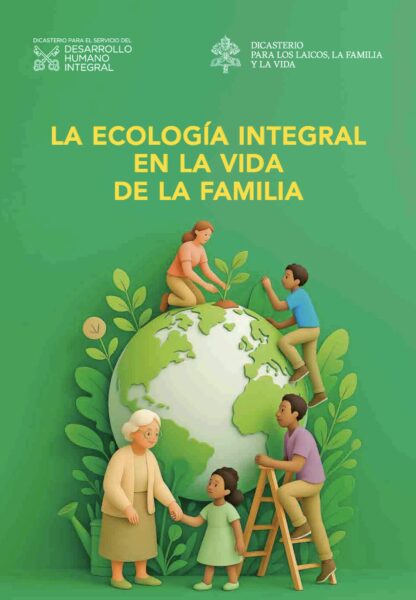
The Vatican has published a document addressed to families, based on Laudato si’, Amoris laetitia, and the concept of “integral ecology,” in which it proposes adopting a model of domestic life centered on recycling, energy austerity, and greater environmental awareness. The guide, prepared by the Dicasteries for Integral Human Development and for Laity, Family, and Life, applies these principles to the everyday realm of the home.
The text invites the change to begin in the family, presented as the first space where these criteria must be applied, not only on the spiritual plane, but especially in concrete habits of consumption, resource use, and relationship with the environment.
Recycling, consumption, and everyday life
The document delves into practical proposals in detail: reducing consumption, avoiding waste, recycling, reusing materials, and adopting sober lifestyles. It also states that the economic decisions of the home—purchases, savings, and investments—must respond to ethical and environmental criteria.
In the same vein, it encourages involvement in community initiatives, the care of common spaces, or activities like gardening, configuring a model of an active family in social transformation from the everyday.
Birth rates in the background
In addressing the major challenges, the document downplays the demographic issue by pointing out that the main problem is not population growth, but consumerism and environmental degradation.
Although it includes references to the defense of life—rejecting abortion or forced sterilization—it does not directly address the birth rate crisis affecting much of the West, nor the real difficulty of forming families in contexts marked by economic and cultural precariousness.
Ecological education as the axis
One of the central points is the formation of children. The guide proposes instilling ecological habits from childhood, promoting respect for the environment, responsible use of resources, and a sustainable lifestyle.
The family thus appears as the place where an environmental consciousness is formed that must be projected into society.
The contrast: Domestic church or environmental agent
Catholic tradition has defined the family as the “domestic church,” a place for transmitting the faith, sacramental life, and Christian education. In that realm, the spiritual formation of children, the experience of marriage as a sacrament, and the very continuity of the faith are at play.
However, in the Vatican document, the emphasis shifts to another dimension. The family is presented, above all, as a subject of change in consumption habits, lifestyles, and environmental commitment.
The central issues of Christian life—the prayer in the family, education in the faith, the defense of sacramental marriage, or the fight against secularization—appear in a secondary way compared to a broader development of ecological and social practices.
A shift in priorities
The result is an approach that combines traditional elements of doctrine with a markedly practical focus on environmental matters. The “ecological conversion” is presented as an essential part of Christian life, but without an equivalent development of spiritual conversion in its Christian sense.
Without denying the importance of caring for creation, the document leaves open a fundamental question: whether the Catholic family is primarily called to be a witness to the faith and transmitter of Christian life, or whether its role is progressively redefined as an agent of social and environmental transformation.
In a context marked by the crisis of faith, the collapse of birth rates, and the real difficulty of educating children in Christianity, the priority seems clear: forming families that welcome life, live and transmit the faith, and are the true foundation of a Christian society. However, the emphasis on “pastoral innovation” and alignment with global discourses dilutes that essential core, leaving a diffuse message precisely when the world demands clarity, truth, and life with greater urgency.