


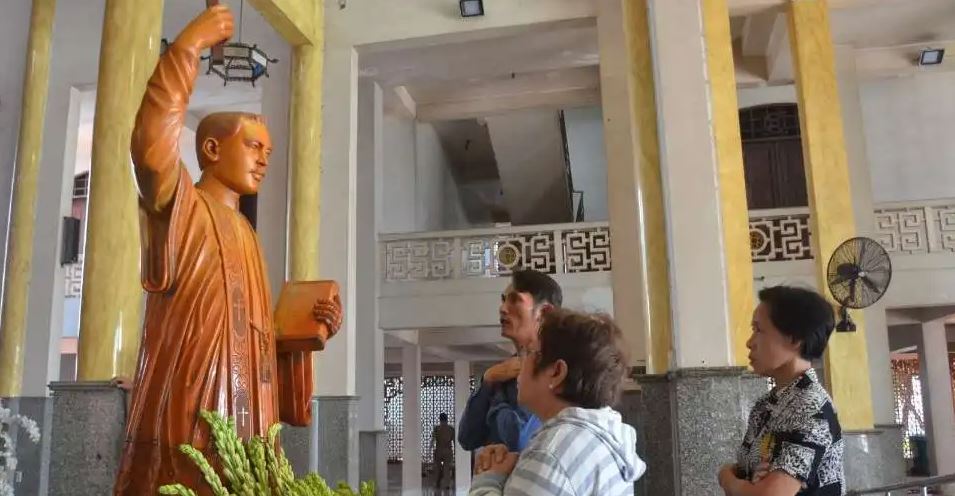
Vietnamese Catholics are preparing for the upcoming beatification of Father Francisco Javier Truong Buu Diệp, a martyr priest who was murdered in 1946 after offering his life for his community, in an event that will bring together hundreds of thousands of faithful in the south of the country.
A beatification with national dimension
The ceremony will take place on July 2 in the Tac Say pilgrimage center, in the Mekong Delta, where the priest’s relics are preserved.
The celebration will be presided over by Cardinal Luis Antonio Tagle, the Pope Leo XIV’s special envoy, and massive attendance is expected in what could become one of the largest recent Catholic events in Vietnam, a country where about eight million Catholics live.
Church authorities are already preparing to welcome the pilgrims, with forecasts that far exceed the sanctuary’s usual capacity.
A pastor who chose to die with his people
Father Diệp, born in 1897, developed his priestly ministry in southern Vietnam for more than two decades, standing out for his closeness to the faithful and his pastoral dedication in a context marked by instability and violence.
In March 1946, amid the chaos following World War II, he was arrested along with several of his parishioners. Although he had the opportunity to flee, he decided to remain with them, uttering a phrase that has remained etched in the memory of the faithful: “I will die in place of my people”.
He was murdered shortly afterward, in violent circumstances, and his death has been recognized by the Church as martyrdom “in odium fidei”.
A sanctuary that attracts millions of pilgrims
Since his death, the Tac Say sanctuary has become one of the country’s main pilgrimage centers, attracting millions of people each year.
One of the most striking aspects is that a large part of the devotees are not Catholics, but they still come seeking consolation, protection, and graces attributed to his intercession.
This popular devotion has significantly contributed to the spread of faith in a country marked by ideological and religious tensions.
Recognition of a faith tested in persecution
The upcoming beatification not only represents the recognition of a priest’s holiness, but also a sign of the fidelity of the Vietnamese Church, which has lived its history amid persecutions, conflicts, and difficulties.
In this context, the figure of Father Diệp appears as a clear testimony of priestly dedication, fidelity to the Gospel, and love for the people, in a line that directly connects with the tradition of the Church’s martyrs.
An example of priesthood and evangelization
Father Diệp’s life offers a concrete teaching for the current Church: the priesthood understood as total dedication, even to the sacrifice of one’s own life.
His testimony also shows how holiness is not built in exceptional moments, but in everyday fidelity, in constant service, and in charity lived day by day.
His figure continues to evangelize today, not only through the memory of his martyrdom, but also through the popular devotion that continues to bring many closer to the Christian faith.